
India on Tuesday welcomed the United States announcement of a bounty of $ 10 million on Pakistan-based Jamaat-ud-Dawa chief Hafiz Saeed, the mastermind of the 26/11 Mumbai attacks, saying it sends a strong signal to Lashker-e-Tayyiba and its patrons.
Pakistan's promise to contain its activities has simply failed to affect the LeT at all as the group's activities have intensified, observes Amir Mir
Unfazed by India's attack, Pakistan Foreign Minister Shah Mahmood Qureshi has justified his statement comparing Home Secretary G K Pillai with Jamaat-ud Dawa chief Hafiz Saeed, saying it was "balanced and objective".
Despite their differences, mainly related to political strategy, Islamist groups like the Jamaat-e Islami and the Jamaat- ud-Dawashare a very similar ideology -- of the centrality of the notion of the Islamic State and the compelling need to acquire political power in order. Yogi Sikand critiques a study on the rising Islamic radicalism in Pakistan
National Investigating Agency withdraws plea from a Delhi court for non-bailable warrants against David Headley and Tahawwur Hussain Rana on charge of plotting terror attacks in India.
Clinching evidence of key Mumbai attack accused David Headley's links with the Inter-Services Intelligence and Jamaat-ud Dawa is provided by his diary, which contains telephone numbers of two Major-rank officers of the Pakistani Army besides some others who handled the 26/11 attackers.
Jamaat-ud Dawa chief Hafiz Mohammad Saeed, the 2008 Mumbai attacks mastermind and for whom the United States has offered a bounty of $10 million, on Tuesday said his organisation was ready to help Americans affected by the superstorm Sandy.
Expressing disappointment over Pakistan Supreme Court letting off Jamaat-ud-Dawa chief Hafiz Mohd Saeed, India said on Friday that it had given "enough evidence" against the Mumbai terror attack "mastermind" which was sufficient to convict him.
Notwithstanding India's insistence on action against Jamaat-ud-Dawa chief Hafiz Saeed, Pakistan was non-committal on action against the mastermind of Mumbai attacks and several other terror strikes in India. "Same old beaten track," said Pakistan Foreign Minister Shah Mahmood Qureshi when asked for his response to India's repeated demand that action should be taken against Saeed in connection with Mumbai attacks.
A Delhi court on Wednesday sentenced a Bangladeshi national and his Kashmiri associate belonging to the banned militant organisation Harkat-Ul-Jihad-al-Islami to life imprisonment for possessing explosives and waging war against the country.
Jamaat-ud-Dawa chief Hafiz Mohammad Saeed, mastermind of the Mumbai attacks, today alleged that India has "imposed war on Pakistan" by constructing "illegal dams" and diverting water of Pakistani rivers and said the government must prepare the nation to counter this aggression.
The group's supporters collected funds in the courtyard and later marched through Lahore, calling for the death of those who insult Islam.
The banned Jamaat-ud Dawa has speeded up its campaign of collecting donations via social networking during the holy month of Ramadan. To collect zakat and sadaqa al-fitra the JuD has turned to Twitter and Facebook.
Making it clear that Islamabad's claims of cooperation in Mumbai attacks probe will not suffice, India on Thursday asked Pakistan to implement its words and show in a "transparent" manner that action has been taken against Jamaat-ud-Dawa and other such groups.
Ahead of Prime Minister Manmohan Singh's visit to Washington, the United States on Wednesday pressed Pakistan to act against perpetrators of the Mumbai attacks, including Jamaat-ud Dawa chief Hafiz Saeed, saying it wants to see results.
Pakistan has had the dubious distinction of being the 'most dangerous nation' on earth for some time now. The country has been the hapless target of numerous terror strikes, it is often bombarded by drones sent by its 'ally' United States and lives in constant fear of a bloody coup by the powerful military.
After apparent initial jitters on the United States slapping a $10 million bounty on his head, Pakistan's Jamaat-ud Dawa chief and an alleged 26/11 Mumbai mastermind, Hafiz Mohammad Saeed had decided not to go into hiding.
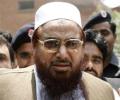
Pakistan's claims about placing Jamaat-ud-Dawa chief and alleged mastermind of the terror attack on Mumbai Hafiz Mohammad Saeed in custody might be yet another false claim, as a senior police official has clarified that the authorities have only 'restricted' his movement.Punjab Inspector General of Police Tariq Saleem Dogar said Saeed has neither been arrested nor put under house arrest, rather the police is providing an extra security cover to the Lashkar-e-Tayiba's founder
Pakistan may have filed two anti-terrorism cases Jamad-ud-Dawa chief Hafiz Saeed, the alleged mastermind behind the Mumbai terror attacks, but his lawyer has disclosed that the case filed against his client are "very weak".
Pakistan has said it is ready to take action against Jamaat-ud Dawa chief Hafiz Saeed but added that India should give 'concrete evidence' that stands 'legal scrutiny' and holds him responsible for the Mumbai terror attacks. Pakistan Foreign Minister Shah Mahmood Qureshi insisted that his country was committed to bringing the perpetrators of 26/11 to justice but could not give any specific time-frame for conclusion of the trial in the case as the judiciary acted independently
Pakistan's Supreme Court has indefinitely adjourned the petitions challenging the release from detention of Jamaat ud-Dawa chief Hafiz Mohammad Saeed, accused by India of being the mastermind of the terror attack on Mumbai. The apex court's direction comes two days after India said there was 'enough evidence' to continue investigations against the JuD chief in connection with the terror attacks.
Jamaat ud-Dawa chief and Lashkar-e-Tayiba founder Hafiz Mohammed Saeed cannot be prosecuted for involvement in the Mumbai terror attacks without 'concrete evidence' against him, Pakistan's top law official said on Wednesday. "The government has the evidence provided by the United Nations Security Council that can only keep Saeed behind bars for a certain period of time under the Maintenance of Public Order law," said Attorney General Latif Khosa.
China is providing tacit support to Pakistan in its jihadi strategy with an aim to pin down half a million Indian troops in Kashmir, a leading European security expert has said.
The government of Pakistan's Punjab province has decided to disassociate itself from the case against Jamaat-ud-Dawa chief and Lashkar-e-Tayiba founder Hafiz Muhammad Saeed, the suspected mastermind behind the terror attack on Mumbai, and filed a plea for its withdrawal.On Monday, the provincial government informed Pakistan's Supreme Court that it has challenged the release of Saeed due to certain 'confidential evidence' against him.

India on Friday asked Pakistan to expeditiously bring to justice all those behind the Mumbai terror attacks, including Jamaat-ud-Dawa chief Hafiz Saeed and handlers of terrorists, including some Pakistani army personnel. Home Minister P Chidambaram said he will 'politely' tell Pakistan that the time has come to address issues concerning the deadly Mumbai terror attacks with the seriousness that they warrant.
Jamaat-ud-Dawa chief Hafiz Mohammad Saeed has asked Muslim men to 'make their women observe pardah' and criticised co-education, saying it is perverting the youth of Pakistan. Delivering the sermon during Friday prayers at the JuD's Jamia Masjid Al-Qadsia at Chowburji in Lahore, Saeed described the ban imposed by France and other European countries on wearing the 'hijab' and constructing minarets in mosques as a "conspiracy against Muslims."
Khakan Babar, recently appointed by the government of Pakistan's Punjab province as the Chief Administrator, took over the JuD's Markaz-e-Taiba headquarters at Muridke, about 30 kms from Lahore.
Jamaat-ud_Dawa chief Hafiz Mohammed Saeed, designated as a terrorist by the United Nations Security Council in the wake of the Mumbai attacks, and other militant leaders detained by Pakistani authorities cannot be tried in the absence of solid evidence against them, Defence Minister Chaudhry Ahmed Mukhtar said on Wednesday. The government had recently launched a crackdown against militant groups, including the JuD.
A Pakistan-based conglomerate of militant groups active in Kashmir, headed by Syed Salahuddin, has temporarily dissolved itself with its leaders going underground in the wake of the crackdown on Jamaat-ud-Dawa and other banned terrorist outfits, a media report said on Saturday.The United Jehad Council -- which comprises Hizbul Mujahideen of Salahuddin, Harkat-ul-Ansar, Jamiat-ul- Mujahideen, Al-Jihad, Al-Barq, Ikhwan-ul-Mussalmin and Tehrik-ul-Mujahideen -- has closed offices

External Affairs Minister S M Krishna said India considers Taliban as a dreaded terror outfit, and wants Pakistan to take action against it along with other groups like Lashkar-e-Tayiba and Jamaat-ud-Dawa (JuD).

India on Tuesday said Pakistan should do more in containing militancy as well as dismantling terror infrastructure in that country. "Frankly we have not seen enough action on either, though we acknowledge that the civilian government in Islamabad had apprehended seven persons in connection with the Mumbai terror attacks," Shashi Tharoor, minister of state for external affairs, said in New York.
Pakistan on Tuesday expressed disappointment over India's reaction to the Lahore high court quashing cases registered under the anti-terror law against 26/11 mastermind and Lashkar-e-Tayiba founder Hafiz Saeed, saying that questioning decisions made by the country's independent judiciary was "not a wise step".

Disappointed at the Lahore high court's decision to scrap terror cases against Jamaat-ud Dawa chief Hafiz Saeed, India on Monday said it would take up the issue with Pakistan, as it had earlier made to understand that formal investigation would be conducted against him.
A Pakistani court on Thursday sought a "fresh and comprehensive" response from the foreign ministry to a petition by Jamaat-ud-Dawa chief and Lashkar-e-Tayiba founder Hafiz Saeed asking it to direct the government to defend him in a United States lawsuit filed by relatives of victims of the 26/11 attacks.
The Pakistani police on Wednesday said they were awaiting instructions from the government for taking further action against founder of Lashkar-e-Tayiba and Jamaat-ud-Dawa chief Hafiz Saeed, who was placed under house arrest after two cases were registered against him under an anti-terror law.
Dr Rajiv Shah, administrator of the United States Agency for International Development and the highest-ranking Indian American in the Barack Obama administration, has set the record straight over conflicting reports that he had visited a relief camp run by a front organisation of Jamaat-ud-Dawa in Pakistan's Sindh province and handed over US aid.The JuD is headed by Hafiz Saeed, the founder of Lashkar-e-Tayiba and alleged mastermind of the horrific 26/11 terror attacks.

With Interpol issuing Red Corner Notice against Jamaat-ud Dawa chief Hafiz Saeed, India on Wednesday said the development vindicates its stand on his involvement in Mumbai terror attacks, and urged Pakistan to act on the basis of evidence collected 'painstakingly'.External Affairs Minister S M Krishna said the world should take note of the Interpol notice.
India handed over "additional information" on Mumbai attacks to Pakistan High Commissioner Shahid Malik, who met Foreign Secretary Nirupama Rao in New Delhi on Friday. During the meeting held following a request by Malik, additional information on the 26/11 terror attacks including inputs on some of the key aspects and accused involved was given by Rao.
The National Investigation Agency told a Delhi court on Tuesday that the complicity of Pakistan-based Jamaat-ud-Dawa chief Hafiz Saeed and other five terror suspects was not confined to 26/11 Mumbai terror attacks, as they had conspired to plot such attacks in other parts of the country as well.
Pakistan on Thursday said that the information provided so far by India on the Mumbai attacks was not enough for it to take legal action against outlawed Jamaat-ud-Dawa chief Hafiz Mohammed Saeed. "It needs to be underlined that the dossiers and information received from India apropos Saeed are not really enough ... to proceed legally as is being expected," Foreign Office spokesman Abdul Basit told a weekly news briefing in Islamabad.
 © 2026 Rediff.com - Investor Information - Advertise with us - Disclaimer - Privacy Policy - Sitemap - Feedback - About us - Terms of use - Grievances