The Indian Army's broader reorganisation is inevitable as India's military doctrine adapts to the demands of the modern battlefield.

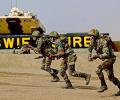
The armies of India and the US on Tuesday began an over two-week mega military exercise at a military facility in Uttarakhand with the aim of exchanging best practices and tactics in sync with growing defence ties between the two countries.
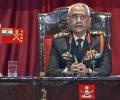
The Defence Ministry said his tenure will be remembered for the 'resolute reply' to the Northern adversary in Eastern Ladakh and for a determined push towards self-reliance in defence besides embracing niche and disruptive technologies to fight future wars.

General Pande said the northern border region has been peaceful and steps have been taken to maintain peace through established protocol and existing mechanism.

The Taliban insurgents stormed Afghanistan days ago capturing all major cities in a matter of days, two weeks before the US was set to complete its troop withdrawal after a vexatious two-decade war and the Kabul airport attack has left dozens dead and many injured.

Army sources indicate the first Integrated Battle Groups would come up in the plains of Jammu, Punjab, and Rajasthan, providing New Delhi instruments of retaliation in the event of grave provocation by Pakistan, such as a 26/11-style terrorist attack.

'The Chinese fault lines are tremendous and we need to exploit them.'
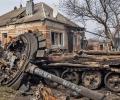
'The wise men learn lessons in war.' 'The smart men learn lessons from others, it's only the foolish who learn the wrong lesson.'

The defence minister clearly asserted that there will be no budgetary constraints to enhance the capability of the Army and meeting its other requirements.

Giving an account of India's overall military modernisation, Lt Gen Pande also said that an in-principle approval has been given to new combat formations called the Integrated Battle Groups (IBGs) which can mobilise fast with a more effective approach.

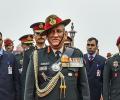
The creation of a CDS has got the head right. Issues that were not talked about for years are now being discussed, points out Ajai Shukla.

Addressing a press conference, Gen Naravane said the focus of training will be on preparing the army for future wars which will be network-centric and complex.
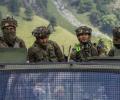
'The leverage created by the Indian military must not be lost.'
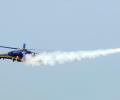
The Light Combat Helicopter will enable the army to provide fire support to soldiers at altitudes of 15,000 to 20,000 feet, where the oxygen-depleted air prevents them from carrying weaponry heavier than their personal rifles and light machine guns.

India's doctrinal policy shift in combating terror by carrying out the Balakot air strikes inside Pakistan, appointment of a Chief of Defence Staff and hastening work on military modernisation marked a new beginning in 2019 in dealing with complex security challenges.
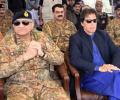
'Any conventional conflict could trigger a nuclear war with results that neither India nor Pakistan could survive easily.' >A revealing excerpt from Shuja Nawaz's The Battle For Pakistan: The Bitter US Friendship And A Tough Neighbourhood.
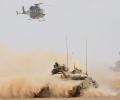
'Offensive operations to capture objectives across the LoC to eliminate terrorist launch pads and deny the use of the most dangerous routes of infiltration, are likely to be limited to brigade-level attacks.' 'These limited operations are unlikely to escalate to war across the international boundary,' says Brigadier Gurmeet Kanwal (retd).
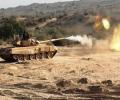
'It is ironic that General Rawat, an infantry officer who the government chose because of his expertise in counter-insurgency, has made his first bold statement in the realm of warfighting and mechanised operations,' points out Colonel Ajai Shukla (retd).
 © 2026 Rediff.com - Advertise with us - Disclaimer - Privacy Policy - Sitemap - Feedback - About us - Terms of use - Grievances