
Move can also bring a huge change in the way business is done in India, where firms use multiple current accounts, often for even individual projects, making them difficult to monitor.

India's equity markets are on a roller-coaster ride, after delivering spectacular returns for two consecutive years - in 2020 and 2021. The benchmark National Stock Exchange's (NSE's) Nifty50 is down 1.5 per cent in the first nine months of the current calendar year 2022 (CY22) as foreign portfolio investors sold Indian stocks due to rising bond yields in the US and across global markets, including India. The sell-off in the Indian equity markets has, however, not been broad-based and largely limited to sectors facing earnings headwinds from rising interest rates, lower commodity and energy prices, and likely economic recession in advanced economies.

Emerging markets such as India have always run higher inflation rates than developed economies such as the US and countries of Western Europe. But for the first time in the past 30 years, the US reported a higher consumer price inflation (CPI) rate than India in five consecutive months. The US reported a CPI rate of 7.5 per cent in January 2022 against 6.01 per cent in India and analysts expect the trend to continue for at least a few months more

'Investing in the stocks of holdcos can be a very efficient and inexpensive way of gaining exposure to the stocks of India's reputable growing business houses.'

'The markets have corrected almost 8-9 per cent from their highs, so one can accumulate quality stocks at reasonable prices.'

'Pockets of mid and small-cap indices are showing exuberance and are discounting even FY23 valuations now.'

A seasonally-strong quarter, with no immediate impact of the second wave and continued acceleration of digital transformation will allow the IT services sector to report a robust Q1 this financial year. However, key metrics to look out for will be attrition rate and margin lever as they will be impacted by salary hikes. Analysts expect growth for the quarter to be broad-based, with sectors like banking, financial services and insurance (BFSI), retail, manufacturing, hi-tech and life sciences driving revenue growth. Analysts across brokerage houses are pegging revenue growth in the range of 1.5 per cent to 4.5 per cent.

At least five companies looking to raise a cumulative Rs 6,595 crore could launch their initial public offerings (IPOs) next month after a busy August that saw eight IPOs. On Thursday, south-based diagnostic chain Vijaya Diagnostics announced its plans for a Rs 1,895-crore IPO. Ami Organics will announce its plans for a Rs 600-crore issue on Friday.

Covid-19, US yields, dollar to weigh on equity flows in the near term.

Corporate revenues will decline for a third consecutive quarter in March on a YoY basis - one of the worst shows by these companies in many years.

Top laggards in the Sensex pack included IndusInd Bank, Bajaj Finance, ITC, UltraTech Cement and HDFC Bank, while Sun Pharma, Tech Mahindra, M&M and Asian Paints ended with gains.

Ramping up e-commerce operations and going beyond its current strongholds are key challenges for the grocery chain in its battle with Mukesh Ambani's retail behemoth.

Sanjiv Mehta, chairman of the country's largest consumer goods company, HUL, believes that the second wave of the Covid-19 pandemic between April and June this year has been a mere pause in India's consumption story, and that it will not change the country's overall growth trajectory. India is poised for growth, especially in the fast-moving consumer goods (FMCG) sector, Mehta told shareholders at the company's annual general meeting on Tuesday. The signs of recovery are becoming evident with many states lifting lockdown restrictions in recent weeks.

'The concern that the bad bank may create a moral hazard for the system is extremely valid.'

After outperforming the broader market and their public sector peers for the better part of the post-Lehman period, private sector banks - such as HDFC Bank, ICICI Bank, Axis Bank, and Kotak Mahindra Bank - are now underperforming. Last week, the Nifty Private Bank index was up just 6 per cent year-to-date in the calendar year 2021, against nearly 13 per cent rally in the Bank Nifty and a 15 per cent rise in the benchmark Nifty50. Public sector (PSU) banks, such as State bank of India, Bank of Baroda, and Punjab National Bank, are now rally leaders and outperforming the broader market. The Nifty PSU Bank index was up 42 per cent since the beginning of this calendar year. But on a longer term, the Nifty Private Bank index is up 101 per cent since March 2016, against a 118 per cent rally in the Bank Nifty and just 2 per cent rise in the Nifty PSU Bank index in the period.

India's top IT companies have shown a hiatus between their performance on the bourses in the pandemic period and earnings growth. The combined market cap of the top five IT companies - Tata Consultancy Services, Infosys, Wipro, HCL Technologies, and Tech Mahindra - is up 87 per cent since the end of March 2020. In comparison, the benchmark BSE Sensex is up 68 per cent during the period. So the industry beat the broader market by a big margin in the last one year.

With slippages increasing every quarter, any derailment on growth or change in customers' repayment behaviour after moratorium may impact the overall asset quality. Correction, though, presents attractive buying opportunities, given the bank's sustained leadership position.

'At this moment, investors should look for relative value within sectors and clear visibility (third-wave-or-not) on earnings delivery.'

Colgate-Palmolive India is placing greater emphasis on freshness, whitening, therapeutic, and family toothpastes, as rivals such as Dabur and Patanjali dominate the growing naturals segment of the market. Once under 5 per cent of the Rs 10,000-crore domestic toothpaste market, the naturals segment, which includes ayurvedic and herbal variants, is now 25-30 per cent of the market, industry executives said. Growth rates of the naturals segment are estimated to be in the region of 8-9 per cent in volume terms. In value terms, the growth rate for naturals is around 10-12 per cent, sector experts said.

The current up move, according to analysts, closely resembles the rally post the global financial crisis in 2008-09, not just in quantum and speed, but also the way small-and mid-cap indices outperformed large-cap peers.

The primary market is set for a bumper Rs 80,000-crore bonanza with 30 companies already filing IPO papers to raise Rs 55,000 crore, while around 10 more are lined up for this month itself, seeking to mop up another Rs 25,000 crore, say investment bankers. The market has been on a non-stop rally, hitting new records almost every week, on the back of an influx of investors -- a vast majority of them first-timers -- coupled with a flood of liquidity. Foreign funds alone had pumped in a record $35 billion into the market in FY21, while the trend has continued this fiscal as well. Domestic institutions led by LIC have also infused trillions of rupees, helping woo retail investors in troves -- the year saw over 20 million new investors coming to the market.

Assuming that the value of LIC's holding has risen in line with the markets, its portfolio size today could be around $86 billion, higher than the previous record of $84 billion in March 2018.

When, recently, Bharti Airtel announced a Rs 21,000 crore rights issue, analysts pointed out that its structure was similar to that of Reliance's issue in June 2020. One similarity is that shareholders in both companies have to pay only 25 per cent of the money on application. The rest is to be paid in two tranches. In Bharti Airtel's case, it is within 36 months; in Reliance Jio's, it is within 17 months.

The new PN3 norms and lack of clarity on what constitutes beneficial ownership are the primary reasons for the decline in investments from China and Hong Kong.

Among the key concerns of the Street is market share losses in growth segments, led by higher competitive pressures.

Experts said banking is a play on the economy and the latest buying into this space is underpinned by hopes of a sharper-than-expected recovery in the economy.

At the end of Monday's trading session, the market capitalisation of BSE-listed companies stood at Rs 1,51,86,312.05 crore against Rs 1,46,58,709.68 crore on Friday.

This is first time in 25 years that a benchmark equity index in India is trading at a P/E multiple of 40x or higher.

'In the short term, we may see some disruptions due to Covid, but in the medium-to-long term, we should keep an eye on US inflation and 10-year bond yields.'

Analysts attribute the surge to a host of factors, particularly the interest shown by the retail investors in these two market segments.

Foreing investors have high hopes from India due to an uptick in the economy

After Maharashtra, analysts expect more states like Karnataka and Haryana to slash stamp duty rates. However, analysts, do caution that it's still a long road to recovery for the realty sector.

This year, the combined net profit of 24 index companies, which have declared their June-20 numbers, has declined by 37 per cent year on year, while their revenues, including other income, is down by 21 per cent YoY so far.

Real estate experts say rentals have corrected by 5-10 per cent across formats, including office, retail and housing, with a pick-up expected over the next few quarters as the economy recovers.

The earnings are, however, expected to be down around 2 per cent on a sequential basis due to pent-up demand getting exhausted and the adverse impact of rising metals and energy prices on consumer goods and manufacturing companies.
The combined profit before tax of 748 companies, which have declared their results for Q1FY21, is down 46 per cent YoY. Their net sales went down by a quarter as the Covid-19 lockdown led to a sharp fall in economic activity.

Sebi penalised Shruti Vishal Vora - found guilty of leaking price sensitive information related to financial results of Wipro, Asian Paints and Mindtree, and Parthiv Dalal for similar action in case of Wipro earnings.

Chandra, who will turn 69 years old on Saturday, becomes non-executive director with immediate effect.
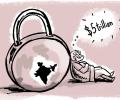
While seven companies bagged orders worth Rs 42,000 crore, industry experts said most of this new order activity was a spillover, and fresh project finalisation remains weak.

While a coordinated aggressive monetary easing from the central banks is most likely to offer some respite in the near-term, it is unlikely to improve the sentiments.
 © 2026 Rediff.com - Advertise with us - Disclaimer - Privacy Policy - Sitemap - Feedback - About us - Terms of use - Grievances