
To make sure liquid schemes reflect the underlying portfolio risks, Sebi has said all debt papers with maturity of 30 days or more to be marked to market. Earlier, fund houses didn't have to do so for securities that had less than 60-day maturity.

In what is in effect a deposit to be paid into court pending a full trial in the case, Judge David Waksman has set a six-week timeline for Anil to pay $100 million to three Chinese banks as he concluded that he did not accept Ambani's defence that his net worth was nearly zero or that his family would not step in to assist him when "push came to shove".

He said while the previous UPA government hid the bad loans, his government has properly recognised them and brought tough laws to deal with defaults and recovery money.
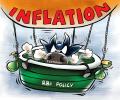
'Election years tend to see high government expenditure on unproductive schemes, though that money sloshing around can boost private consumption.' 'Again, it can mean higher inflation,' explains Devangshu Datta.

'If India can only grow at 5%, why bother spending time on the country?' asks Akash Prakash.

The incoming government will have to encourage private investments, bring down cost of capital

Essar group, Bhushan Steel and JSW group likely to be impacted by changes

'There has been far too much overconfidence about the size and composition of the Indian consumer economy,' notes Mihir S Sharma.

Of the Rs 4,405 crore unpaid debt of 12 companies, more than half was locked in just one Mumbai-based real estate company, Kohinoor CTNL Infrastructure.

Those involved in the discussions say the guidelines for selection of bidders in insolvency cases need to be transparent, otherwise anyone who loses out could take legal recourse, leading to wastage of time and derailing the whole process.

Indian bankers are fearful that going out of their way to save Jet could lead to subsequent harassment from investigative agencies.
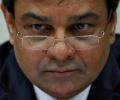
RBI has cited at least 10 areas where it has no control over PSBs.
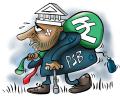
The 'bad bank' -- which will help banks clear their balance sheets by transferring the NPAs to special purpose vehicles -- has been one of the most debated ideas for stressed asset resolution.

The decision to do away with Rs 500 and Rs 1,000 notes accelerated the slowdown in economic activity with growth averaging 6.8 per cent in the seven quarters after it, as against an average of 8 per cent in the six quarters preceding it, says former chief economic advisor Arvind Subramanian.
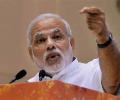
Various twists and turns by govt post-demonetisation prove that it has been tall order for the PM

Stating that a weak fiscal position continues to constrain India's sovereign ratings, Fitch said the next government's medium-term fiscal policy will be of particular importance from a rating perspective.

The biggest achievement of demonetisation is that it has brought about a social revolution against black money and corruption, says Sukumar Mukhopadhyay.

'The entire government-owned banking system (excluding SBI) is now in the red.' 'But worse is to come,' warns T N Ninan.

'Clearly, the depositors of cooperative banks need the maximum protection.'

The NCLAT said the RBI cannot restrict it from prohibiting banks from 'asset classfication' and observed that any change in this order would upset the entire resolution process of the IL&FS
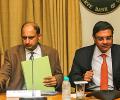
'Those who come from outside are surprised at the relatively small strength of the RBI supervisory cadre, relative to the needs of the country and the needs of the financial sector.'

'Some business families would probably have to revert to their core businesses, which the IBC will ensure.'

Aggressive rate hikes by the US Federal Reserve could result in a flight of capital from emerging markets like India, says B Gopkumar, chief executive officer, Reliance Securities.

Jaitley slammed lack of ethics in certain sections of businesses and said multiple layers of auditing system chose to either look the other way or did a casual job.

Without naming either the alleged kingpin of the fraud, billionaire jeweller Nirav Modi, or Punjab National Bank, Jaitley questioned the ethics of some businesses in the country and asked as to why the bank's internal and external auditors could not detect the fraud which had been going on for 7 long years.

'In India, most funds have one or at most two platforms, but we are the only one which has four -- growth equity practice, real estate practice, a special situation and credit platform, and infrastructure.'

With Indian infrastructure companies burdened with debt, global PE funds and developers sense an opportunity to buy the airports cheap

'We all wanted a strong Centre with a decisive mandate from the people, to allow them to take bold decisions.'
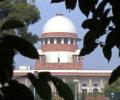
From Rafale relief to heat on realtors, 10 landmark Supreme Court judgments in 2018.

'The BJP has shown signs lately of returning to its trader mindset.' 'Several strong emotions get meshed in this: Nationalism, protectionism, mercantilism, and arrogance,' points out Shekhar Gupta.
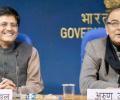
While Arun Jaitley remains part of the decision making process, Piyush Goyal, who was given additional charge on May 14, attends cabinet meetings and takes the day-to-day decisions.

The initiation of IBC proceedings in respect of a debtor has certain drastic consequences on both day-to-day running of the business of a debtor and on all creditors generally.

"I invite each one of you to become a partner in India's growth story. And once again assure you of our wholehearted support."
While passing the scrutiny of courts is a tough challenge, with eight proposed amendments to the insolvency law, the government has sought to turn the focus back on at least some of the functions of the bankruptcy law.

If the states do not chip in with better governance procedures in the setting up of new businesses, providing electricity connections, enforcing contracts, issuing construction permits or registering property, there is little the Centre can do on its own to quickly move India up the index on ease of doing business, says A K Bhattacharya.
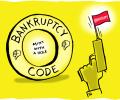
'When a company goes into insolvency, by definition it means that existing shareholders have been wiped out.'

Modi said the ease of doing business ranking improved because the government initiated reforms to end difficulties in the lives of people.
He said the country has witnessed a journey from indecisiveness to clarity and decisiveness.

'Good economics isn't necessarily bad politics, or vice versa,' says Shekhar Gupta.

'The new government will have to contend with slowing economic growth, weak private investment, anaemic exports and vulnerable external imbalances, a stressed financial system, mounting fiscal pressures (including high government debt-to-GDP ratios) and an exceptionally bad employment situation,' says Shankar Acharya, former chief economic adviser to the Government of India.
 © 2026 Rediff.com - Investor Information - Advertise with us - Disclaimer - Privacy Policy - Sitemap - Feedback - About us - Terms of use - Grievances