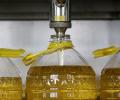
The government has reduced the tariff value for import of edible oil, including palm oil, by up to $112 per tonne, a move which experts said can lead to lower domestic prices. The Central Board of Indirect Taxes and Customs (CBIC), through a notification, has cut the tariff import value of crude palm oil by $86 per tonne, and of RBD and crude palmolein by $112 per tonne each. It also reduced the base import price of crude soyabean oil by $37 per tonne. The changes in tariff value of edible oil are effective from Thursday (June 17).

'While collections under the Income Disclosure Scheme explain it partly, indirect tax numbers not showing any effect of the withdrawal of high denomination currency notes was puzzling.'

The Centre received 5.59 lakh public grievances against various government departments in the first half of this year, with the Department of Financial Services (DFS) getting most of such complaints, according to an official report.

Cars and two-wheelers attract 28% GST and a cess in the range of 3-22%, taking the effective tax rate to up to 50%.

Will it benefit you? Or will it lead to an increase in inflation? Bipin Sapra believes it will be some time before GST's benefits reach consumers.
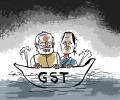
Agra has long been known for the Taj Mahal, but it is also a manufacturing hub filled with micro, small and medium enterprises (MSMEs) that make everything from electronic components to metal products, from paints and chemicals to footwear. And five years after the introduction of the Goods and Services Tax (GST), the MSMEs here complain that while the indirect tax regime has been transformative, cutting out the need to file multiple taxes, its biggest drawback has been the delay in credit refunds. Whoever you speak to - MSME owners, tax lawyers, or industry bodies like the National Chambers of Industries and Commerce (NCIC), Agra Footwear Manufacturers and Exporters Chamber (AFMEC) and Agra Shoe Manufacturers Association (ASMA) - they all emphasise that the GST continues to face some key challenges.
FM says, he will not tax the middle class.

Listing out the achievements of his government, he said the country has moved away from a culture of delaying work through 'atkana, latkana and bhatkana' (obstructing, delaying and misguiding).

The remarks came amid reports of mounting tension between the finance ministry and the RBI over the autonomy of monetary policy makers.

Small scale and cottage industries which are labour intensive will be severely hit.

Supplying food to schools under mid-day meal scheme, pre-schools and anganwadis is exempt from GST, the Central Board of Indirect Taxes and Customs (CBIC) has said. Issuing a set of clarification on certain decisions taken by the GST Council in its 43rd meeting on May 28, the CBIC said it had received representations regarding applicability of GST on the issues as to whether serving of food in schools under mid-day meals scheme would be exempt if such supplies are funded by government grants and/or corporate donations. Under the goods and services tax (GST), any catering service, including mid-day meals, provided to an educational institution is exempt from the levy.
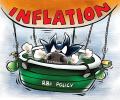
The Consumer Price Index (CPI)-based inflation is now projected to be at 5.3 per cent for 2021-22 with risks evenly balanced. In its August policy, the central bank had estimated inflation to be at 5.7 per cent due to supply side constraints, high crude oil and raw materials cost.

On indirect tax front, the government will earn 21 paise from excise and customs.

The Constitution amendment bill for roll-out of GST is pending in Rajya Sabha for a long time.

The net direct tax collections jumped by 18 per cent to Rs 43,391 crore during the first two months of the current fiscal.

To propel demand, one should concentrate on indirect taxes and bring down the goods and services tax (GST) rates to a uniform 12 per cent as the Vijay Kelkar panel had recommended, said Ajit Ranade, chief economist at Aditya Birla Group.

The total gross GST revenue collected in the month of June, 2019 is Rs 99,939 crore
From road transport to health insurance, tax rules have changed from October 1.

The discussions are at a very critical stage
After the RBI surprised the Centre with a record Rs 99,122 crore in surplus transfer for FY21, analysts said this will help the government tide over the revenue losses from lockdowns and extend more support to the pandemic hit industries and to the poor people. In fiscal 2020, the RBI had paid only Rs 57,128 crore in dividend to the government and the finance minister had budgeted only Rs 45,000 crore from the central bank. The higher payout followed the Bimal Jalan panel report that had set a new economic framework capital buffer for the central bank along with the contingency risk buffer at 5.5 per cent.

There are doubts about the meeting of indirect tax collection target for the current fiscal as there is slowdown in the economy.

Heeding to demands made by several states, the GST Council on Friday put on hold a decision to hike the tax rate on textiles to 12 per cent and referred to a panel of state ministers to recommend rate by February, Union Finance Minister Nirmala Sitharaman said. The panel, the highest decision-making body for indirect taxes, met under emergency provisions after states made a request for deferring the tax rate hike on textiles, from the current 5 per cent, to be effective from January 1, 2022. Currently, the tax rate on manmade fibre (MMF) is 18 per cent, MMF yarn 12 per cent, while fabrics are taxed at 5 per cent.

For every rupee in government kitty, as much as one-fourth will come from market borrowing in 2014-15 while 20 paise would be spent towards interest payment.

In its essence, GST is a national level system of value added taxation of goods and services, says Shankar Acharya.

In the Budget for 2011-12, the government revised the tax mop-up target for 2010-11 to Rs. 4.46 lakh crore for direct taxes and Rs. 3.36 lakh crore for indirect taxes.

India has a very low tax/GDP ratio by world standards.
Data released earlier by CAG shows capital expenditure by the Centre had contracted 9.2 per cent in Q2

Recently, the finance ministry waived off basic customs duty and health cess on imported oxygen and related equipment for three years.

Lower revenue collection puts upward pressure on government borrowing, ensuring that it deviates from the glided path of debt reduction
Reform ideas do not occur overnight and evolve over the years.

Tax experts say one of the most dispute-prone proposals is making "fraudulent availing" of input tax credit (ITC), without an invoice or bill, a cognizable and non-bailable offence.

The government has allowed import and export of COVID-19 vaccines without any value limitation, in order to ensure speedy clearance and distribution. The Central Board of Indirect Taxes and Customs (CBIC) has amended the regulations to facilitate the import/export of COVID-19 vaccines through courier, at locations where the Express Cargo Clearance System (ECCS) is operational. "Imports and exports of vaccines in relation to COVID-19 has been allowed without any value limitation," said the amended Courier Imports and Exports (Electronic Declaration and Processing) Amendment Regulations, 2020.

The government had set a budgetary target of over Rs 1.87 lakh crore for collection from customs duty in current fiscal
The Vivaad se Vishwas scheme is a replica of the Sabka Vishwas (Legacy Dispute Regulation) Scheme, 2019 (SVLDRS) for indirect tax litigation. The hope is that this would unlock revenue blocked in long-drawn litigation at various forums. Sources in the department say the total value at stake in these disputes would be Rs 5-6 trillion.
The Reserve Bank of India on Friday raised the retail inflation forecast for 2021-22 to 5.7 per cent due to supply side constraints, high crude oil and raw materials cost. The RBI in June had pegged the retail inflation estimate at 5.1 per cent for the current financial year. The RBI has the mandate to keep inflation in a band of 2-4 per cent, with a tolerance level of 2 per cent on either side.
The Vijay Kelkar task force on direct and indirect taxes, submitted its report to Finance Minister Jaswant Singh.

He also said GST will take about a year to stabilise.

Hoping to meet the indirect tax collection target this fiscal despite a negative trend in the first four months, Finance Minister Pranab Mukherjee on Tuesday ruled out tax cuts to tackle the drought faced by nearly half of the country.

GST seeks to subsume many indirect taxes at the Central and state levels.
In the post-demonetisation phase, the govt's tax revenues have ended up soaring in November.
 © 2026 Rediff.com - Advertise with us - Disclaimer - Privacy Policy - Sitemap - Feedback - About us - Terms of use - Grievances