
'Nehru was an idealist, he was certainly a visionary in one way, but Mao Zedong was not. Mao Zedong was a very down-to-earth strategist. He wanted to take Tibet, to take the plateau, to take the rivers, to take the minerals.'
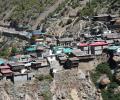
On August 5, 1953, Jawaharlal Nehru sent a strange note to the foreign secretary. It is worth mentioning because it was symptomatic of the lack of knowledge about Western Tibet in India and in South Block in particular, notes Claude Arpi.

Chhonzin Angmo became the first visually-impaired woman from India to plant the Tricolour on Earth's highest mountain.
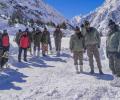
The bodies of the last four of the trapped labourers were pulled out from the site of the avalanche-hit Border Roads Organisation (BRO) camp in Chamoli on Sunday, taking the death toll to eight as authorities ended the nearly 60-hour rescue operation.
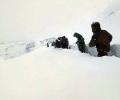
The avalanche hit the BRO camp between Mana and Badrinath between 5:30 am and 6 am on Friday, burying the workers inside eight containers and a shed, according to the Army.
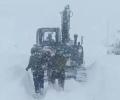
Forty-one Border Road Organisation labourers working to clear snow near the high altitude border village of Mana in Uttarakhand's Chamoli district were trapped under an avalanche on Friday.
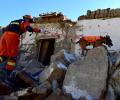
Local officials said no casualties have been reported due to Wednesday's quake that hit the Madoi County in Golog Tibetan Autonomous Prefecture of Qinghai province of northwest China at 3:44 pm (Beijing time), tremors for which were also felt in north-eastern Nepal.

Last year, the trade could not take place, for the first time since 1992, due to protests in Tibet in the wake of the Beijing Olympics. This year China has not given its permission so far heightening suspense over resumption of the trade at Taklakot mart in Tibet.

'It is a breathtaking journey towards the Tibet border, especially since the Border Road Organisation has accomplished a fabulous feat in black-topping the road till the border.' 'One is left with a salute for the dauntless Indian soldiers who spend the winter in these majestic, though inhospitable areas (we were told that the temperature comes down to minus 40 in winter),' recounts Claude Arpi.

'The General appreciated the importance of history in understanding modern conflict.' Tibetologist Claude Arpi recalls his meetings with General Bipin Rawat.

Every week, we bring you fascinating videos, chosen by you, through your likes.

China will use airpower to support Pakistan from the start of a war. China will use the opportunity to at least take Ladakh. Its growing navy will prevent India from blockading or attacking the Makran Coast. And thanks to Chinese weapons, Pakistan keeps expanding its forces, observes Ravi Rikhye.

'Is China's intention not clear?' 'Do we still think that if we are nice to China, it will be good to us?'


'Guarding the borders in extreme weather conditions is not easy and most people don't realize it is a very tough job.'

'When you look at the border -- from Ladakh to Arunachal -- which is called the Sino-Indian border, but in effect it is actually the Indo-Tibet border.' 'Since the borders are still not secure, it has resulted in transgressions in Galwan, Dokalam etc.'
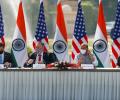
Henry Kissinger once said, 'It may be dangerous to be America's enemy, but to be America's friend is fatal.' India will have to wait and see, observes Rajeev Srinivasan.
What could be the reason for the Chinese to all of a sudden churn up the placid waters? Perhaps the reading on the banner is: no hobnobbing with ASEAN countries. But upping the ante along the borders has its own demerits for the Chinese. It serves to push India closer to the US thus strengthening the latter's Asian pivot, says Brigadier (retd) S K Chatterji.

Blindfolding himself with a piece of black cloth that had a slogan 'wake up UN' written on it, Tibetan activist Sherab Tsedor on Tuesday appealed to world leaders, especially the United Nations, to wake up to the plight of Tibetans at the hands of People's Republic of China.
For India, Tibet is just one of the topics they may or may not raise during the ongoing visit of Chinese Premier Wen Jiabao. But for the fraction of Tibetans in exile settled in India, the talk regarding the status of Tibet is of paramount importance.
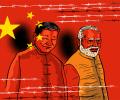
'It is time we Indians stop our internal bickering and present a united front to Chinese machinations,' advises Colonel Anil A Athale (retd).
The Dalai Lama, in a message, said that since India was Tibet's southern neighbour and since a relationship between the countries had existed for centuries, he held concern from this nation for the Tibet issue was of utmost importance.
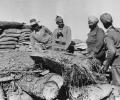
'The Himmatsinghji Report is still 'missing'.' 'It is a great loss for the knowledge of India's borders.' 'It would have an immense value at a time China is bound to shift its attention to other border fronts in the Himalayas,' notes Claude Arpi.

Arpi deserves to be complimented for the commitment and hard work that have gone into this production. The frustrations of seeking reliable documentation from the catacombs of the Indian bureaucracy did not deter him from going after the best information available, and the result is one that he can take much satisfaction in. Ambassador Prabhat P Shukla, Member Advisory Council, Vivekananda International Foundation, reviews Claude Arpi's The End of an Era: India Exits Tibet.

Claude Arpi's fascinating account of the Dalai Lama's arrival in Tawang in March 1959.

'The choice of Dhoka La for the intrusion by Chinese troops is significant and suggests a twin objective of pressuring Thimpu to allow Beijing to establish an embassy there and reinforcing Chinese claims on Arunachal Pradesh,' warns former RA&W officer Jayadev Ranade.

'At 1.58% of GDP, the defence budget is one of the lowest since the Chinese aggression of 1962.' 'The government of the day has lost sight of the fact that defence of the country is as important as its growth,' says Brigadier S K Chatterji (retd).

'The Tibetan movement will never turn violent during the Dalai Lama's life-time.'
It is a dark legacy bequeathed by Nehru to India. In its DNA lies the subconscious fount of India's schizophrenic geopolitics that forsook in one sweep all its historically-entrenched strategic interests in Tibet in favour of China, says R N Ravi, on the 60th anniversary of the Panchsheel Agreement.

Scientists believe the unique geological locations where they are situated makes them worthy of veneration.
Claude Arpi gives a fascinating firsthand account of the Dalai Lama's arrival in Tawang in March 1959 and explains why he will once again receive a grand welcome, whether Beijing likes it or not.

While Nehru remains an icon for many, including his critics, for the stellar role he played in building institutions of democracy, the 1962 humiliation blots Nehru's copybook, says Colonel Anil A Athale (retd).

'Pakistan has employed force to curb Baloch aspirations and rights. There have been charades of giving rights and concessions and packages, but all of them are hollow and meaningless and not even worth the paper these are written on.' 'Pakistan is appeasing China for the investments which will benefit them. The economic corridor with China will not only deprive the Baloch of their land and resources, but will turn them into a minority because of the influx of outsiders.' 'The Balochs want to be masters, not slaves and hired labour in their own land.'
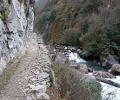
'It is certainly time for New Delhi to open up. Not only should it go ahead at full steam with the roads to the LAC, but the government must also allow tourists to visit these stunningly beautiful areas of Indian territory.'
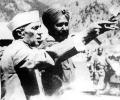
Let us hope that what happened in 1962 will never happened again, prays Claude Arpi

'It is a pattern of behaviour of the Chinese that whenever a Chinese leader visits India or an Indian leader visits China, some incidents take place.' 'When Modi visits China, we should look out for some similar demonstration by the Chinese.'
 © 2026 Rediff.com - Investor Information - Advertise with us - Disclaimer - Privacy Policy - Sitemap - Feedback - About us - Terms of use - Grievances