
Actor Amitabh Bachchan has paid up GST of Rs 1.09 crore on sale of non-fungible tokens (NFTs) worth Rs 7.15 crore following a notice by the Directorate General of Goods and Services Tax Intelligence (DGGI), people aware of the matter said. Though Bachchan has deposited the amount, investigations by tax authorities continue, they said. Bachchan had entered into an agreement with Rhiti Entertainment Pte. Ltd, Singapore, for conversion of his content into NFTs by way of an auction.
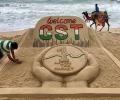
The collections from Goods and Services Tax (GST) grew by 15 per cent to over Rs 1.49 lakh crore in December 2022, indicating improved manufacturing output and consumption demand, besides better compliance. This is the 10th month in a row that the revenues have remained above the Rs 1.4 lakh crore mark. The collection in November was about Rs 1.46 lakh crore. "The gross GST revenue collected during December 2022 is Rs 1,49,507 crore, of which CGST is Rs 26,711 crore, SGST is Rs 33,357 crore, IGST is Rs 78,434 crore (including Rs 40,263 crore collected on import of goods) and cess is Rs 11,005 crore (including Rs 850 crore collected on import of goods)," the ministry said in a statement.

The revenues for August are 88 per cent of the GST collected in the same month last year.

If there is no third wave of the pandemic, the fiscal position of the Centre and the states will be much better than budgeted for FY22 and the states may garner Rs 60,000 crore more in tax collections at Rs 8.27 lakh crore this fiscal year than they have budgeted, a report said. The report by SBI Research on Monday bases its optimism on GST collection so far this fiscal, which has been the best ever in spite of the fact that the two months bore the maximum brunt of the second wave -- with April setting a record Rs 1.41 lakh crore and May collection a tad low at Rs 1.03 lakh crore. The report also said overall government finances do not look overstretched as GST collections have continued to maintain pace so far and the additional fiscal impact arising from free vaccination and more food supplies will only be around Rs 28,512 crore.
Can this growth in GST collection be sustained in the coming years? asks A K Bhattacharya.

GST revenue for May stood at nearly Rs 1.41 lakh crore, a 44 per cent increase over the same month last year, the finance ministry said on Wednesday. Bucking the month-on-month increasing trend of the last two months, the Goods and Services Tax (GST) revenues came in lower than the record high collection in April at Rs 1.68 lakh crore. In March GST revenues were at Rs 1.42 lakh crore, while in February it was Rs 1.33 lakh crore.

Total number of GSTR-3B returns filed up to January 30, 2022 is 1.05 crore that includes 36 lakh quarterly returns, the finance ministry said. January is the fourth straight month when Goods and Services Tax collection has crossed Rs 1.30 lakh crore.

The commerce ministry is proposing a host of direct and indirect incentives such as deferral of import duties and exemption from export taxes to revamp Special Economic Zones through a new legislation, an official said. In the Union Budget this year, the government proposed to replace the existing law governing Special Economic Zones (SEZs) with a new legislation to enable states to become partners in 'Development of Enterprise and Service Hubs' (DESH). The official said the commerce ministry has sought views of different ministries, including finance, on the new bill.

With exporters' claim for over five months still pending, liquidity has been wiped out and the process of finalising new contracts has been held up.

For 2019-20, the government proposes to collect Rs 6.10 lakh crore from CGST and Rs 1.01 lakh crore as compensation cess.

The all-powerful GST Council on Friday decided to charge food delivery platforms such as Swiggy and Zomato a tax even as it extended concessional tax rates on certain COVID-19 drugs by three months till December 31. The Council, which comprises the Union finance minister and her state counterparts, decided to continue keeping petrol and diesel out of the GST purview as subsuming the current excise duty and VAT into one national rate would impact revenues. Briefing reporters on the decisions taken by the Council at a meeting here, Union Finance Minister Nirmala Sitharaman said GST has been exempted on muscular atrophy drugs like Zolgensma and Viltepso, which cost crores of rupees.

With recent rate cuts, November collections could be even less
Mop up grows 10% y-o-y at Rs 1.05 trillion, almost equal to levels in February before a nationwide lockdown to contain the coronavirus pandemic

GST collections crossed the Rs 1 lakh crore-mark for the fifth month in a row in February, rising 7 per cent to over Rs 1.13 lakh crore, indicating economic recovery, the Finance Ministry said on Monday. The collection is, however, lower than the record Rs 119,875 crore collected in the previous month.

1.03 crore taxpayers have been registered under GST till February 25, of which 17.65 lakh are composition dealers who are required to file returns every quarter.
The mop-up could have been much higher, but tax on imports fell 2 per cent y-o-y.

The budgeted indirect tax collection target is Rs 9.26 trillion, and the Centre has collected around Rs 5 trillion in the first 8 months. So it needs another Rs 4.2 trn in the last four months
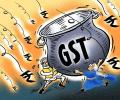
The GST collection in April touched the highest ever level of about Rs 1.68 lakh crore, up 20 per cent from the year-ago period, on improved compliance and recovery in business activity, the Finance Ministry said on Sunday. During the month, 1.06 crore GST returns from GSTR-3B were filed, of which 97 lakh pertained to March 2022. The gross GST revenue collected in April is Rs 1,67,540 crore, of which CGST is Rs 33,159 crore, SGST Rs 41,793 crore, IGST Rs 81,939 crore (including Rs 36,705 crore collected on import of goods) and cess Rs 10,649 crore (including Rs 857 crore collected on import of goods), the ministry said.

The government on Wednesday extended the existing foreign trade policy (FTP) for six more months up to September 30 this year due to the Covid-19 pandemic, according to a notification. FTP provides guidelines for enhancing exports to push economic growth and create jobs. On March 31, 2020, the government had extended the Foreign Trade Policy 2015-20 for one year till March 31, 2021, amid the coronavirus outbreak and the lockdown.

GST collections for January touched an all-time high of about Rs 1.20 lakh crore, the finance ministry said on Sunday. The ministry said in line with the trend of recovery in the GST revenues over past five months, the revenues for the month of January 2021 are 8 per cent higher than that in the same month last year.
During the month, the GST revenue from domestic transactions witnessed a growth of 16 per cent as compared to the year-ago period.

They are evaluating realignment of warehouses and supply chains, besides exploring locations to set up hubs and shutting down some distribution centres

The challenge before the government now is to use the factors that are favourable to its benefit.

According to official sources, the number reflects pick up in consumption and improvement in compliance as well.

The states which achieved "extraordinary growth" in total taxes collected include Kerala (44 per cent), Jharkhand (20 per cent), Rajasthan (14 per cent), Uttarakhand (13 per cent) and Maharashtra (11 per cent), an official statement said.

K M Mani was appointed the chairman of the panel in March this year.

The data primarily pertains to activities in March, which had only a few days under the Covid-19 lockdown. For April , hence, CGST collections could be much lower, fear analysts.
Is the curated and limited data put out by the central government sufficient enough to pass a judgement on the trend in GST collections, particularly that of the Centre?

The Goods and Services Tax (GST) Council, chaired by Union Finance Minister Nirmala Sitharaman, will likely consider on Saturday a GST rate cut for Covid-19 relief essentials and drugs for treating the black fungus disease and might leave the vaccines untouched. The meeting is being held following a report submitted by a Group of Ministers (GoM) to the GST Council on Monday. The GoM, set up by the Council on May 28, was mandated to look at tax exemption and concessions on various Covid items including vaccines, drugs, and equipment.

Round-tipping creates the opportunity for exporters to source funds at a much cheaper cost, which they divert to some other business.

The government is looking to plug loopholes in the Indian customs law provision that allows tax exemptions for gifts up to Rs 5,000 and trade samples up to Rs 10,000 sent to India from abroad.
GST collections touched a record high of over Rs 1.15 lakh crore in December, reflecting festive demand and reflating economy. The gross GST revenue collected in the month of December 2020 is Rs 115,174 crore and is the highest since the introduction of Goods and Services Tax from July 1, 2017, the finance ministry said in a statement.

Revenue from Goods and Services Tax (GST) stood at over Rs 1.04 lakh crore in November as against Rs 1.05 lakh crore collected in the previous month, the Finance Ministry said in a statement. This is the second straight month in the current fiscal when GST revenue has topped Rs 1 lakh crore. The collection in November 2020 is 1.4 per cent higher than in November 2019 when the GST mop-up was Rs 103,491 crore.

A total of 35 persons have been arrested by the CGST authorities.

Data released earlier by CAG shows capital expenditure by the Centre had contracted 9.2 per cent in Q2

Of the 11,000 kg imported between July 1 and August 9, around 90 per cent was brought in by two business groups which took advantage of the favourable reduction in tax incidence under GST, routing their imports through Korea.
The revenue collection in the same month a year ago stood at Rs 94,442 crore.

Blocked working capital worth Rs 1,500 crore, in the almost-defunct job work diamond polishing units, is expected to be released even as diamantaires will issue fresh orders to such units following the GST relief.

GST collections in March slipped below the psychological Rs 1 lakh crore-mark for the first time in four months to Rs 97,597 crore as the Covid-19 lockdown that shut most businesses compounded tax collection woes in an already sluggish economy. Goods and Services Tax (GST) mop-up in March recorded a 8.4 per cent decline over March 2019 collection of Rs 1.06 lakh crore. The collections were lower on account of dip in revenues from domestic transactions as well as imports.

In signs of acceleration in economic activity, India's tax collections on goods sold and services rendered returned to over Rs 1 lakh crore in July after the second wave of Covid-related restrictions caused a blip in the previous month. Goods and Services Tax (GST) mop-up grew 33 per cent year-on-year in July to over Rs 1.16 lakh crore, indicating that the economy is recovering at a fast pace. In July 2020, the collection was Rs 87,422 crore. This is the second highest collection so far this fiscal after a record Rs 1.41 lakh crore mop-up in April.
 © 2026 Rediff.com - Investor Information - Advertise with us - Disclaimer - Privacy Policy - Sitemap - Feedback - About us - Terms of use - Grievances