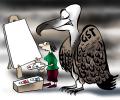
E-invoicing would be implemented on a voluntary basis by those having an annual turnover of above Rs 500 crore from January 1.

Simplifying the processes will lead to greater efficiencies. Bad processes will not help even if implemented well, says T N C Rajagopalan

GST collections touched a record high of over Rs 1.15 lakh crore in December, reflecting festive demand and reflating economy. The gross GST revenue collected in the month of December 2020 is Rs 115,174 crore and is the highest since the introduction of Goods and Services Tax from July 1, 2017, the finance ministry said in a statement.
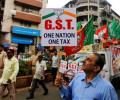
The buoyancy in the tax revenue of GST reflects the upswing in the economy and better compliance

'There were lots of functionalities the Group of Ministers asked us to incorporate.'

This meeting has led to the deferment of the Goods and Services Tax (GST) Council meeting by a day.

Tax experts are nudging the authorities to figure out why so many assessees are not filing their returns.

The GST Council also decided that a committee of officers will be constituted to examine the simplification of forms for annual return and reconciliation statement.

Agriculture implements that are currently taxed up to 18 per cent may come under the 12 per cent or the 5 per cent bracket.

The GST Council on Friday left taxes on COVID-19 vaccines and medical supplies unchanged after the BJP- and Opposition-ruled states sparred over whether tax cut benefits will reach the common man. Congress and other Opposition ruled states have been demanding a reduction in taxes but the central government felt the move may not result in tangible gains for people. "It is one thing to rush to say - do this, it will benefit the common man. But when the technical, fitment and law committees go into the details, you realise that that could have collateral impact on many others," Finance Minister Nirmala Sitharaman said. "I am not talking about the revenue generation aspect, but how many other items will get included in it as a result of which how you are going to implement it," she added.

The Council also discussed process to make return filing simpler with just one return to be filed every month.

After the 2019 election, one thing is sure: GST will see a number of changes, explains Indivjal Dhasmana.

Cheque payments will be safer; the limit for contactless card transactions hiked.

For fiscal 2019-20, the GST collection target has been budgeted at Rs 13.71 lakh crore.
According to official sources, the number reflects pick up in consumption and improvement in compliance as well.

As much as Rs 6,696 crore has been released to the states as GST compensation for the month of March 2018, as on May 29.
For 2019-20, the government proposes to collect Rs 6.10 lakh crore from CGST and Rs 1.01 lakh crore as compensation cess.

The data primarily pertains to activities in March, which had only a few days under the Covid-19 lockdown. For April , hence, CGST collections could be much lower, fear analysts.
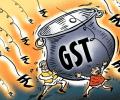
Central Board of Indirect Taxes and Customs said despite the electronic way or E-way bill mechanism there has been rampant evasion and there is a need to increase compliance.

The large drop was for export orders that were meant to be delivered until October.
This is the third consecutive month when GST mop-up remained below the Rs 1 lakh crore mark, despite the festival season.
Only 69 per cent of the assessees filed returns
'So far, the government has sanctioned more than Rs 300 billion as GST refunds,' Ansh Bhargava and Aditya Singhania point out.
1.03 crore taxpayers have been registered under GST till February 25, of which 17.65 lakh are composition dealers who are required to file returns every quarter.

Inter-state supply may come under GST composition

India is on the brink of overhauling its tax system, implementing the BEPS project and seeing a further evolution of the GST at the same time as a general election. This makes 2019 an exciting and challenging year, note Maulik Doshi and Jigar Doshi.

GST collections in March slipped below the psychological Rs 1 lakh crore-mark for the first time in four months to Rs 97,597 crore as the Covid-19 lockdown that shut most businesses compounded tax collection woes in an already sluggish economy. Goods and Services Tax (GST) mop-up in March recorded a 8.4 per cent decline over March 2019 collection of Rs 1.06 lakh crore. The collections were lower on account of dip in revenues from domestic transactions as well as imports.

GSTN said those who do not want to give their Aadhaar numbers would have to undergo physical verification.
The total revenue earned by central government and state governments after regular settlement in December was Rs 43,851 crore for CGST and Rs 46,252 crore for SGST.
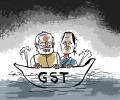
The Centre managed to collect only Rs 990 crore as compensation cess in April 2020-21, almost one-ninth of the figure of Rs 8,874 crore mopped up a year ago. The subdued collection would further increase states' problems unless the GST Council, which meets next week, decides to borrow from the market.

Despite a steady collection rate, the government faces a steep Budget target of Rs 6.1 trillion for CGST for 2019-20.
The GST rate on mobile phones will be hiked to 18 per cent while that on maintenance repair overhaul (MRO) services for aircraft will be lowered to 5 per cent with effect from April 1, Finance Minister Nirmala Sitharaman said on Saturday. The GST rate on handmade and machine-made matchsticks has been rationalised to 12 per cent from 5 per cent and 18 per cent respectively.

GST seeks to subsume many indirect taxes at the Central and state levels.
Restricting the input credit is not a good idea for any sector, particularly real estate which requires more formalisation.
The CAG audit and other data suggests it could be far from the efficient new alternative that was once conceptualised. A conclusive review remains elusive till the government begins to release more granular and comparable data on the complex backend of GST to a deeper scrutiny, by researchers, auditors and the public.

The GST Council's agenda includes trimming the number of items in the 28 per cent slab by 75 per cent, easier compliance for assessees and small taxpayers, and a presentation on bringing real estate under GST.
A government report revealed that fake companies floated with fake addresses, issued fake GST invoices and generated fake e-way bills, with fake vehicle registration details without supplying any goods causing huge loss to the exchequer.
 © 2026 Rediff.com - Advertise with us - Disclaimer - Privacy Policy - Sitemap - Feedback - About us - Terms of use - Grievances