
Gen Naravane's visit to Nepal from November 4-6 is largely aimed at resetting bilateral ties that came under severe strain following a bitter border row between the two countries.
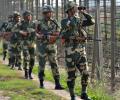
In his speech during the Army day parade, he also said that there has been 44 per cent increase in ceasefire violations that reflects Pakistan's sinister design.
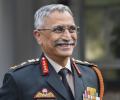
Gen Naravane also said the Army will enhance combat capabilities along the border with China so that it is fully prepared to deal with any security challenge.
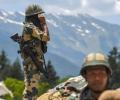
Gen Naravane said India is dealing with China in a "firm" and "non-escalatory" manner to ensure the sanctity of its claims in eastern Ladakh, and that it was even open to initiating confidence-building measures.

The Chief of the Army Staff interacted with almost all the injured soldiers and complimented them for their bravery.
Wrapping up his two-day visit to Ladakh, Gen Naravane said the Indian Army has undertaken precautionary deployment in some areas and that the force is well prepared to safeguard the territorial integrity of the country.

It is the first-ever visit by a head of the Indian Army to South Korea.

Addressing a press conference, Gen Naravane said the focus of training will be on preparing the army for future wars which will be network-centric and complex.
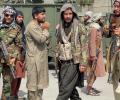
Chief of Army Staff General M M Naravane on Saturday did not rule out the possibility of Afghan-origin foreign terrorists attempting to infiltrate into Jammu and Kashmir once the situation stabilises in Afghanistan as he cited similar instances when the Taliban were in power in Kabul over two decades ago.

The talks between India and China on the border row in eastern Ladakh have helped 'build trust' and the situation in the region has been normal since the disengagement in the Pangong Tso areas in February, Chief of Army Staff General M M Naravane said on Thursday, exuding confidence of resolution of the 'remaining issues'.
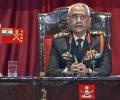
Army chief General M M Naravane on Tuesday hoped for an amicable resolution of the military standoff with China in Ladakh through talks based on 'mutual and equal security' even as he said India will have to be prepared to deal with a 'two-front' threat scenario due to the potent and collusive threat from China and Pakistan.
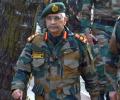
Gen Naravane reviewed the overall security situation in the region with Northern Army Commander Lt Gen Yogesh Kumar Joshi, commander of the 14 Corps Lt Gen Harinder Singh and other senior Army officials.

As per the plan, each of the theatre commands will have units of the Army, the Navy and the Air Force, and all of them will work as a single entity looking after security challenges in a specified geographical territory under an operational commander.
General Naravane said that the Chinese army has been trying to alter the status quo along the LAC in very 'small incremental steps' and over a period of time Beijing has gained a lot.
India is witnessing trailers of future conflicts and its adversaries will continue with efforts to achieve their strategic aims, Army Chief Gen MM Naravane said on Thursday delving into national security challenges emanating from China and Pakistan.
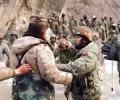
In his memoir Four Stars of Destiny, Naravane recounts Singh's direction as well as a flurry of phone calls between the defence minister, external affairs minister, the national security advisor and the chief of defence staff that night on the sensitive situation.

Indian Army has taken the initiative to induct women in rank and file, and the first batch of 100 women soldiers is undergoing training at Corps of Military Police Centre and School, he said.

Lt Gen PGK Menon, the commander of the Leh-based 14 Corps, popularly known as 'Fire and Fury' Corps, briefed the army chief on various aspects of the situation in eastern Ladakh.
Chief of Army Staff Gen MM Naravane on Friday visited several forward areas in eastern Ladakh and carried out a comprehensive review of India's operational preparedness in the backdrop of its prolonged military standoff with China in the mountainous region.

Indian troops were maintaining their "posture" along the border with China while infrastructure development in the frontier areas was on track, Army Chief Gen M M Naravane said on Thursday, days after personnel of the two countries were locked in two separate incidents of violent face-offs. Gen Naravane said the incidents in Eastern Ladakh and North Sikkim involved aggressive behaviour by Chinese and Indian troops resulting in minor injuries to personnel from both the sides.
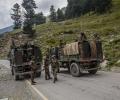
Top commanders of the Army on Thursday carried out a comprehensive review of India's overall security challenges including in eastern Ladakh as well as other sensitive areas along the Line of Actual Control with China on the first day of a two-day conference, people familiar with the development said.

He visited areas falling under the operational command of the Rising Star Corps, including Kathua, Samba, Jammu and Pathankot, to review the security situation.
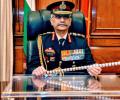
Nepal raised objection to India's newly-inaugurated road linking Lipulekh Pass with Dharchula in Uttarakhand.

He noted that the primary responsibility of the Indian Army is to maintain operational readiness of the "highest order".

He said India had made matching deployments in terms of troops and infrastructure in its areas along the LAC and there was no way anyone would be able to behave in an aggressive manner again.

In continuation of a tradition that started in 1950, Nepal Army chief Gen Prabhu Ram Sharma was conferred with the honorary rank of 'General of the Indian Army' by President Ram Nath Kovind on Wednesday.
On the first day of his two-day visit to Ladakh, Gen Naravane held a series of meetings with top commanders about the evolving situation in the region as well as on India's overall combat readiness to deal with any eventualities, military sources said.
His comments came in the midst of the disengagement process between Indian and Chinese armies in Pangong Tso areas in eastern Ladakh where the two sides have been locked in a nine-month standoff.
The Chief of Army Staff is scheduled to hold extensive talks with the top civilian and military brass of Nepal including his counterpart General Purna Chandra Thapa on a range of key issues such as further boosting the management of the nearly 1,800 km-long border between the two countries.
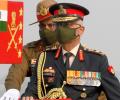
The Army Chief replied in the affirmative when asked by the moderator whether he concurs with Prime Minister Narendra Modi's remarks after the border standoff that the Chinese have not come into control of Indian territory.
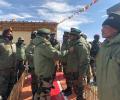
Gen Naravane awarded Commendation Cards to a number of soldiers who fought valiantly during the recent face-offs with Chinese Army.

Gen Naravane on Tuesday said he was eagerly looking forward to the visit and exuded confidence that it will go a long way in strengthening the "bonds of friendship" between the armies of the two countries.

On the first anniversary of the deadly clashes, the army said the supreme sacrifice of the soldiers while fighting the adversary in the "most difficult" high altitude terrain will be "eternally etched" in the memory of the nation.

The visit comes a week after 20 Indian Army personnel were killed in a brutal assault by the Chinese military in Galwan Valley which escalated the border tension.

It is the first highest level face-to-face meeting between the two sides after the border row escalated in eastern Ladakh in early May.

India and China are likely to hold another round of diplomatic talks this week on eastern Ladakh with a focus on moving forward in disengagement of troops in the remaining friction points, people familiar with the development said on Tuesday.

Army Chief General M M Naravane carried out an aerial reconnaissance of forward areas on Wednesday and was briefed about the prevailing security situation along the Line of Control (LOC) in the Jammu region, officials said.

The visit is also aimed at boosting morale of the army personnel engaged in the seven-week bitter border faceoff with the Chinese troops in the region, sources added.

While interacting with jawans, the General highlighted that it was "the dawn of a new era of development, peace and prosperity in Kashmir" and applauded them for their high level of morale and contribution to peace building in Jammu and Kashmir.
India on Thursday once again called for completion of the disengagement process at the remaining friction points in eastern Ladakh to pave the way for both the Indian and Chinese troops to consider de-escalation and ensure full restoration of peace and tranquillity in border areas.
 © 2026 Rediff.com - Investor Information - Advertise with us - Disclaimer - Privacy Policy - Sitemap - Feedback - About us - Terms of use - Grievances