
'The robust tax collections give the finance minister a fair amount of headroom for an expansionary fiscal policy.'

Exports to China saw sustained double-digit growth for the fourth straight month in August, led by eightfold rise in iron and steel shipments.

The Indian IT industry will stage a "strong recovery" in 2021-22 with a revenue growth of up to 11 per cent, ratings agency Crisil said on Wednesday. The recovery will be led by increasing outsourcing and accelerating digital transformation services mainly in sectors such as banking, financial services and insurance (BFSI), healthcare, retail and manufacturing, it said. As per Nasscom, the IT services industry grew 2.7 per cent to $99 billion in 2020-21.

Whether it is DLF in the National Capital Region, or Godrej Properties and Oberoi Realty in Mumbai or Sunteck Realty, Prestige Estates and Sobha Realty in Bengaluru, most top players have launched or lined up a slew of new project launches during this season.

The mop-up could have been much higher, but tax on imports fell 2 per cent y-o-y.

The company, backed by China's Ant Group, is planning to issue fresh shares worth Rs 7,500 crore in the IPO. This will make this India's third-largest offering after Reliance Power and DLF.

Even as the semiconductor shortage has limited the demand for new cars, the pre-owned car segment is seeing a surge. A preference for personal mobility, availability of multiple organised online platforms, including e-commerce channels, aggregators, and classifieds, have been fuelling growth. The growth rate of the pre-owned car market is expected to be 1.5x that of the new car market over the next five years.

Ehile the Centre had projected tax revenues to touch 12.1 per cent of GDP in FY19, Revised Estimates peg the collections at 11.9 per cent, owing to a shortfall in the goods and service tax (GST) collections, reports Ishan Bakshi.

Mumbai-based Dream11, which is run by Sporta Technologies Private Limited, reported a profit of Rs 181 crore (Rs 1.81 billion) in FY2020, making it one of the few Indian consumer-tech unicorns to have turned profitable.

Analysts expect Colgate's overall volume growth to remain in single digits (around 5-6 per cent) for the next two years.
The moves on basic income for farmers - Rs 6,000 per person in three installments per annum - and subsidised agricultural loans are likely to boost the rural economy through consumption in the near-term, but will have a fiscal cost, it noted.

As even bigger road construction players are not willing to bet on BOT projects., NHAI will have to rethink its thrust on the BOT model.

With the government looking to divest loss-making steel assets, significant interest from secondary players is most likely this time apart from the anticipated list of large integrated primary steel producers, said industry experts. Rashtriya Ispat Nigam Limited (RINL), Neelachal Ispat Nigam Ltd (NINL), NMDC Integrated Steel Plant (NISP)-Nagarnar, Ferro Scrap Nigam Ltd and three units of Steel Authority of India (SAIL) - Alloy Steels Plant, Durgapur; Visvesvaraya Iron and Steel Plant, Bhadravati; and Salem Steel Plant, Salem - constitute the divestment list. All the three units of SAIL have been loss-making for more than five years.
The finance ministry will kick-start the exercise to prepare the Union Budget for financial year 2022-23 (FY23) from October 12, according to an official notification released on Monday. "The pre-Budget meetings as well as the meetings to discuss the revised estimates will start from October 12 and will continue till the second week of November," according to the Budget circular of the Department of Economic Affairs' Budget Division. The Union Budget is expected to be announced on February 1, as has been the practice of the past few years.

Last year, major tea companies performed well on the back of higher prices. However, a drop in prices over the past month and a half, is threatening to put a spanner in a repeat performance. Tea prices started on a strong note this year with prices ruling higher than last year on the back of crop loss due to adverse weather conditions. After mid-June, however, prices started dropping, though they are still higher than 2019-levels for north Indian teas (which account for more than 80 per cent of total production).

The central government is likely to exceed the budgeted tax collection target of Rs 22.2 trillion for the current fiscal year, led by better indirect tax mop-up, compliance measures, and recovery in most sectors following the second wave of the Covid pandemic. Personal income and corporate tax collections (net of refunds) grew 74 per cent to Rs 5.70 trillion in the first half of the current financial year, driven mainly by advance tax and TDS payments. The target for the current fiscal year is Rs 11.08 trillion; higher taxes are paid usually towards the end of a fiscal year.

This demand comes at a time when the government is falling short of its revenue targets due to dwindling tax and low disinvestment receipts. It could account for the dividend in the upcoming Union Budget on February 1. RBI is, however, yet to take a final call on the government's demand and might decide on this at its central board meeting scheduled for February 15 in New Delhi.

'Is taxable amount above 1 Lac is also to be shown as income from other sources?'

Free provision of food, cash transfers, and jobs in villages see enhanced flow of funds despite a precipitous fall in revenue. Till May, defence spend was nearly 30 per cent less than the previous year.
Most of the changes have come about in the last four years and ITC is now reaping the dividends - standalone revenues from the non-cigarettes FMCG business have grown 40 per cent from FY17 to Rs 14,728.21 crore in FY21 and pre-tax profits 30 times to Rs 823.69 crore. The business accounted for 30.58 per cent of gross revenues and 4.85 per cent of pre-tax profits in FY21. "In the last four years, our margins in FMCG have gone up by 640 basis points (bps) and EBITDA margins have been moving up consistently. "We created levers that enabled a sustained growth trajectory," said ITC chairman and managing director Sanjiv Puri. Puri took charge as the chief executive officer in 2017; in 2018, he was redesignated managing director and effective May 2019, he became chairman.

Despite a shaky Q3, conviction over the stock remained high, with 65 per cent of the analysts polled on Bloomberg retaining their 'buy' recommendation.

Bankruptcy court NCLT on Tuesday allowed billionaire Anil Agarwal's Twin Star Technologies to take over Videocon Industries Ltd for about Rs 3,000 crore. Twin Star, a part of Vedanta Group, will pay around Rs 500 crore within 90 days as upfront payment and the rest as non-convertible debentures over a period of time. A two-member Mumbai bench of the NCLT comprising members - H P Chaturvedi and Ravikumar Duraisamy - approved the resolution plan by Twin-Star Technologies.
Given the expectations of growth in the packaged foods segment, the company seeks to become a Rs 1-trillion FMCG business by FY30.

Several carmakers, including car market leader Maruti Suzuki India pulled the plug on diesel models citing higher costs for BSVI variants leaving buyers with limited options.

The annual meet also saw some shareholders of the country's second largest IT services company raising concerns over falling operating margins. But many congratulated the management for delivering good FY20 performance despite the tough economic conditions.

The Cabinet on Wednesday gave in-principle approval for strategic disinvestment along with transfer of management control in IDBI Bank in line with the Budget announcement earlier this year. The central government and LIC together own more than 94 per cent equity of IDBI Bank. LIC, currently the promoter of IDBI Bank with management control, has a 49.21 per cent stake. The Cabinet Committee on Economic Affairs chaired by Prime Minister Narendra Modi approved the strategic sale of IDBI Bank, an official statement said on Wednesday.

Measures that quickly boost demand and increase employment are needed to push up growth. Moreover, without announcing new planss, the government should strengthen schemes such as PM KISAN, MNREGA and programmes to build rural roads.
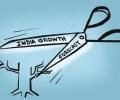
SBI economists on Tuesday sharply slashed their FY22 GDP growth estimates to 7.9 per cent - the lowest among all analysts - from the earlier projection of 10.4 per cent growth. The economists at the state-run lender seemed to attribute the impact of the second wave of COVID-19 infections as a key factor for the revision in the growth estimate, and pitched for faster vaccination. "... our analysis shows a disproportionately larger impact on the economy this time and given that rural is not as resilient as urban, the pick-up in pent-up demand is unlikely to make a large difference in FY22 GDP estimates, and hence it could only be a modest pick-up," they said.

'I would recommend two parts to fiscal support. One, support the lower end of the society by direct intervention through ways such as direct benefit cash transfer. Second, give fiscal support to the stressed sectors in line with the Rs 3-lakh crore (Rs 3 trillion) emergency credit line guarantee norms'

Multiple triggers such as asset sales, pickup in energy cash flows, increased traction in omni-channel retail, and rise in ARPUs could further drive the stock.

Though a weak dollar will lend some support to revenues and margins in FY21, the demand environment will outweigh any gain.

According to its DRHP filed in 2010, the company's net worth was just Rs 140 crore. Its total income for the financial year 2009-10 stood at Rs 119 crore and it had a net profit of Rs 16 crore. In sharp contrast, at the end of March 2021, Paytm's networth was Rs 6,535 crore and total income stood at Rs 3,187 crore.

In November, DRL registered growth of 28 per cent year-on-year (YoY), which was the highest among peers and double that of the industry growth (14.5 per cent).

Most listed corporate entities in the country are in a fix. With the sudden declaration in late March of a nationwide lockdown to tackle the Covid-19 pandemic, the final calculations of their financial results for the year 2019-20 (FY20) are hanging in limbo. Till April 19, only 41 of the 3,947 companies listed on the BSE have managed to finalise the dates for the declaration of their yearly financial results.

Revenue foregone on account of corporation tax exemptions is estimated to grow by 16 per cent in 2018-19 (FY19) versus 8.7 per cent in the previous year and 12 per cent in 2016-17, show the Budget documents.

Domestic tyre demand is seen to grow by 7-9 per cent over the next five years.

Campus recruits can also aim to double the existing entry level package by proving their skills through the TCS national qualifier tests.

A look at six indicators shows all of them have collapsed from positive growth in April to contraction in September.
The bank expects to grow loan book by 10 per cent in the current financial year with calibrated exposure to corporate accounts and thrust on the retail segment.

'The overall death claims have gone up.'
 © 2026 Rediff.com - Advertise with us - Disclaimer - Privacy Policy - Sitemap - Feedback - About us - Terms of use - Grievances