
A high-level government committee has accused activists of ruling Awami League alongside main opposition Bangladesh Nationalist Party and fundamentalist Jamaat-e-Islami for the attack on Buddhist temples and localities in south-eastern Bangladesh last month, reports said on Friday.

Quamruzzaman, an assistant secretary general of Jamaat, is the fourth accused who was convicted for the 1971 war crimes siding with Pakistani troops while his party was opposed to Bangladesh's independence.
Bangladesh's main opposition leader Khaleda Zia has condemned recent attacks on Hindus in different parts of the country allegedly by activists of fundamentalist Jamaat-e-Islami and demanded punishment to perpetrators of the attacks.
A top leader of Bangladesh's fundamentalist Jamaat-e-Islami party was on Thursday sentenced to death for "crimes against humanity", including genocide and religious persecution, during the country's 1971 war of independence against Pakistan.
A top leader of the fundamentalist Jamaat-e-Islami was on Tuesday sentenced to life by a special Bangladeshi tribunal on charges of committing "crimes against humanity" during the 1971 independence war against Pakistan. "He (Abdul Kader Mollah) will serve the life term," said chairman of the three-member International Crimes Tribunal Justice Obaidul Hassan.
At least three people, including two teenagers, were killed as violence rocked Bangladesh for the third day on Saturday as the death toll rose to 49 in clashes that erupted after a top leader of fundamentalist Jamaat-e-Islami was sentenced to death for "crimes against humanity" during the 1971 liberation war.

Bangladesh on Friday deployed paramilitary border guards to beef up security after a top Islamist opposition leader was sentenced to death, sparking nationwide riots that killed at least 42 people.

Bangladesh was on the boil on Thursday as at least 23 people, including three policemen, were killed and scores injured in violence after a death sentence was handed down to a top leader of the fundamentalist Jamaat-e-Islami for "crimes against humanity" during the 1971 liberation war.
Bangladesh government on Monday pressed war crime charges against fundamentalist Jamaat-e-Islami (JI) leader Ghulam Azam at the International Crimes Tribunal, calling him a "key collaborator" of the then Pakistani regime during the 1971 Liberation War.
At least three persons were killed in sporadic clashes in Bangladesh on Monday during a nationwide general strike called by fundamentalist Jamaat-e-Islami to protest their leaders' ongoing trial for 1971 war crimes.

The clashes broke out this morning when protesters attending a non-cooperation programme to demand the government's resignation faced opposition from the supporters of the Awami League, Chhatra League, and Jubo League activists.
Pakistan's fundamentalist Jamaat-e-Islami party has announced it will provide financial aid of Rs 3 lakh to the families of the three men killed in an incident involving suspected Central Intelligence Agency contractor Raymond Davis. This is in a bid to forestall reported efforts by Saudi Arabia to arrange a "blood money" deal to settle the matter.
Police opened fire and used tear gas to disperse student groups belonging to the ruling Bangladesh Nationalist Party and its coalition ally the fundamentalist Jamaat-e-Islami party.

'Religion and extremism is going to be a big force, a very important force, in Bangladesh's politics.'

An intelligence agency of a foreign country mobilsed funds for the Dhaka cafe attack which was carried out on behalf of a top fundamentalist Jamaat-e-Islami leader who is on death row after being convicted for 1971 war crimes in Bangladesh, according to a media report.

Three Islamists from the infamous Al-badr militia were on Monday sentenced to death while five others jailed until death by a special tribunal in Bangladesh for committing crimes against humanity during the 1971 liberation war against Pakistan.

The Egyptian embassy in Bangladesh will remain closed for 11 days from Wednesday over "security reasons".

A top leader of the fundamentalist Jamaat-e-Islami party was sentenced to death on Wednesday by a special Bangladeshi tribunal for committing "crimes against humanity" during the country's 1971 liberation war.
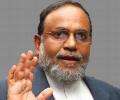
Bangladesh's fundamentalist Jamaat-e-Islami leader and media tycoon Mir Quasem Ali was hanged on Saturday, the sixth Islamist to be executed for war crimes committed during the country's 1971 Liberation War against Pakistan.
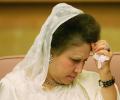
Former Bangladeshi prime minister Khaleda Zia was booked for sedition over her alleged "slanderous comments" concerning martyrs of the 1971 liberation war against Pakistan.

Election Commissioner Shah Nawaz said the Jamaat would not be able to participate in the polls as the high court had declared its registration illegal.
Fundamentalist Jamaat-e-Islami leader and media doyen Mir Quasem Ali was Thursday indicted by a special Bangladeshi tribunal on charges of "crimes against humanity" committed during the 1971 liberation war.

Seven top leaders of Bangladesh's main opposition party Bangladesh Nationalist Party were arrested today during raids, prompting it to extend a 48-hour nationwide strike by one more day, defying premier Sheikh Hasina's appeal to shun violence.

The death toll in violence across Bangladesh, following dispute over electoral system, rose to six even as the country braced for a 60-hour opposition strike on Sunday, calling for a neutral caretaker government to oversee the next general elections.

Zia and 27 leaders and officials of her BNP have been accused of instigating the firebombing in Dhaka as part of a deadly campaign against the government.

Bangladesh police detained a college student and claimed to have found some "important evidence" in connection with the brutal killing of two gay rights activists.
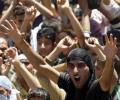
Bangladesh's supreme court on Wednesday wrapped up the appeal hearing against the judgment of a special tribunal that had sentenced to death a key 1971 war crimes suspect with the final verdict due any day now.
Bangladesh's supreme court on Wednesday wrapped up the appeal hearing against the judgment of a special tribunal that had sentenced to death a key 1971 war crimes suspect with the final verdict due any day now.
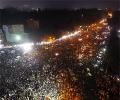
Bangladesh's Supreme Court on Tuesday handed down the death penalty for fundamentalist Jamaat-e-Islami leader Abdul Quader Mollah for his involvement in the 1971 war crimes, revising a special tribunal verdict which had sentenced him to life imprisonment.

Bangladesh's Supreme Court on Monday upheld the death sentence handed down to a fundamentalist Jamaat-e-Islami stalwart for committing mass murder and crimes against humanity during the 1971 liberation war against Pakistan.

The Islamic State has claimed the gruesome killing of a Hindu head priest in Bangladesh using guns and cleavers at a temple in an area bordering India.

Nizami now faces execution unless his case is reviewed by the court or he is granted clemency by the President.

Prime Minister Sheikh Hasina on Monday warned Bangladeshis against attacking the minority Hindu community, saying such assaults could have repercussions in neighbouring India.

A Hindu tailor was hacked to death by machete-wielding Islamic State militants in his shop on Saturday in central Bangladesh.
Fundamentalist Jamaat-e-Islami activists on Saturday held violent demonstrations, exploding several homemade bombs, to protest a Bangladeshi court ruling that barred it from contesting future polls.
A 91-year-old top leader of the fundamentalist Jamaat-e-Islami was sentenced to 90 years in jail on Monday by a special Bangladeshi tribunal for masterminding atrocities during the 1971 war of independence against Pakistan.

Abdul Quader Mollah, a senior leader of the fundamentalist Jamaat-e-Islami party, was executed on Thursday for genocide during Bangladesh's 1971 liberation war, hours after the Supreme Court rejected his review petition.

Bangladesh's Supreme Court on Thursday cleared the way for the execution of a senior leader of the fundamentalist Jamaat-e-Islami, three months after it overturned a tribunal's ruling that sentenced him to life for genocide during the 1971 war.
73-year-old leader of the Bangladesh's largest Islamist party had refused to seek presidential clemency.

Bangladesh's Supreme Court on Tuesday upheld the death sentence against the second highest ranking leader of the fundamentalist Jamaat-e-Islami for war crimes, including massacre of intelligentsia during the liberation war against Pakistan, paving the way for his execution.
 © 2026 Rediff.com - Investor Information - Advertise with us - Disclaimer - Privacy Policy - Sitemap - Feedback - About us - Terms of use - Grievances