
Mufti Mohammad Sayeed wanted a government with the PDP (representing Kashmir), the BJP (representing Jammu) and the Congress (representing Ladakh), but he failed because the BJp and Congress were unwilling to make any exception to their national level inimical relationship, reveals Mohammad Sayeed Malik.

'We must begin dialogue with openness and goodwill, but we will not proceed very far without trust and good faith. The alternative is the violence of 'might is right,' which settles very little and destroys so much of real value,' says Dr Rudolf C Heredia, author of Religious Disarmament -- Rethinking Conversion in India.
Mufti's political graph shows his fondness for courting unpopular, politically hazardous ventures in pursuit of his ultimate objective to vindicate his leadership. Towards the end of his life, Mufti's public profile had come to assume the dimensions of statesmanship. One reason being his willingness to learn from his experience, says Mohammad Sayeed Malik.

The stage on which the Jammu and Kashmir flood disaster played out is littered with protagonists, most of whom did not receive the attention they deserve, says Ajai Shukla

'The man stood alone, fought alone.' 'Some of those battles appeared Quixotic at times.' 'Ultimately, it was he who won though it may have seemed as if a Sancho Panza was fighting a relentless battle against the windmill.' N Sathiya Moorthy salutes the fearless editor who has passed into the ages.

Who was Mohammad Azharuddin? More crucially, *what* was he? Those are precisely the questions that, as the end credits roll after 132 minutes of run-time, remain unanswered, feels Prem Panicker.

Admitting that the party was at crossroads and there were shortcomings both in the organisation and the United Progressive Alliance government, former Union Minister Sachin Pilot on Monday said "changes will happen soon" to put in place a 21st-century Congress.

One of the urgent tasks ahead for the new government should be to improve public trust in the executive.

'Reflex responses to Dalit student Rohith Vemula's suicide are band aids that stem the current hemorrhage but do precious little to the festering wound beneath,' says Vivek Gumaste.

Its promise has fallen short before the onslaught of the votaries of the old order and ruthless extremist forces, notes Talmiz Ahmad.

10 takeaways from the prime minister's UN speech.

Narendra Modi was both conciliatory and mocking towards the Opposition, particularly Congress, during his hour long reply to the debate on the motion of thanks to the President's address in the Upper House.

Refuting allegations of divisions in the Congress in Rajasthan, Corporate Affairs Minister and Member of Parliament from Ajmer, Sachin Pilot, speaks to Kavita Chowdhury on a range of issues, including the Congress's prospects in the coming Rajasthan Assembly polls.

Talmiz Ahmad is a former Indian ambassador to Saudi Arabia, Oman and the UAE. In an interview with Aditi Phadnis, he says the disequilibrium in Iraq will continue to prevail. Ahmad also says there are indications that the US is now anxious to avoid intervening militarily in West Asia, and that this is the appropriate moment for Asia to assume responsibility for its own security. Edited excerpts:

'The Modi government's pusillanimity vis-a-vis Pakistan makes almost certain that India will, in the coming weeks and months, be confronted with cross border terrorist actions of increasing intensity,' warns Satish Chandra, former deputy national security adviser.
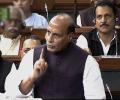
Mohammad Salim cited a news magazine which quoted Singh as reportedly saying -- after Narendra Modi and BJP's victory last year -- that India had the first "Hindu ruler after 800 years."

'I like to see myself as a troll-slayer and I have realised the best way to do that is to ignore them. Nothing bothers them more,' Barkha Dutt tells Rashme Sehgal.

The million dollar question that begs for an answer is: Why is it that an amateurish attempt to convert a handful of Muslims by fringe Hindu elements garners so much attention while large scale systematic attempts to subvert Hinduism go unnoticed or are deliberately overlooked? If this is not double standards then what is, asks Vivek Gumaste.
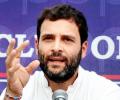
If we have to elect Rahul Gandhi to rule the country because 'secularism', of all things, dictates it, we are strengthening the ugly aspects of the dynastic system of democracy that has come to infect India's body politic deeply, says Jaya Jaitly.

President Pranab Mukherjee talked extensively about the forthcoming Lok Sabha polls and the role of lawmakers during his address to the nation on the eve of Republic Day.

No account of the 1962 war could be complete without Maxwell's authoritative analysis. Which is why we are reprinting this article which was run on Rediff.com in June 2001.

'Since Pranab Mukherjee is the Custodian of the Constitution, he should present practical ideas to solve the problems he has been so outspokenly highlighting,' feels Sudheendra Kulkarni.

PM Modi addressed a crowded UNESCO gathering, speaking of the importance of culture.

'That was the key to a game where, on paper, there is nothing to separate the two sides: Intensity. From the first ball of the innings to the run out of Southee, the Australian bowlers and fielders buzzed around like predatory yellow-jacketed wasps.' 'Adding teeth to the bowling and relentless fielding is the captaincy of Michael Clarke, leading in his last one day international. His body may require an entire college of medical specialists to maintain, but his mind is scalpel-sharp, cutting through the complexities of the game to hit on simple solutions.'

'I could have never imagined any other prime minister giving time to a separatist leader.' 'I think the Hurriyat should not be ignored. I think like Pakistan, they are being unnecessarily ignored.' A S Dulat, the former RA&W chief who visited Kashmir recently, speaks to Sheela Bhatt/Rediff.com

'The obsession of the Pakistan army with India leads to several destabilising things. Support for the Taliban in Afghanistan. Support for groups like the Lashkar-e-Tayiba, that have attacked India. Every time you get an attack like that there is a possibility of a war. And then the build up of the their nuclear arsenals. Chances of a nuclear weapon landing in the hands of a terrorist group, or a nuclear war breaking out, are tiny. But they are higher here than anywhere else in the world.'

If you are more than your rhetoric about a strong and united country, give us our due -- treat us as countrymen, says an ordinary Muslim in this open letter.

Keep exit plans handy, D-day could be the second week of August, writes Sonali Ranade in Market Notes.
 © 2026 Rediff.com - Investor Information - Advertise with us - Disclaimer - Privacy Policy - Sitemap - Feedback - About us - Terms of use - Grievances