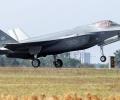
Two Elon Musk from November 2024 surfaced online over the weekend in which he can be seen criticising the US' F-35 fighter aircraft which President Donald J Trump offered to sell India during Prime Minister Narendra D Modi's visit to the White House on Thursday.
Congress general secretary Randeep Surjewala has raised concerns about the Indian government's decision to potentially acquire F-35 fighter jets from the US, questioning whether the decision was made in the national interest and if security experts were consulted. He highlighted the high cost of the F-35, its operational flaws, and the potential impact on the Indian Air Force's existing fleet and maintenance infrastructure. Surjewala's comments come after Prime Minister Narendra Modi and President Donald Trump unveiled plans for a 10-year defense partnership between India and the US, including potential F-35 sales.

India and the United States have announced a groundbreaking 10-year defence partnership, paving the way for increased military cooperation and potential sales of F-35 stealth fighter jets. The agreement aims to bolster both countries' defence capabilities in the Indo-Pacific region, with plans for joint production of weapons and platforms. The move comes amid China's growing military presence in the region.
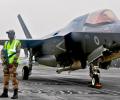
While the peacetime stranding of a foreign fighter jet is rare in India, the F-35 -- a military asset of a foreign country with which India has strategic relations -- was being guarded by the Central Industrial Security Force, the agency responsible for security at Indian airports.

By threatening to punish India with high tariff, Trump is actually planting a tantalising thought in the Indian mind that the Modi government should suitably 'incentivise' him, explains Ambassador M K Bhadrakumar.

The Pentagon has stopped accepting new F-35 jets after it discovered a magnet used in the stealthy fighter's engine was made with unauthorised material from China.

US Vice President JD Vance called on India to drop non-tariff barriers, give greater access to its markets and buy more American energy products and military hardware. Vance, in a speech in Jaipur, highlighted the need for a stronger US-India partnership for a prosperous and peaceful 21st century. He emphasized the importance of working together to address global challenges and praised Prime Minister Narendra Modi, describing him as a "special person." Vance also urged India to provide greater market access to American products and buy more defense platforms and energy from the US. He suggested that India consider dropping some of the non-tariff barriers for American access to the Indian market and highlighted the benefits of closer India-US defense collaboration, advocating for New Delhi to procure more military hardware from the US. He cited the example of American fifth-generation F-35s, arguing they would give the Indian Air Force the ability to defend its airspace and protect its people like never before. Vance also welcomed the Modi government's budget announcement to amend India's civil nuclear liability laws, paving the way for US producers to export small modular reactors and build larger US-designed reactors in India. He emphasized the importance of energy security for India's AI ambitions, stating "there is no AI future without energy security and energy dominance." Vance's visit comes amid growing global concerns over the US's tariff war.
We need to equip the Indian Armed Forces, not 'commercial' as Trump wants, but 'operationally' looking at growing Chinese military capabilities, asserts Lieutenant General Prakash Katoch (retd).

The US Air Force's (USAF) two newest fifth-generation supersonic multirole F-35A aircraft made a historic debut at Aero-India here on Monday, drawing strong interest and adding lustre to the five-day marquee event.

'Rajnath Singh's message was very clear: India's focus is on developing self-reliance.'

A United States fighter jet Friday shot down an object, the size of a small car, flying with payloads at a height of about 40,000 feet off the northern coast of Alaska on the direction of President Joe Biden, officials said.

It is well known that Israel would welcome a diplomatic relationship with Pakistan and feelings of a section of the Pakistani military were likewise.
An undeterred Chief Executive Officer of NSO Group, Shalev Hulio, in an interview to Israeli Channel 12 on Saturday, strongly defended the company's operations, though he also conceded that some 'mistakes' may have happened over the years.

This is perhaps the most authoritative portrayal so far of Indian air power as a threat to China.
In contrast to the bare-bones price of $115 million for each Rafale fighter, the F-35A cost $94.6 million, reports Ajai Shukla.

Lockheed Martin's offer involves transferring the world's only F-16 production line from Fort Worth, Texas, to India. Thereafter, every F-16 built, and a large share of the spare parts and sub-systems for every F-16 flying across the globe would come from India.
 © 2026 Rediff.com - Investor Information - Advertise with us - Disclaimer - Privacy Policy - Sitemap - Feedback - About us - Terms of use - Grievances