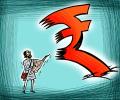
Indian rupee, which earlier this week touched an all-time low, is likely to remain under pressure and may test new levels as a fallout of the US Federal Reserve indicating more interest rate hikes, experts said. The aggressive rate hikes will dampen demand and increase the possibility of a recession in the US. This could accelerate the pace of capital outflows, weaken the rupee and raise the threat of imported inflation.

Currently, Deloitte, EY and KPMG with their associates work as statutory auditors of most of the top league domestic IT services firms. Owing to many alleged auditing lapses, the regulators have either imposed restrictions on the audit firms or are seeking to do so.

Initial share sales are set to dazzle the Dalal Street in 2022 too as companies are expected to garner up to Rs 1.5 lakh crore in the New Year, continuing with the bullish momentum after 2021 turned out to be the best IPO year in two decades for the Indian market. Excessive liquidity and increased retail investor participation ensured a persistent euphoria in the Initial Public Offer (IPO) space wherein companies mopped up more than Rs 1.2 lakh crore this year even as pandemic gloom shadowed the broader economy. In 2022, the higher amount of funds through the primary market will be largely driven by the mega IPO of state-owned Life Insurance Corp (LIC).

USL board said its second forensic audit by EY has revealed fund diversion worth Rs 1,225 cr to Mallya companies.

EY Foundation India and India Paryavaran Sahayak Foundation have come up with a cost-efficient and scalable solution. The project involves spreading awareness and driving usage of in-field straw management practices among farmers, to reduce the air pollution caused due to crop residue burning.

Businesses that have not filed GSTR-3B returns in the preceding two months will not be able to file details of outward supplies in GSTR-1 from September 1, GSTN has said. While businesses file GSTR-1 of a particular month by the 11th day of the subsequent month, GSTR-3B, through which businesses pay taxes, is filed in a staggered manner between 20th-24th day of the succeeding month. In an advisory to taxpayers, GSTN, which manages the technology backbone for Goods and Services Tax, said that Rule-59(6) of Central GST Rules which provides for restriction in filing of GSTR-1, will come into effect from September 1, 2021.

The jury is still out whether the GST will lower or increase your monthly budget, says Priya Nair.

The study is based on responses from over 40 organisations in India across sectors to gauge the success factors, challenges, collaboration landscape and growth areas for divestments in India.
The government has extended the deadline for filing GST annual return and audit report for the 2018-19 fiscal year by a month, till October 31.

By 2022, the entire job landscape would undergo drastic change.

'The main thing Cyrus left is to tell us that you can be a business leader by being good.' 'He practiced that in all of his dealings, in all of his decisions -- in the way he thought, the way he behaved and indeed as he spoke.'

The total value of M&As involving Indian companies surged nearly 63 per cent to $7.8 billion in the first three months of 2016, primarily spurred by big-ticket divestment transactions.

The controversy over the goods and services tax (GST) rate on food products refuses to die. Now, the Gujarat-based authority of advance rulings (AAR) has ruled that 'parathas' would attract 18 per cent GST. The applicant, Vadilal Industries, sought to know whether various kinds of 'parathas' supplied by them would attract five per cent GST in line with 'khakhra', plain chapati or 'roti'.

HR can make better hiring decisions with solutions powered by robotics & machine learning.

Concessional rate of tax on dividends received by Indian companies from foreign subsidiaries will be done away with from April 1, a change that may hamper global expansion of Indian companies and compel some firms to move their headquarters out of India to geographies such as Singapore and Dubai. At present, dividends received by Indian companies from their foreign subsidiaries are subject to a concessional tax rate of 15 per cent under Section 115BBD of the Income Tax (I-T) Act. The provisions of this section shall not apply from assessment year 2023-24 onwards, according to the Finance Bill.

'It is surprising and unfortunate that unfounded allegations are now being made without any reference to me whatsoever,' Vijay Mallya said.

Probable reasons that led to failure of the sale process include 24 per cent government stake and corresponding rights, high debt, volatile crude oil prices, fluctuations in exchange rate, changes in macro environment, profitability track record of bidders and restriction on bidding by individuals.

The government has notified mandatory requirement of e-invoicing for B2B transactions for businesses with a turnover over Rs 100 crore with effect from January 1, 2021. Under Goods and Services Tax (GST) law, e-invoicing for business-to-business (B2B) transactions is mandatory for companies with turnover of over Rs 500 crore from October 1. In a notification, the Central Board of Indirect Taxes and Customs (CBIC) said e-invoicing will be extended to businesses with a turnover over Rs 100 crore from January 1.

The expected interest rate hike in the US and the resultant volatility in the domestic secondary market could play a dampener to the over Rs 2-trillion initial public offering (IPO) pipeline in 2022. IPOs in 2022 look promising, with as many as 35 companies holding the Securities and Exchange Board of India's approval to raise roughly Rs 50,000 crore. Another 33 companies are waiting for the regulator's nod to raise around Rs 60,000 crore next year.

The government has reduced the tariff value for import of edible oil, including palm oil, by up to $112 per tonne, a move which experts said can lead to lower domestic prices. The Central Board of Indirect Taxes and Customs (CBIC), through a notification, has cut the tariff import value of crude palm oil by $86 per tonne, and of RBD and crude palmolein by $112 per tonne each. It also reduced the base import price of crude soyabean oil by $37 per tonne. The changes in tariff value of edible oil are effective from Thursday (June 17).

India is currently home to 52 unicorn startups and one of the fastest-growing startup ecosystems.

Falling valuations, slowing funding rounds and faltering investor sentiment seem to have prompted many start-ups to lay off employees in a bid to conserve cash. The latest to do so is SoftBank-backed Cars24, a leading e-commerce platform for pre-owned vehicles, which has laid off over 600 staff, according to sources in the know. The move, they said, is aimed at conserving cash amid cautious investor sentiment and a slowdown in funding.

IT and ITeS companies accounted for $28.1 billion of the total investment pie during the first nine months of 2021.

The reopening of schools and colleges has sparked a crisis in the edtech sector with falling valuations, slowing funding rounds and faltering investor sentiment. In a totally altered, post-pandemic landscape where students are back at school and colleges, companies are scrambling to revert to bricks-and-mortar tuition centres and adopting a hybrid model of offline and online education. Demand for online tuition has fallen, affecting the revenue of edtech companies in recent months. After two years of booming revenues, some experts say the sector is looking at a possible meltdown.

More than 80 executives participated in the survey that was done from April to June this year.

No response has been received for the Expression of Interest floated for the strategic divestment of Air India

The domestic deal-making activities were hit by weak corporate governance and a huge liquidity crunch in 2019, while the global deals were also hard to come by due to various factors including uncertainties caused by the US-China trade war, which left many investors in a wait-and-watch mode.

Supplying food to schools under mid-day meal scheme, pre-schools and anganwadis is exempt from GST, the Central Board of Indirect Taxes and Customs (CBIC) has said. Issuing a set of clarification on certain decisions taken by the GST Council in its 43rd meeting on May 28, the CBIC said it had received representations regarding applicability of GST on the issues as to whether serving of food in schools under mid-day meals scheme would be exempt if such supplies are funded by government grants and/or corporate donations. Under the goods and services tax (GST), any catering service, including mid-day meals, provided to an educational institution is exempt from the levy.

Last year, it was not just the economy that slowed hiring. Employers were also unable to complete the verification process because of the lockdowns, resulting in delays in hiring and an increase in discrepancies between an employee's professed abilities and the reality. The experience is driving many companies to automation. In a recent EY survey, 56 per cent of the companies said they'd automated their processes, while 72 per cent felt technology could be leveraged to digitise employee records.

The number of deals announced in the month were the highest ever at 102 for any month, compared to 75 in the same period last year and 92 deals in March.

While Road Transport Minister Nitin Gadkari has been dropped, the panel now has four ministers - Shah, Finance Minister Nirmala Sitharaman, Commerce and Railway Minister Piyush Goyal and Civil Aviation Minister Hardeep Singh Puri.

Jet has come under regulatory scrutiny twice this year.

Recently, the finance ministry waived off basic customs duty and health cess on imported oxygen and related equipment for three years.

The Brazilian football federation, (CBF) along with the country's footballers have raised $463,787 and the money will go to three organisations working in Brazil's densely-populated favelas.

In 2017, when Infosys announced that Salil Parekh would be its next chief executive officer (CEO) and managing director (MD), very few in the industry or the analyst community doubted his ability to bring the company back to a healthy growth trajectory, improve morale within the company and, more importantly, win the promoters' trust and investor confidence. There were reasons for this confidence. He was not only the deputy CEO of the Paris-headquartered IT services major Capgemini, but also one of the only non-European faces on the executive board of the company.

Of the 59 IPOs for which the data is available, 36 IPOs received mega responses of more than 10x (of which, six IPOs more than 100x), while eight IPOs were oversubscribed more than 3x.

One of the the biggest tax reforms since Independence, GST will create a national market for goods and services

'IIM Ahmedabad has seen one of the best placement seasons ever and this change can be attributed to the markets opening up after the pandemic.'

Discussions are said to have been heating up over how long a tax indemnity clause, which is part of such deals, should run, according to multiple people familiar with the matter.

With the government looking to divest loss-making steel assets, significant interest from secondary players is most likely this time apart from the anticipated list of large integrated primary steel producers, said industry experts. Rashtriya Ispat Nigam Limited (RINL), Neelachal Ispat Nigam Ltd (NINL), NMDC Integrated Steel Plant (NISP)-Nagarnar, Ferro Scrap Nigam Ltd and three units of Steel Authority of India (SAIL) - Alloy Steels Plant, Durgapur; Visvesvaraya Iron and Steel Plant, Bhadravati; and Salem Steel Plant, Salem - constitute the divestment list. All the three units of SAIL have been loss-making for more than five years.
