
Launched in September 2013, the Conference Board Leading Economic Index for India, conceptualised back to April 1990, has successfully signalled turning points in the economic cycles of India.

India's likely medium-term potential growth will almost certainly be markedly lower than that experienced in pre-pandemic years, warns Shankar Acharya, former chief economic advisor to the Government of India.

According to the BofA-ML Fund Manager Survey for January, asset allocators assigning more funds to equities than at any time since February 2011, while their confidence in the world's economic outlook has reached its most positive level since April 2010.

Returns from the yellow metal may be subdued, as focus returns to equities.

"Indian markets (are) well placed to absorb the US Fed rate hike. Gradual approach in future increases augurs well for emerging markets," Economic Affairs Secretary Shaktikanta Das has tweeted.
Why phasing out the fertiliser subsidy will affect small farmers.

Although the government had pegged fiscal deficit for the current financial year at 5.1 per cent of the GDP in the budget, it has revised the target to 5.3 per cent in view of subdued revenue collection and rising fuel and food subsidy bills.

In Q1, India's GDP shrank by a staggering 24 per cent year-on-year amid the imposition of one of the most stringent global nationwide lockdowns.

New businesses have been secured from the public and private sectors, as well as domestic and international markets.
Raise the price of diesel and restrict supply of subsidised LPG cylinder in a year to four per family, Prime Minister's Economic Advisory Panel suggested on Friday.

Inflation is expected to remain low in the near term, in part because of the further declines in energy prices.

The agency welcomed the Rs 1.70-lakh crore package announced by Finance Minister Nirmala Sitharaman earlier in the day but said more measures like loan forbearances for small businesses and households are necessary.

In 2016, one in two companies is planning to increase head count with hi-tech, shared services and life sciences leading the pack

According to the Grant Thornton International Business Report, 45 per cent of businesses in the BRIC countries (Brazil, Russia, India and China) plan to increase investment in research and development over the next year, compared to just 18 per cent in the G7.


However, the growth during the next financial year would be higher at 8.1 per cent in case of a second wave of the coronavirus and bit slower at 7.9 per cent if the virus recedes and remains under control.

The RBI has already hiked interest rates 12 times since March, 2010, to control inflation, which is currently hovering near the double-digit mark.
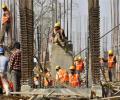
"We see the Indian economy rebounding from our projected 6.1 per cent growth this fiscal year to something like 7 per cent in the next fiscal year (2020). We see the factors that will support growth, including monetary policy stimulus, working their way through the pipeline," Jonathan Ostry, Deputy Director, Asia Pacific Department at the IMF, told reporters.

The International Monetary Fund, in its latest World Economic Outlook, projected an average growth rate of about 3.8 percent in market prices for India in fiscal 2013, which is expected to pick up to 5.1 per cent next year.

The RBI is understood to be dithering since it would want more clarity on the cost of the fiscal policies the new government would undertake before it decides to cut rates, even though it has pencilled in a lower gross domestic product growth rate for this fiscal year.
According to the Organisation for Economic Cooperation and Development's latest Economic Outlook, India's growth rate is likely to slow to 7.1 per cent in 2012 from 7.3 per cent in 2011, but would inch up to 7.7 per cent in 2013.

Officers across departments and ministries have been asked to speak to people across sectors for 'SWOT' analysis of issues for revival of the economy.

The disruptions caused by COVID-19 have more severely impacted small and mid-sized corporates, including NBFCs and MFIs, in terms of access to liquidity.

The World Bank on Sunday said the coronavirus outbreak has severely disrupted the Indian economy, magnifying the pre-existing risks to its outlook. In its 'South Asia Economic Update: Impact of Covid-19', the World Bank estimated the Indian economy to decelerate to 5 per cent in 2020 and projected a sharp growth deceleration in fiscal 2021 to 2.8 per cent in a baseline scenario.
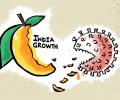
'The finance ministry's decision to accept the deficit target of 4.5 per cent in 2025-2026 appears to have emanated from its endorsement of the Finance Commission's view that the Indian economy will continue to remain impacted by the pandemic, adversely undermining its growth potential,' notes A K Bhattacharya.

China's economy, which suffered 6.8 per cent slump in the first quarter due to the coronavirus pandemic -- the worst in 44 years -- bounced back posting 4.9 per cent growth between July and September buoyed by the government's sweeping efforts to stimulate demand and consumption.

The business confidence index stood at 145.2 points in July-September quarter of 2011 as compared to 145.3 points reported over April-June period of this year, pointing to a continuation of cautious outlook on the economy in the short term, the latest NCAER-MasterCard Worldwide Index of Business Confidence said.
'Nations like India with high inflation and public debt should be cautious'

'We expect a pick-up in the second half of the current fiscal. But before that, data is likely to show a further slowdown. The second quarter print is likely to be worse than the first quarter,' said a senior official.

If the projections come true, then India would regain the tag of the fastest growing major economy of the world, crossing China with more than 0.7 percentage point in 2018 and an impressive 1.2 percentage point growth lead in 2019.

RBI Governor Shaktikanta Das and Finance Secretary Subhash Chandra Garg are also expected to attend the meetings.

"The challenge for many emerging and some developing economies (is) to ensure that present boom-like conditions do not develop into overheating over the coming year," the IMF said in its World economic Outlook report.

Adapting to the new hybrid normal of remote and office work, cautiously optimistic corporate are looking to hire more people and provide better appraisals in the new year as they step out of the pandemic-ravaged 2020. The coronavirus pandemic emerged as the biggest inflection point for the Indian job landscape. For the corporates, work-from-home and remote workers became the new normal and for the professionals, online learning and digital skills took centrestage.

"Now is the time for countries with room in their budgets to deploy -- or get ready to deploy -- fiscal firepower. In fact, low interest rates may give some policymakers additional money to spend," new IMF chief Kristalina Georgieva said.

In a global economic outlook, released Wednesday afternoon, the Paris-based grouping warned: "With inflation remaining elevated and the recovery appearing to have taken root, there is a risk that price increases for inputs will flow through to second-round increases and that inflationary expectations will become destabilised.
Bank stability and safety are still high on corporate and investor agendas, says a Global Finance study.
The International Monetary Fund expects India's economic growth rate to moderate to 7.5-7.75 per cent this fiscal, from 8.5 per cent in 2010-11, on account slowing investments and sluggish global recovery.

The global economy is projected to expand by 4.2 per cent this year, but rising oil and commodity prices and European debt crisis could hurt the overall recovery, according to Paris-based think-tank OECD.
India can raise funds through selling up to\n49 percent of its state-run firms, Montek Singh Ahluwalia, deputy chairman of the\nPlanning Commission, has said.

Order inflows during the quarter-ended September declined 31.5 per cent compared to the level a year ago. Companies are still not committing fresh capital expansion.
 © 2026 Rediff.com - Investor Information - Advertise with us - Disclaimer - Privacy Policy - Sitemap - Feedback - About us - Terms of use - Grievances