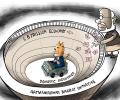
The Indian economy is on the path of a durable recovery on the back of conducive monetary and credit conditions, the global headwinds notwithstanding, said a Reserve Bank of India (RBI) article on the state of the economy. Domestically, there have been several positives on the COVID-19 front, in terms of reduced infections and faster vaccinations, the article published in the RBI Bulletin November 2021 added. The Indian economy, the article said, is clearly differentiating itself from the global situation, which is marred by supply disruptions, stubborn inflation and surges of infections in various parts of the world.

While most economies contracted in the second quarter of 2020, the Chinese economy grew by 3.2 per cent.

In its report, 'Global Economic Outlook: December 2011', the agency said the Indian economy is likely to regain the 8 per cent economic growth trajectory only in 2013-14.

Eighteen months after the economy was battered by the Covid-induced lockdown, employment has not recovered to its pre-pandemic levels, points out Mahesh Vyas.

Fitch Ratings has revised India's GDP growth estimate to 12.8 per cent for the fiscal year beginning April 1 from its previous estimate of 11 per cent, saying its recovery from the depths of the lockdown-induced recession has been swifter than expected. In its latest Global Economic Outlook (GEO), Fitch said revision is on the back of "a stronger carryover effect, a looser fiscal stance and better virus containment." "India's second half of 2020 rebound also took GDP back above its pre-pandemic level and we have revised up our 2021-2022 forecast to 12.8 per cent from 11.0 per cent," it said. "Nevertheless, we expect the level of Indian GDP to remain well below our pre-pandemic forecast trajectory."

Kotak Bank was the top loser in the Sensex pack, cracking around 6 per cent, followed by Hero MotoCorp, Bajaj Finance, Maruti and HDFC twins. On the other hand, HUL, HCL Tech, ITC and Nestle India were among the gainers.

However, the World Bank has projected India's GDP growth rate at 7.5 per cent for the next three financial years, including the current one.

The upward revision in growth forecast for current fiscal comes in the backdrop of GDP expanding 8.2 per cent in April-June quarter, higher than Fitch's expectation of 7.7 per cent.
The Reserve Bank of India on Wednesday retained the economic growth projection for the current financial year at 10.5 per cent, while cautioning that the recent surge in COVID-19 infections has created uncertainty over the economic growth recovery. In its last policy review, the RBI had projected a GDP growth rate of 10.5 pc for FY'22. Taking various factors into consideration, it said, "the projection of real GDP growth for 2021-22 is retained at 10.5 per cent consisting of 26.2 per cent in Q1, 8.3 per cent in Q2, 5.4 per cent in Q3 and 6.2 per cent in Q4."

The S&P BSE Sensex plunged 461 points to end at 25,603.

The Indian economy, severely hit by the coronavirus pandemic, is projected to contract by a massive 10.3 per cent this year, the International Monetary Fund said on Tuesday. However, India is likely to bounce back with an impressive 8.8 per cent growth rate in 2021, thus regaining the position of the fastest growing emerging economy, surpassing China's projected growth rate of 8.2 per cent, the IMF said in its latest 'World Economic Outlook' report.
The International Monetary Fund has reduced India's contribution to world gross domestic product in purchasing power parity terms to 4.6 per cent in 2007 from the earlier estimate of 6.4 per cent.

If New Delhi finds itself out in the cold in Afghanistan, both the Congress-led UPA and BJP-led NDA have only themselves to blame. Each has been in power for a full decade from 2001, without reaching out to the Taliban, points out Ajai Shukla.

There is so much liquidity in the system, in the global economy, and that's why the stock market is very buoyant. It will certainly witness correction in the future: RBI's Das.
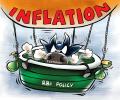
On food inflation, RBI said it is likely to soften from the high levels registered in December and the decline is expected to become more pronounced during the fourth quarter of this fiscal as onion prices ease following arrivals of late kharif and rabi harvests.
With a change in investor preference to cyclical stocks like those of capital goods, infrastructure and automobile firms, the defensives, especially the IT pack, have taken a back seat.

China's GDP jumped a record 18.3 per cent in the first quarter of 2021, riding on strong domestic and foreign demand and aided by recovery from a low base in early 2020 when Covid-19 stalled the world's second-largest economy, according to statistics released on Friday.

Top losers in the Sensex pack included IndusInd Bank, Bajaj Finance, Tata Motors, Tata Steel, Hero MotoCorp, Axis Bank, M&M, Vedanta and Maruti, falling up to 3.50 per cent.
Indian companies are likely to give more than 10 per cent pay hike to their top executives this year amid hopes of revival in economic growth and business prospects, says a study.
But worries mount over emerging markets and regulation

Other top losers in the Sensex pack included Bharti Airtel, Asian Paints, TCS, HCL Tech, Tata Steel, SBI, IndusInd Bank and Hero MotoCorp, declining up to 3.28 per cent.
The robust export performance, coupled with a compression of imports led by gold, has led to a substantial narrowing in the current account deficit to comfortable levels.
The time frame for this is difficult to specify and much depends on stability in the foreign exchange markets, Prime Minister's key economic advisor C Rangarajan said.
India's monetary policy continues to remain hawkish as RBI Governor Raghuram Rajan fights a lone battle to get the economy back on track while the government 'fails to walk the talk.
The patriotism of wealthy overseas Indians has helped the country avert economic crises in the past and it is little surprise that embattled policymakers are turning to them again to plug a record trade gap that is battering the rupee.

They say that a stimulus package may not be necessary because, unlike last year's total lockdown, public transport, including the railways and airlines, is running and the restrictions on movement are localised and, in some cases, are partial rather than total.

The government had on Wednesday issued a statement dismissing report of Moody's Analytics.
Let's take a look at how India and world's major economies will perform in the next four years.

The improving earnings and economic outlook has titled the scales back in favour of Indian equities this year, reports Pavan Burugula.
The IMF, in its latest World Economic Outlook report, also said India is among the economies that may require more tightening to address inflation pressure.
The IMF, in its latest World Economic Outlook report, also said India is among the economies that may require more tightening to address inflation pressure.
The Prime Minister's Economic Advisory Council has projected India's GDP growth at 5.3 per cent in 2013-14.

From the 30-share Sensex pack, 23 scrips declined in Wednesday's session, led by IndusInd Bank, Bajaj Finance, Tata Motors and Tata Steel which fell by up to 3.87 per cent.

Even as most manufacturers are still assessing the overall impact on their businesses, early projections suggest the market may grow at its lowest ever rate, in 2020.
Although the government has started phasing out the subsidy on diesel sale, it continues to supply kerosene and LPG cylinders at subsidised rates.
It now occupies Japan's position right below US and China.
Without accounting for refunds, however, the collection contracted 5.4 per cent, indicating muted economic activity as the Covid-19 pandemic and subsequent curbs paralysed most sectors.
Revising its economic outlook, International Monetary Fund (IMF) today marginally brought down India's growth rate projections to 5.6 per cent for this fiscal and 6.3 per cent for the next financial year.

India's factory output climbed 22.4 per cent in March, benefiting from the base effect of the lockdown-marred month a year back as well as a turnaround in the manufacturing sector, while retail inflation slipped to a three-month low of 4.29 per cent in April. The high positive annual growth in the index of industrial production (IIP) in March 2021 came on back of a contraction of (-)0.9 per cent and (-)3.4 per cent in January and February 2021 respectively, according to the data released by the National Statistical Office (NSO) on Wednesday. This turnaround was led by recovery in the mining, manufacturing and electricity sectors.
There is a significant risk that advanced economies could experience another downturn, said the World Economic Outlook report released on Thursday.
 © 2026 Rediff.com - Investor Information - Advertise with us - Disclaimer - Privacy Policy - Sitemap - Feedback - About us - Terms of use - Grievances