
Hindustan Unilever Ltd, India's largest personal care product maker, on Tuesday reported a better-than-expected increase in its September quarter net profit and revenues, signalling a revival of demand following the world's biggest lockdown.

'The numbers are null and void now. Look, we can give out projections now, but we know that a week later those numbers will also be irrelevant. So we need to wait,' a top government official said.

According to Business Roundtable's first quarter 2010 Economic Outlook Survey, CEOs of leading US firms anticipate increase in capital expenditure, sales and employment in the next six months.

Prime Minister Manmohan Singh will be briefed on the state of the economy and the growth outlook by his economic advisory council on Friday.

Projecting acceleration in India's GDP growth to 9% for FY 2011-012, Economic Advisory Council to Prime Minister seeks measure to address serious supply bottlenecks.

Finance Minister Pranab Mukherjee on Wednesday said Indian markets cannot remain immune to the Eurozone debt problems and will feel the impact if the $1 trillion bailout package by the European Union and the International Monetary Fund does not inspire confidence.

Tata Motors was the biggest loser in the Sensex pack, tumbling 2.47 per cent, followed by Reliance Industries (2.44 per cent), Maruti (1.84 per cent), SBI (1.76 per cent) and Bajaj Finance (1.23 per cent).

Investor sentiment got a boost after the IMF said India will see its growth picking up to 7.4 per cent in 2018-19 to regain the status of the world's fastest growing major economy.

Of the six-member rate-setting monetary policy committee, five members voted for a 25 bps cut while one by 40 bps, the RBI said.
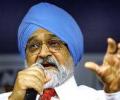
The Planning Commission on Thursday described the International Monetary Fund's growth projection of 8.8 per cent for India as optimistic and said the panel would stick to its outlook.

Multilateral lending agency Asian Development Bank said on Thursday it is likely to revise upwards by the September-end India's growth and inflation forecast, which is 8.2 per cent and 5 per cent respectively for the current fiscal.

IMF also asked countries around the world to coordinate policies to achieve a global rebalancing and sustain the recovery.

Advanced economies are projected to grow by just 2.7 per cent in 2010 and 2.2 per cent in 2011, the IMF report said.
As the world climbs out of the deepest recession in recent history, Asia is leading the global recovery.

India is expected to grow by 8.75 per cent in 2010 and 8.5 per cent in 2011, driven by a strong domestic demand, International Monetary Fund said in its 2010 World Economic Outlook released here on Wednesday.
It forecast a growth of 9 per cent for 2011-12.

The Prime Minister's Economic Advisory Council on Friday said the economy will grow by 8.5 per cent, up from a projected 8.2 per cent, and inflation will come down from double digits to 6.5 per cent by the end of 2010-11.
With emerging economies facing the possibility of "abrupt slowdowns", India's Gross Domestic Product growth rate could slip to as low as 4.3 per cent in 2009, said the OECD.

For the 2009-10 fiscal, Pranab said, he expects the economy to grow by 7.2 per cent.
With growing concerns over global economic growth and further cuts in earnings estimates, a recovery in markets is not expected before end-2009.
Global rating agency Fitch has revised upwards India's growth projection to 6 from 5 per cent for the current fiscal and said the recent election results should provide additional confidence and spur growth.

The Prime Minister's Economic Advisory Council, headed by former Reserve Bank Governor C Rangarajan, had said that it was unlikely that the GDP growth rate would be lower than 6.25 per cent for the current fiscal; buy might reach 6.75 per cent despite the adverse impact of monsoon on farm sector output.
Facing a layoff is fast becoming more and more a real prospect for many professionals. To keep your job, you need to work smart not and do whatever it takes to make sure you are crucial to your company.

The Prime Minister's Economic Advisory Council (PMEAC) expects the economy to grow by over 7.2 per cent during the current fiscal and exceed 8 per cent in 2010-11, thanks to increased economic activity.

International spot gold, which guides the domestic market, has continued its upwards trend in recent weeks. Bullion remains boosted by its safe haven status amidst the uncertain economic outlook.

According to Fitch rupee is expected to weaken to 72 to a dollar by the end of December 2019, and further to 73 by December 2020, from 69.82 to a dollar in end December 2018.
Most of the Asia-Pacific economies would be cushioned by healthy foreign exchange reserves in the last quarter of the current calendar year, global ratings agency, Standard & Poor, said in a report.

'It is becoming clear that we will no longer see declines in GDP growth for the next few quarters.'
The temporary disruptions (primarily to private consumption) caused by cash shortages accompanying the currency exchange initiative are expected to gradually dissipate in 2017 as cash shortages ease, the International Monetary Fund said in its regional economic outlook.

Asian economies have been very strong in their stimulus from both monetary and fiscal sources.

On an average, PMEAC said economic growth could be around 6.5 per cent.

The International Monetary Fund on Thursday retained its projection for Indian economic growth at 5.4 per cent in 2009, implying a slower growth in the second half of this calendar year.

The panel also said the decline in exports would slow down after 2010 when the developed economies would return to positive growth. India's exports are on a down slide since October 2008, because of the global slump in demand. In 2008-09, the country's overseas shipment grew by meagre 3.4 per cent to about $168 billion compared to the same period last year.

Globally, gold fell 0.2 per cent to $1,162.25 an ounce in Singapore.
The Shanghai Stock Exchange has registered maximum fall (56 per cent) from its peak, while the benchmark index of the Bombay Stock Exchange dipped by as much as 40 per cent and the Manila Stock Exchange dropped by 39 per cent, registering the third largest fall. The report added that 'having lost one fifth to one third of their value, equity assets would appear to have greater upside rather than down side prospects.

The Sensex posted its biggest single-day jump in over a decade at 1,921 points and investors' wealth soared by a staggering Rs 6.8 lakh crore after Finance Minister Nirmala Sitharaman delivered a surprise cut in corporate tax rates on Friday.
India will grow at around 8 per cent this year and next, but the principal risk to this projection stems from the demand-led inflation that "would occur if the total Pay Commission award for government employees were to be paid out immediately," the Paris-based Organisation for Economic Cooperation has warned.Besides, "quick action to write off small farmers' debt would also add substantially to demand," the OECD indicated in its latest Economic Outlook.

The government kept its nerve in the face of a massive shock. It chose not to resort to a massive fiscal stimulus. It focused instead on providing liquidity support and easing restrictions on movement in stages, observes T T Ram Mohan.

'India is nowhere near the peak of the infection given its large population of 1.3 billion'

Interestingly, in his entire remarks, Modi never once mentioned regional security, Ambassador M K Bhadrakumar points out.
 © 2026 Rediff.com - Investor Information - Advertise with us - Disclaimer - Privacy Policy - Sitemap - Feedback - About us - Terms of use - Grievances