
Key stock indices Sensex and Nifty declined over 1 per cent at close on Monday due to heavy selling in banking, auto and FMCG shares amid weak global market trends and continued foreign fund outflows. Reversing its previous session's gains, benchmark BSE Sensex tumbled 638.11 points or 1.11 per cent to settle at 56,788.81. During the day, it tanked 743.52 points or 1.29 per cent to 56,683.40. The broader NSE Nifty fell by 207 points or 1.21 per cent to end at 16,887.35 as 42 of its constituents declined.

Ahead of the Union Budget for 2023-24, Budget makers have welcomed the global consensus view that India will remain one of the bright spots in calendar year 2023. But there is some alarm over the grim global situation and how that might impact the Centre's projections and assessments for next financial year. The big global headwinds include a deep and sustained recession in the West, including India's biggest trading partners in North America and Europe, continuing volatility in commodity markets, and renewed Covid-19 fears, as lifting of strict curbs by China could potentially lead to a massive spread again.
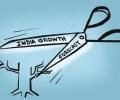
The International Monetary Fund (IMF) on Tuesday cut its projection of India's economic growth in 2022 to 6.8 per cent, as it joins other global agencies that have trimmed forecasts. The IMF had in July projected a gross domestic product (GDP) growth of 7.4 per cent for India in the fiscal year that started in April 2022. Even that forecast was lower than 8.2 per cent projected in January this year. India had grown at 8.7 per cent in 2021-22 fiscal (April 2021 to March 2022).

Benchmark indices continued their downtrend on Monday, with the Sensex falling 84.88 points, tracking selling in index majors Infosys and Reliance Industries along with weak global equities. The 30-share BSE benchmark went lower by 84.88 points or 0.15 per cent to settle at 56,975.99 after recovering some lost ground during the fag-end of trade. During the day, it tanked 648.25 points or 1.13 per cent to 56,412.62. The NSE Nifty declined 33.45 points or 0.20 per cent to close at 17,069.10.
Fitch Ratings on Thursday slashed India's GDP growth projection for FY23 to 7 per cent, saying the economy is expected to slow against the backdrop of global economy, elevated inflation and high interest rate. In June, it had forecast 7.8 per cent growth for India. "We expect the economy to slow given the global economic backdrop, elevated inflation and tighter monetary policy. "We now expect the economy to grow 7 per cent in the financial year to end-March 2023 (FY23) from 7.8 per cent previously, with FY24 also slowing to 6.7 per cent from 7.4 per cent before," Fitch said in its September edition of the Global Economic Outlook.

Silver, which is currently trading at Rs 68,453 per kilogram, has appreciated 21.7 per cent over the past three months. Investors, however, shouldn't get carried away by its recent performance and put their money in it. Instead, they should evaluate its pros and cons and then take a considered decision based on their risk appetite.

Retail investment demand for gold bars and coins as well as central bank purchases pushed the global gold demand by 28 per cent to 1,181.5 tonnes in the September quarter, according to the World Gold Council report. The total global demand stood at 921.9 tonnes during the July-September quarter of 2021, the World Gold Council's 'Gold Demand Trends Q3 2022' showed on Tuesday. Investment was down 47 per cent year-on-year as gold backed Exchange Traded Fund (ETF) investors responded to a challenging combination of higher interest rates and a strong US dollar with significant outflows of 227 tonnes.

'Given the worries about sluggish growth, rising interest rates and likely volatility, it's quite logical to infer that the SIP route could be the preferred way of investing.'

Eminent economist Arvind Panagariya has said India is on the cusp of returning to a high growth trajectory and voiced confidence that the country will become the world's third-largest economy by 2027-28. Currently, India is the fifth largest economy "so it's another five years.We are already in (the year) 2023. "So 2027-28, India should be the third-largest economy," Panagariya, Columbia University Professor and former Vice Chairman of NITI Aayog, told PTI in an interview in New York.

In an interview with the Financial Times following an assassination attempt this month, Khan said he no longer 'blamed' the US and wants a 'dignified' relationship if re-elected.

Consumer anxiety is at the highest levels since the outbreak of coronavirus pandemic in India with the less affluent most skeptical about economic outlook while a majority of consumers think their income in the next six months will be lower than the pre-COVID levels, says a latest study. As per the COVID-19 consumer sentiment research by global management consulting firm Boston Consulting group (BCG) conducted between May 23 and May 28, 2021, covering around 4,000 respondents across metros, tier I, II, III, IV and rural India, 51 per cent of consumers expected their spends over the next six months to be lower. In the last round of survey conducted from July 20 to August 2, 2020, the figure stood at 40 per cent.

India's growth projection released by the latest World Economic Outlook remains unchanged from its previous WEO (World Economic Outlook) update of July this summer but is a three-percentage point in 2021 and 1.6 percentage point drop from its April projections. According to the latest WEO update, released ahead of the annual meeting of the IMF and the World Bank, the world is expected to grow at 5.9 per cent in 2021 and 4.9 per cent in 2022.

Rating agency Fitch on Tuesday slashed India's growth forecast for the next fiscal to 8.5 per cent from 10.3 per cent, citing sharply high energy prices on account of the Russia-Ukraine war. With the Omicron wave subsiding quickly, containment measures have been scaled back, setting the stage for a pick-up in GDP growth momentum in the June quarter this year, the agency said. It has revised upwards the GDP growth forecast for the current fiscal by 0.6 percentage points to 8.7 per cent.

India has been relatively insulated from the severe headwinds in the West. However, with a third of the global economy expected to slip into recession in calendar year 2023, the impact will strongly be felt on India's exports and trade economy, leading economists said in a panel discussion at the Business Standard BFSI Insight Summit in Mumbai on Wednesday. The panel comprised former Reserve Bank of India executive director and former Monetary Policy Committee member Mridul Saggar, State Bank of India Chief Economic Advisor Soumya Kanti Ghosh, Citibank India Chief Economist Samiran Chakraborty, ICRA Chief Economist Aditi Nayar, and IndusInd Bank Chief Economist Gaurav Kapoor. The topic of the panel discussion was No recession in sight: Is India decoupled from developed economies?

The survey also shows a majority in favour of ousted leader Boris Johnson, with 55 per cent saying that Tory MPs were wrong to effectively force him to resign and 40 per cent saying they were right.
The Asian Development Bank on Wednesday revised down India's economic growth forecast for the current fiscal to 10 per cent, from 11 per cent predicted earlier, citing the adverse impact of the second wave of the pandemic. The growth forecast for India in fiscal year 2021 (ending in March 2022) was revised down, as the spike in COVID-19 cases during May dented the recovery, the Asian Development Bank (ADB) said in its latest economic outlook. "The outbreak, however, dissipated faster than anticipated, resulting in several states easing lockdown measures and returning to more normal travel patterns.

India's growth in the last three financial years has averaged just 1.9%. It is natural to project rapid growth from this low base. Crucial to that would be the assumption that the economy has suffered no lasting damage from the pandemic, observes T N Ninan.

The International Monetary Fund (IMF) said on Thursday that a multilateral response is critical to overcome the COVID-19 pandemic in India and globally as it hailed recent announcements by several countries to provide immediate support to India. India is struggling with a second wave of the pandemic with more than 300,000 daily new coronavirus cases being reported in the past few days, and hospitals are reeling under a shortage of medical oxygen and beds.

Amid China's economic slowdown, the country's economic challenges may increase manifold and its economy may be hit harder in the wake of the Ukraine-Russia crisis.

The second wave of COVID-19 may have a more lasting damage on the Indian economy and exports will once again be the foundation for recovery, Moody's Analytics said on Monday. In its report titled 'APAC Economic Outlook: The Delta Roadblock', Moody's Analytics said social distancing is weighing on the current quarter, but economic recovery will resume by the year-end. The Delta variant of COVID-19 is among factors now adversely affecting economies of the Asia-Pacific (APAC) region, but the economic hit from the current round of movement restrictions in the region will not be as severe as the recessions in the second quarter of last year.

Pakistan was "drowning" in debt and it was the new government's job to "sail this ship ashore," Prime Minister Shehbaz Sharif said on Wednesday.

'If you look at the order books of capital equipment companies or money deployed on the ground, there is forward movement in terms of actual investment by the private sector.'

The IMF on Tuesday projected an impressive 12.5 per cent growth rate for India in 2021, stronger than that of China, the only major economy to have a positive growth rate last year during the COVID-19 pandemic. The Washington-based global financial institution, in its annual World Economic Outlook ahead of the annual Spring meeting with the World Bank, said the Indian economy is expected to grow by 6.9 per cent in 2022. Notably in 2020, India's economy contracted by a record eight per cent, the International Monetary Fund (IMF) said as it projected an impressive 12.5 per cent growth rate for the country in 2021.

'We actually have a problem because there may be too much activity in India.' 'Markets don't like too much concentration. But we are very happy with our collaborations in India.'

Benchmark stock indices Sensex and Nifty tumbled nearly 1 per cent on Wednesday due to profit booking in banking, financial and IT stocks after a recent rally. The 30-share BSE Sensex plunged 537.22 points or 0.94 per cent to end at 56,819.39 as 24 of its stocks declined. During the day, it tanked 772.57 points or 1.34 per cent to touch a low of 56,584.04. The broader NSE Nifty declined by 162.40 points or 0.94 per cent to 17,038.40 with 39 of its constituents ending in the red. Bajaj Finance was the biggest loser among Sensex stocks, dropping by 7.24 per cent.

Gandhi took a swipe at the government on Twitter by tagging a chart that showed IMF growth projections for 2020-21 for Bangladesh, Myanmar, Nepal, China, Bhutan, Pakistan, Sri Lanka, Afghanistan and India.

India's economic growth has slowed to a three-year low of 5.3 per cent in the April-June quarter of the current fiscal.
The International Monetary Fund (IMF), in its latest World Economic Outlook report, has slashed its forecast for India's FY23 gross domestic product growth to 8.2 per cent from 9 per cent, saying that higher commodity prices will weigh on private consumption and investment. This was one of the steepest cuts for emerging economies compared to the IMF's January WEO forecasts. Saying that global economic prospects have worsened significantly due to commodity price volatility and disruption of supply chains caused by the war in Europe, IMF cut its global growth outlook for calendar year 2022 to 3.6 per cent from 4.4 per cent, and said both Russia and Ukraine could experience large GDP contractions.

M&M was the top gainer in the Sensex pack, rallying over 5 per cent, followed by Bajaj Finance, HDFC Bank, ICICI Bank, Bharti Airtel and Hero MotoCorp. NSE Nifty rose 65.30 points, or 0.71 per cent, to finish at 9,270.90.

Gita Gopinath, the IMF's Indian-American chief economist has been promoted as its First Deputy Managing Director recognising her exceptional intellectual leadership in helping the global economy and the Fund to navigate the "twists and turns" of the "worst economic crisis of our lives". Gopinath would replace Geoffrey Okamoto who plans to leave the International Monetary Fund early next year, Kristalina Georgieva, IMF's managing director announced on Thursday. Gopinath, who was scheduled to return to her academic position at Harvard University in January 2022, has decided to stay, she said. Gopinath, 49, has served as the first female chief economist of the Washington-based global lender for three years.
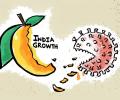
The Asian Development Bank has downgraded India's economic growth forecast for the current financial year to 10 per cent on Tuesday, from 11 per cent projected in April, on account of the adverse impact of the coronavirus pandemic. India's GDP growth recovered to 1.6 per cent in the last quarter of fiscal year ended March 2021, narrowing contraction in the whole fiscal year from 8 per cent estimated in April to a revised 7.3 per cent, the multilateral funding agency said in the Asian Development Outlook (ADO) Supplement. "Then a second wave of the pandemic induced many state governments to impose strict containment measures.

India's manufacturing sector activity witnessed a significant loss of growth momentum in May due to the intensification of the COVID-19 crisis and its detrimental impact on demand, a monthly survey said on Tuesday. The seasonally adjusted IHS Markit India Manufacturing Purchasing Managers' Index (PMI), fell to 50.8 in May, down from 55.5 in April, as companies observed the slowest rises in new work and output in ten months amid intensification of the COVID-19 crisis. In PMI parlance, a print above 50 means expansion while a score below 50 denotes contraction.
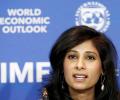
The IMF on Tuesday cut India's economic growth forecast by 0.5 percentage points to 9 per cent for the current fiscal year, with its chief economist Gita Gopinath saying that the slight downgrade is mainly due to the impact of the spread of the Omicron variant. "If you look at the 2021-22 fiscal year, we have a slight downgrade of -0.5 percentage points and for the next fiscal year 2022-23 we have a slight upgrade of 0.5 percentage points. So, growth for the previous fiscal year is now nine per cent and for this year now is at nine per cent. We moved it up slightly," Gopinath told reporters during a news conference in Washington. In its latest update of World Economic Outlook on Tuesday, the International Monetary Fund has cut India's economic growth forecast to 9 per cent for the current fiscal year ending March 31, joining a host of agencies which have downgraded their projections on concerns over the impact of the spread of Omicron on business activity and mobility.

The Adani group has the maximum number of companies in the trillion club at five, followed by the Tata group (four).

Retail inflation slowed to 4.29 per cent in April from 5.52 per cent in March, mainly due to easing food prices, government data showed on Wednesday. The Reserve Bank mainly factors in the retail inflation based on Consumer Price Index (CPI) while arriving at its monetary policy. As per the data released by Ministry of Statistics and Programme Implementation, inflation in the food basket was 2.02 per cent in April, down from 4.87 per cent in the preceding month.

Maintaining a rapid pace of the vaccination drive and quickly bridging healthcare infrastructure gaps across both urban and rural areas would emerge as the most sustainable stimulus for durable recovery of the Indian economy, says a report by the department of economic affairs.
The International Monetary Fund (IMF) on Tuesday cut its economic growth forecast for India to 9.5 per cent for the fiscal year to March 31, 2022 as the onset of a severe second COVID-19 wave cut into recovery momentum. This forecast for 2021-22 is lower than the 12.5 per cent growth in GDP that IMF had projected in April before the second wave took a grip. For 2022-23, IMF expects economic growth of 8.5 per cent, larger than the 6.9 per cent it had projected in April.

The country's gross domestic product (GDP) growth is likely to be 8.8 to 9 per cent in the current financial year, driven by agriculture and industry sectors, Care Ratings said in a report. The country's economy had contracted by 7.3 per cent in fiscal 2020-21. The agency said the outlook for the Indian economy on almost all counts in FY22 would look seemingly better than FY21 on account of the negative base effect.

HDFC was the top loser in the Sensex pack, shedding over 2 per cent, followed by Axis Bank, Bharti Airtel, M&M, Reliance Industries, ICICI Bank, IndusInd Bank and Titan.
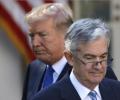
In a drastic measure to stem any major disruption to the US economy as a result of the coronavirus outbreak, the Federal Reserve has cut its benchmark interest rate to almost zero and said it would buy USD700 billion in bonds. The covid-19 pandemic has sickened more than 156,000 people worldwide and left more than 5,800 dead. The death toll in the US stands at 68, while infections neared 3,700.
 © 2026 Rediff.com - Investor Information - Advertise with us - Disclaimer - Privacy Policy - Sitemap - Feedback - About us - Terms of use - Grievances