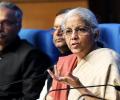
'The voice which came wherever I travelled was that we are proud taxpayers. We are honest taxpayers. We want to continue to serve the country by being good taxpayers.' 'But what do you think about the kind of things you can do for us?'

'Spend, but create assets, spend but make sure that people benefit from it.' 'This has been a beautiful guiding principle. And I think as a finance minister I owe so much to the prime minister for keeping this path clear before us.'


Direct tax collections fell Rs 12,000 crore (Rs 120 billion) short of the Rs 3.87 trillion target last fiscal, largely owing to lower realisation from corporate tax payers.
The government on Monday promised to come out with a framework for the Direct Taxes Code that will simplify tax structure within 45 days.

The draft direct tax code that will lead to overhaul of the Income Tax Act, has created uncertainty among the developers and units in the special economic zones over continuation of the tax sops.

Anticipating an adverse impact in view of a bad monsoon, Finance Minister Pranab Mukherjee on Tuesday set an ambitious direct tax collection target for the current fiscal, revising it upward to Rs 4 lakh crore, up Rs 30,000 crore (Rs 300 billion) over the Budget estimates.
The Income Tax department on Monday invited public inputs for review of the six-decade old I-T Act with regard to simplification of language, litigation reduction, compliance reduction, and obsolete provisions. Pursuant to the Budget announcement by Finance Minister Nirmala Sitharaman for a comprehensive review of the Income-tax Act, 1961, the Central Board of Direct Taxes (CBDT) had set up an internal committee to oversee the review and make the Act concise, clear, and easy to understand, which will reduce disputes, litigation, and provide greater tax certainty to taxpayers.
Finance Minister P Chidambaram on Monday said he is reviewing the Direct Taxes Code (DTC) Bill and it will be introduced in Parliament after taking into account the recommendations of the Parliamentary panel.

As on April 1, income tax arrears have increased to Rs 43 trillion from Rs 24 trillion on April 1, 2023.

The total direct tax collection stands at a little over Rs 9 trillion, giving the taxman just few days to reach the 2018-19 revised target of Rs 12 trillion., reports Shrimi Choudhary.

The income tax department has allowed tax officials to either waive or reduce interest payable by a taxpayer, subject to specified conditions. Under the Income Tax Act Section 220 (2A), if a taxpayer fails to pay the tax amount specified in any demand notice, he/she is liable to pay interest at 1 per cent per month for the period of delay in making the payment. The Act also empowers Principal Chief Commissioner (PrCCIT) or Chief Commissioner (CCIT) or Principal Commissioner (PrCIT) or Commissioner rank officers to reduce or waive the amount interest due to be paid.
With drought forcing the government to increase its spending, corporations and salaried individuals can expect a tougher tax regime, with Finance Minister Pranab Mukherjee revising this fiscal's direct tax collection target to Rs 4,00,000 crore from Rs 3,70,000 crore mentioned in the Budget last month.

The income tax department estimates total collection to be between Rs 10.5 trillion and Rs 10.7 trillion against the revised target of Rs 11.7 trillion.

The reduced growth is largely because of consumption slowdown and tax rate cuts.

Corporate income tax collections grew 24 per cent to Rs. 2,23,612 crore (Rs. 2,236.12 billion), up from Rs. 1,80,318 crore (Rs. 1,803.18 billion) in the first 11 months last year.

A senior official in the finance ministry said the Central Board of Direct Taxes addressed the nine areas of concern in the Code identified by Finance Minister Pranab Mukherjee.

"We are trying to bring the new taxation regime, which can last for another 50 years. Therefore, our endeavour is to see that new taxation system should include the basic features and time tested procedures of existing act, which have survived judicial security over the years."

The government will introduce the Direct Taxes Code by April 2011 after examining thoroughly seven proposals such as taxing savings schemes and clamping the Minimum Alternate Tax (MAT) on gross assets that have not found favour with the industry, trade and people at large.

Direct tax collections shot up by 13.91 per cent to Rs 1,00,112 crore ( Rs 1,001.12 billion) in the first five months of the 2010-11 financial year till August, the Finance Ministry said on Monday.

The Direct Taxes Code is being mooted as a replacement to the Income Tax Act 1961. What is the idea behind replacing something that has been around for close to 50 years and what is the strategy behind the exercise?
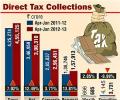
It's less than the budgeted target of 15 per cent.
Though the Planning Commission favours imposition of a direct tax on Special Economic Zones (SEZs), it does not agree with the contention that these tax-free industrial enclaves are leading to revenue loss.
Central Board of Direct Taxes officials claim the figure has surpassed indirect taxes for the first time.
Obsessed with spending, the UPA has ignored the vital task of expanding the direct tax net.

Following the demonetisation move, the recast in direct tax moves is expected to give a boost the economy.

If growth reverts to the pre-Covid level, a lot of people may have to temper their rosy optimism, points out Debashis Basu.
The Direct Taxes Code Bill, introduced in Parliament on August 30 last year, proposes to replace the 50-year-old Income Tax Act.
The direct tax collections surged by 22 per cent to Rs 63,026 crore (Rs 630.26 billion) till December 22, mainly on the back of industrial upturn and better corporate results.

The government had last fiscal exceeded the direct tax collection target set in the Budget.

While experts pointed out the impact of corporation tax cuts cannot yet figure in collections as most companies are yet to decide on their choice, government officials said a part reason for slow collection is the tax cut.

CBDT asks for urgent action, especially with respect to recovery of arrears and current demand, to achieve the collection target.
Mumbai leads the list of cities with highest tax collections, say the tax figures of the first nine months of this fiscal.
The 48-year-old Indian Income Tax Act is set to be replaced by a new Direct Tax Code from April 1, 2011.

Direct tax realisation, however, is likely to fall short of the enhanced target of Rs 3.87 lakh crore (Rs 3.87 trillion), mentioned in the revised estimate for 2009-10.

Personal income tax, corporate tax, wealth tax, were all up. Securities Transaction Tax collection declined by 12.46 per cent.
As on November 15, the government kitty swelled by 42.9 per cent at Rs 1,40,373 crore (Rs 1.40 trillion) against Rs 98,216 crore (Rs 98.21 billion) in the corresponding period last year. With this, net direct tax collections till November 15 stood at 52 per cent of the budgeted target of Rs 2,67,490 crore for this fiscal.
 © 2026 Rediff.com - Advertise with us - Disclaimer - Privacy Policy - Sitemap - Feedback - About us - Terms of use - Grievances