
India will test fire its long-range surface-to-surface missile, Agni-III, by the year end and has started induction of the Agni-I and Agni-II versions in a newly raised strategic command, Dr M Natrajan, scientist claimed on Tuesday.

With increase in range and payload capability, Madhavan said the new variant will be much superior than Tejas Mark-IA, 73 of which are being procured by the Indian Air Force from the HAL under a Rs 48,000 crore deal that was approved by the government on January 13.
Lakshya is the indigenously developed Pilotless Target Aircraft.

India on Friday successfully test-fired its indigenously-developed nuclear-capable Prithvi-II and Dhanush ballistic missiles in separate trials, boosting the armed forces' operational readiness.
With a range of 25km, Akash is one of the five missiles currently under development by the Defence Research and Development Organisation.

The Indian Army will showcase the main battle tank T-90 Bhishma, infantry combat vehicle BMP-II-Sarath, mobile autonomous launcher of the Brahmos missile system, multi-launcher rocket system Pinaka, electronic warfare system Samvijay among others during the parade on Tuesday, the Defence ministry noted.
The 290km range missile is capable of carrying both conventional and nuclear warheads.
The missile was aimed at a moving object, sources said.
Akash was aimed at a target attached to Lakshya, the pilotless target aircraft.
The sophisticated multi-target missile was test fired from a mobile launcher at about 1230 IST.

Air Chief Marshal Bhadauria said the recent induction of Rafale jets along with previous acquisitions of C-17 Globemaster aircraft as well as Chinook and Apache helicopters have provided the IAF with substantial tactical and strategic capability enhancement.
The supersonic anti-ship cruise missile was jointly developed by India and Russia.

HAL is also integrating the Advanced Short Range Air-to-Air Missile onto the Mark 1A. Each Tejas will carry two of these missiles.
The indigenously built multi-target missile has a range of 25km and is one of the five missiles under various stages of development by the DRDO.
Astra is an indigenously developed air-to-air missile.
India's Tryst with the Atom: Unfolding the Nuclear Story by O P Sabherwal reveals details hitherto unknown about India's nuclear programme.
DRDO scientists, who conducted the test, described it as a user's trial.
Chief Controller (R&D) Dr W Selvamurthy told reporters in Bangalore that about 10 people from the US have been joining DRDO each year and the trend is growing.
The missile, weighing 650kg, can carry a 50kg payload over a distance of 25km.
The indigenously built multi-target missile can carry a 50kg payload.

Besides strengthening the IMD's infrastructure, Mohapatra said his priority will be to improve the dissemination of weather-related information -- from nowcasts to weather forecasts -- focus on sector-related forecast and give impact-based prediction in all areas.

The missile successfully flew in its pre-set trajectory meeting its mission objectives
The sleek 3.8 metre high missile has a striking range of 25 to 40 km.

Describing the trial as a "complete success", they said all mission objectives were met during the test-fire. All radars, tracking systems and range stations tracked and monitored the flight performance of the missile, which was launched with support of a mobile launcher.
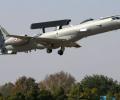
The AEWS&CS was developed by the Centre for Airborne Systems, a laboratory under the Defence Research and Development Organisation headed by woman scientist J Manjula.
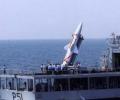
India on Thursday successfully test-fired its nuclear-capable Dhanush ballistic missile with a strike range of 350 km
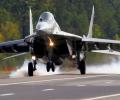
The procurement will come at a cost of Rs 38,900 crore.

'Let's get a woman to be the antagonist, who really throws me around and hammers the s**t out of me. That would be fun.'

Even as Chinese troops continue squatting on territory that we claim as our own -- this was the lowest allocation for defence in percentage terms since the 1950s, reveals Ajai Shukla.

In his address at the 41st Defence Research and Development Organisation Directors Conference, he also said the development of weaponry and other systems should be done keeping "future warfare" in mind.

Thursday will be former President APJ Abdul Kalam's second death anniversary.

The HSTDV is an unmanned scramjet demonstration aircraft for hypersonic speed flight, it can cruise at a speed of mach 6 and move up to an altitude of 32.5 km (20 miles) in 20 seconds, the sources said.

Designed to be a quick reaction missile, it has a strike range of 25 km to 30 km.

The missile has a strike range of more than 2,000 km.

Commercial launch and supply to major government and private hospitals is expected in mid-June.
 © 2026 Rediff.com - Investor Information - Advertise with us - Disclaimer - Privacy Policy - Sitemap - Feedback - About us - Terms of use - Grievances