
The new world order that has emerged from the recession of 2008 is very complex, interconnected and unpredictable.
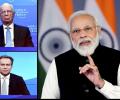
Several Congress leaders and social media users claimed that it was a 'teleprompter gaffe' as Prime Minister Modi had to pause and then restart his special address to the World Economic Forum's online Davos Agenda 2022 summit, but BJP leaders and many others pointed out that it was a technical glitch due to which the WEF people were not able to patch the PM and requested him to start again.

The WEF said its annual meeting is taking place at a time when multiple crises have deepened divisions and fragmented the geopolitical landscape.

Citing India's commitment to deep economic reforms and ease of doing business, Prime Minister Narendra Modi asserted on Monday that this is the best time to invest in the country as policy-making is focussed on the needs for the next 25 years for a 'clean and green' as well as 'sustainable and reliable' growth period. In his special address to the World Economic Forum's online Davos Agenda 2022 summit, Modi underlined a host of reform measures undertaken by his government to stress that it has worked to reduce the administration's interference in business by deregulating many sectors and to clear the way for free trade agreements with different countries. India was once associated with "license raaj", he noted and highlighted the measures, including reduction of corporate tax to boost business and doing away with over 25,000 compliance requirements.

The accelerating pace of digitalisation, fuelled by the COVID-19 pandemic, has led to a record-breaking year for cybercrime with ransomware attacks rising 151 per cent in 2021, and an average of 270 cyberattacks per organisation being faced, a new study showed on Tuesday. The World Economic Forum's 'Global Cybersecurity Outlook 2022', released during its online Davos Agenda summit, further said that each successful cyber breach cost a company $3.6 million (nearly Rs 27 crore) last year, while the average share price of the hacked company underperformed NASDAQ by nearly 3 per cent even six months after the event in case of the breach becoming public. The WEF said the global digital economy surged on the back of the COVID-19 pandemic, but so has cybercrime and nearly 80 per cent of cyber leaders now consider ransomware a 'danger' and 'threat' to public safety.

Accelerating inequality, the market dominance of tech platforms and remote working are likely to be the longest-lasting legacies of the COVID-19 crisis, the WEF said in a report on Monday. Releasing its Chief Economists Outlook report during the online Davos Agenda Summit, the WEF said that beyond managing the pandemic and vaccine rollout, these trends could shape a new era of fiscal, monetary, and competition policy. Deglobalisation is seen as the least likely of the current trends to continue in the longer term; particularly as international coordination is key to resolving global challenges such as vaccine manufacturing and distribution.

Indian billionaires saw their combined fortunes more than double during the COVID-19 pandemic, and their count shot up by 39 per cent to 142, while the wealth of the ten richest is enough to fund school and higher education of children in the country for 25 years, a new study showed on Monday. In its annual inequality survey released on the first day of the World Economic Forum's online Davos Agenda summit, Oxfam India further said that an additional one per cent tax on the richest 10 per cent can provide the country with nearly 17.7 lakh extra oxygen cylinders, while a similar wealth tax on the 98 richest billionaire families would finance Ayushman Bharat, the world's largest health insurance scheme, for more than seven years. The COVID-19 pandemic saw a huge rush for oxygen cylinders and insurance claims during the second wave last year.

Asserting that the self reliant India programme will help revive the global economy, Prime Minister Narendra Modi on Thursday told global business community that his government aims to transform the country through access, inclusion and empowerment while also ensuring complete data security. Addressing the World Economic Forum's online Davos Agenda Summit, where he also interacted with global business leaders, Modi also said India offers a predictable and friendly environment from tax regime to FDI norms. He said Aatmanirbhar Bharat movement is committed to global good and global supply chain while the country's digital profile has been completely transformed.

'From March 2020 to November 2021, the combined wealth of the billionaires of this country has doubled.'

India will soon make available many more COVID-19 vaccines to other countries after two Made-In-India jabs have already been introduced to the world, Prime Minister Narendra Modi said on Thursday while emphasising the country's global responsibility in fighting the pandemic.
 © 2026 Rediff.com - Investor Information - Advertise with us - Disclaimer - Privacy Policy - Sitemap - Feedback - About us - Terms of use - Grievances