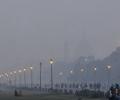
Pollution levels in Delhi during the Diwali period are likely to remain in the higher end of the 'very poor' category in the absence of emissions due to fireworks, the Ministry of Earth Sciences' air quality monitor, SAFAR said.
The National Green Tribunal has directed the Ministry of Jal Shakti to hold a meeting within a month to consider the issue of regulating extraction of ground water for maintenance of play grounds.

Skies over Delhi hung heavy with smoke and its air quality inched towards "severe" category on Diwali night as people burst firecrackers in a blatant disregard to the government's ban against it, imposed amid an increase in the contribution from farm fires.

According to the Central Pollution Control Board (CPCB), the 24-hour average concentration of lung-damaging fine particles known as PM2.5 in Delhi-NCR shot up from 243 micrograms per cubic metre at 6 pm on Thursday (Diwali day) to 410 micrograms per cubic metre at 9 am on Friday, around seven times the safe limit of 60 micrograms per cubic metre.

Under the emergency plan, stringent actions are implemented based on the air quality of the city.

The spurt in pollutants was caused by a combination of meteorological factors including a drop in temperature, wind speed and mixing height, a layer where air and particulates float, the Central Pollution Control Board said.

Welcoming the reduction in pollution, environmentalists urged the government to treat it as a "wake-up call" and stop its "obsession" with "development" at the cost of the environment.

The central government's Air Quality Early Warning System for Delhi said a "significant improvement in air quality is not likely" owing to slow wind speed, particularly during night time, and contribution from farm fires.

Delhi's overall air quality index (AQI) stood at 463 at 11.30 am, according to the System of Air Quality and Weather Forecasting and Research (SAFAR).

The PM2.5 level (presence in the air of particles with a diametre of less than 2.5 micrometres) touched a new high at 158 as authorities predicted further deterioration of air quality in the coming days.

The air quality in Delhi remained poor Sunday with drop in wind speed even as authorities predicted further fall in air quality index of the national capital in the coming days.

The pollution board said that the situation will improve further by Sunday if favourable conditions prevail.
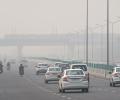
The neighbouring cities of Faridabad (469), Greater Noida (464), Ghaziabad (470), Gurgaon (472) also recorded 'severe' air pollution levels.

The nationwide 'Janta Curfew' followed by the 21-day lockdown to combat the coronavirus outbreak have led to a significant reduction in pollution in the country, with 91 cities recording air quality in the 'good' and 'satisfactory' category on March 29, a Central Pollution Control Board report has stated. Travel restrictions and the closure of industries have helped reduce the pollution level, it said.
Violation of the provisions entails a punishment of a jail term up to five years or with fine up to Rs 1 crore or with both, the ordinance released by the Ministry of Law and Justice on Thursday said.

The non-viability of green crackers may pave the way for e-crackers.

It is believed that the crop residue burning in the nearby states of Punjab and Haryana are contributing to polluting the air.

A bench headed by NGT chairperson Justice Adarsh Kumar Goel directed the carmaker to deposit the amount within two months.

Water is drawn for agriculture, industry and cities, but only waste is returned to the river.

The central government's Air Quality Early Warning System for Delhi said a significant increase in the number of "fire points" was observed over Punjab (around 3,000), Haryana and Uttar Pradesh on Wednesday, which is likely to impact the air quality of Delhi-NCR and other parts of northwest India.

The air quality had turned 'severe' on Saturday evening with stubble burning accounting for 32 per cent of Delhi's PM2.5 pollution, but firecracker emissions and calm winds made the situation even worse.

The smog reduced the visibility to merely 300 meters in the morning affecting traffic, an official of the India Meteorological Department said.

Experts said unfavourable meteorological conditions -- calm winds and low temperatures -- and smoke from farm fires in neighbouring states led to a dense layer of haze as the air quality index entered the "severe" zone.

The overall Air Quality Index was recorded at 231 on Sunday which falls in 'poor' category.

Can Modi enthuse BJP workers to pursue the end of single-use plastic with the same vigour and enthusiasm as they celebrated the attack on a neighbour, asks Aditi Phadnis.

Responding to a question on the issue of felling trees in Mumbai's Aarey forest, in which the Supreme Court has restrained authorities from cutting anymore trees, Javadekar told the reporters that he would not like to comment on a sub judice matter.

The dip in the air quality can be attributed to low wind speed and temperatures which allowed accumulation of pollutants.
A central team on Monday began a probe into allegations that a radioactive contaminated United States ship has been anchored at the Alang coast in Gujarat, even as non-governmental organisations demanded a probe by the Central Bureau of Investigation into the matter.The three-member team comprising an official each from the Central Pollution Control Board, the Steel Ministry and the Atomic Energy Regulatory Board will submit its report by the end of the week.

Delhi recorded an air quality index of 315 at 11:10 am. The last time the air quality hit such a poor level was in February.

Doctors have declared the situation as a 'public health emergency', while the government has taken a series of measures in view of high pollution levels.

'If 20,000 people in the stands did not have problem and the Indian team did not face any issue, I wonder why Sri Lankan team made a big fuss. I will need to talk to the secretary and ask him to write to the Sri Lanka Cricket'
According to a survey carried out by the Central Pollution Control Board (CPCB), the accepted set value for crackers is 124 decibels at a distance of four m from the point of detonation, but 95 per cent of crackers breach this noise and pollution standard.

The overall air quality index was recorded at 426 which falls in the 'severe' category, according to data by the Central Pollution Control Board.

The national capital stood sixth in terms of air pollution in January, with cities like Muzzaffarpur in Bihar and Varanasi showing worse air qualities.
The government asserted that the Central Pollution Control Board will inspect the ship

A bench of Justices Arun Mishra and Deepak Gupta also directed the Delhi government and the Central Pollution Control Board to place before it the data of pollution in Delhi from October till November 14 this year. The bench also directed them to submit pollution data from October 1 to December 31, 2018.

The dramatic reversal in the situation caught people and weather scientists unaware.

However, the company has claimed its vehicles are 'compliant' with the country's emission norms and that it will 'challenge' the tribunal's order.

The eight areas that recorded 'severe' air quality Saturday are Anand Vihar, Dwarka Sector 8, Narela, Punjabi Bagh, Bawana, Mundaka, Vivek Vihar and Rohini.
NHRC issues notices to Centre and governments of Delhi, Punjab and Haryana, saying 'the state cannot leave its citizens to die due to the toxic haze.'
 © 2026 Rediff.com - Advertise with us - Disclaimer - Privacy Policy - Sitemap - Feedback - About us - Terms of use - Grievances