
It was 10.56 per cent in December.

Former finance minister P Chidambaram on Friday rejected Finance Minister Arun Jaitley's contention in Lok Sabha that UPA government left behind double digit inflation.

The retail inflation rate breached the 6 per cent upper tolerance limit of the RBI for the first time in seven months in January, while the wholesale price index stayed in double-digits for the 10th month in a row, showed two sets of data released by the government on Monday. Retail inflation, the key input for the RBI while reviewing the repo rate every two months, soared during the month mainly because of a spike in certain food items. The previous high for retail inflation was 6.26 per cent in June 2021.

Retail inflation, based on Consumer Price Index, was at 10.36 per cent in May.

Driven by rising prices of food items such as sugar, pulses and vegetables as well as clothing, retail inflation moved closer to the double digit mark.

The overall market breadth remained firm as 1,673 stocks are advancing while 1,303 are declining.
Food prices for consumers rose an annual 10.65 per cent in May, slightly faster than an annual rise of 10.61 per cent in April.
This breathes in a sense of relief for the Indian economy already reeling under low growth rate, depreciation of rupee and slowing down of industrial production.

Retail inflation in March inched up to 8.31 per cent from 8.03 in February, mainly on account of a rise in fruit and vegetable prices.

RBI may go for a 25-basis point cut at its February policy meet.

Retail inflation declined marginally to 9.86 per cent in July due to lower prices of spices, cereals and its products although prices of vegetables remained high during the month.

It was higher than 3.2 per cent rate registered in February, the lowest pace recorded in 20 months, state run Xinhua reported.

'The robust tax collections give the finance minister a fair amount of headroom for an expansionary fiscal policy.'

Retail inflation moved up marginally to 10.36 per cent in May on account of increase in prices of vegetables, edible oils and milk.

The government has revised the wages for unskilled manual workers under the national rural employment guarantee scheme by indexing it to inflation, Rural Development Minister Vilasrao Deshmukh said.
The figure was arrived based on a comparison with the annual all-India CPI index average for the whole of 2010.

'Gold could benefit from the resulting risk aversion, as happened last year.'

Retail inflation, based on the Consumer Price Index, was 8.83 per cent in February, as per the government data release in New Delhi on Wednesday.

Overall retail inflation in rural and urban areas stood at 7.38 per cent and 8.25 per cent in January, respectively.

On overall basis, the inflation in the food segment increased to 4.42 per cent in November as compared to 1.9 per cent in the preceding month.
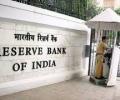
CLSA says government actions to facilitate investment more important for revival than a token monetary easing.

The CPI, based on retail prices, stood at 113.9 points in December compared to 114.4 points in November, as per data released by the government on Wednesday.

There could possibly be some reduction in home/auto loan outgo.
In the urban areas, the CPI rose to 10.19 per cent during the month as compared to 10.10 per cent in July.

According to the global financial services major, the Consumer Price Index based inflation is peaking off and is expected to be around 7.5-8 per cent in September.

To curb soaring inflation, the People's Bank of China, the country's central bank, has raised the benchmark interest rate three times this year.

Falling food prices notwithstanding, consumer inflation will remain high during the current fiscal because of high cost of housing and services as well as the increasing inflationary pressures from smaller cities, Goldman Sachs said in a report on Tuesday.

Treat silver as part of the procyclical or growth assets in your portfolio, advises Sanjay Kumar Singh.
FMCG: Cut in excise duty on baby, clinical diapers, adult diapers and sanitary napkins.

The Reserve Bank's rate-setting panel, Monetary Policy Committee (MPC), began its three-day deliberations on Wednesday amid expectations of a status quo on benchmark rate mainly on account of uncertainty over the impact of the second wave of COVID-19 pandemic. Moreover, the fears of firming inflation may also refrain the MPC from tinkering with the interest rate in its bi-monthly monetary policy outcome to be announced on Friday. The RBI had kept key interest rates unchanged at the last MPC meeting held in April.
The forthcoming Budget is likely to make a provision of Rs 64,000 crore (Rs 640 billion) for the Mahatma Gandhi National Rural Employment Guarantee Scheme in 2011-12, against Rs 40,100 crore (Rs 401 billion) in the current fiscal.

The DA hike will take effect from July 1.
An appropriate policy response always warrants a correct diagnosis of the problem. That is why the recent trend in inflation and its causes, and the inflation outlook take on exceptional importance ahead of the RBI's policy review on January 25.

Industrial production re-entered the negative territory by contracting 1.6 per cent in January, mainly on account of the decline in output of capital goods, manufacturing and mining sectors. The output of the manufacturing sector -- which constitutes 77.6 per cent of the Index of Industrial Production (IIP) -- shrank by 2 per cent in January, as against a growth of 1.8 per cent during the same month last fiscal, as per data released by the government on Friday. The worst performance was witnessed by the capital goods sector, which recorded a contraction of 9.6 per cent during the month under review, compared to a 4.4 per cent decline a year ago.

According to the global financial services major, inflation may remain sticky, with a possible El Nino effect on the monsoon likely to push up food prices and geopolitical uncertainties seen pumping up global commodity rates.
Data suggests that households too are expecting inflation to subside, with the three-month-ahead and the one-year-ahead expectations declining by 40 basis points, reports Abhishek Waghmare.
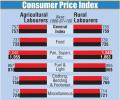
In case of rural workers, the index recorded an increase between 1 to 7 points in 12 States, and a decrease between one to 8 points in 8 states.

Indian households database Consumer Pyramids answers why two years of high inflation did not matter to the consumers of the country.

Costlier vegetables and eggs pushed up retail inflation to a nearly six-and-a-half year high of 7.61 per cent in October, keeping it significantly above the comfort zone of the Reserve Bank.

Wholesale price inflation stood at 4.78 per cent in November. The consumer price index for agricultural labourer and rural labourers were 13.73 per cent and 13.51 per cent in October.
 © 2026 Rediff.com - Investor Information - Advertise with us - Disclaimer - Privacy Policy - Sitemap - Feedback - About us - Terms of use - Grievances