
Inflation moderates, but government can and must do more.
RBI might retain rates at current levels, upside risks to inflation rise.
IIP, inflation numbers bring cheer, but their sustainability is the key.

CPI inflation is on the decline since July.
According to data released on Thursday, Wholesale Price Index-based inflation rose to seven per cent in October from 6.46 per cent in September.
Consumer durables shrank year on year, which could suggest to observers that spending confidence is yet to return to the economy.

The rate of price rise in the food basket contracted by 0.86 per cent in October compared to 0.51 per cent rise in September

Having exposure to international funds and gold is a must for those who have foreign currency-denominated goals.
NTPC, Hero MotoCorp and Reliance Industries down 2% each among the top losers
Rates would stay high for longer as CPI inflation now stands at nearly 10 per cent.
Post workers are collecting data that determines the level of India's consumer price index, which is likely to become RBI's most important tool for setting monetary policy.
Vegetable prices recorded the maximum spurt in prices, up 24.55 per cent, followed by edible oils -- 17.63 per cent and milk products -- 14.94 per cent in April, year-on-year basis.

The Reserve Bank's rate-setting panel began its three-day deliberations on Monday to decide the next monetary policy amid expectations that the central bank will maintain status quo on the benchmark interest rate in the backdrop of global scare due to the new coronavirus variant Omicron. Reserve Bank Governor Shaktikanta Das headed six-member Monetary Policy Committee (MPC) is scheduled to announce the policy resolution on Wednesday. If the RBI maintains status quo in policy rates on Wednesday, it would be the ninth consecutive time since the rate remains unchanged.

Amid fears of a third wave of coronavirus pandemic and hardening of retail inflation, the Reserve Bank is likely to maintain status quo on interest rate and watch the developing macroeconomic situation for some more time before taking any decisive action on monetary policy. The RBI is scheduled to announce its bi-monthly monetary policy review on August 6 at the end of the three-day meeting -- August 4-6 -- of the Monetary Policy Committee (MPC). The RBI Governor-headed six-member MPC decides on the key policy rates.
Costlier vegetables and fruits, such as onions and tomatoes, drove retail inflation to 10.09 per cent in October, entering double digits after seven months.

Raghuram Rajan said on Friday it is not clear India needs a so-called "bad bank.

The Index of Industrial Production (IIP) grew by 1.4 per cent in November as most components like manufacturing, electricity, mining, primary goods, and consumer durables witnessed a slowdown, according to data released by the National Statistical Office (NSO) on Wednesday. This is on the base of a decline of 1.7 per cent in November 2020 and before the new Covid variant started impacting economic activity. IIP growth was lower than the 4 per cent expansion recorded in the previous month but was better than a 1.6 per cent contraction seen in November 2020. Separately, rising prices of kitchen staples pushed retail inflation, or rate of price increase, to 5.59 per cent in December 2021, bringing it close to the upper band of Reserve Bank's comfort zone.
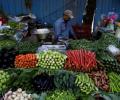
The rate of price rise in the protein rich items like eggs, milk and other products too moderated in March as against the previous month.

In January, consumer price index-based inflation rose for the fourth consecutive month. It stood at 10.78 per cent, against 10.56 per cent in December.
Rupee, however, added some respite after strengthening for the first time today during the last five trading sessions.
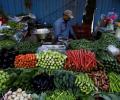
The wholesale price-based inflation rose for the second consecutive month in February to 4.17 per cent, as food, fuel and power prices spiked. The WPI inflation was 2.03 per cent in January and 2.26 per cent in February last year. After witnessing months of softening of prices, the food articles in February saw 1.36 per cent inflation. In January it was (-) 2.80 per cent.

Inflation rate during August, the data for which is yet to be released, was likely to remain at about 7 per cent, said SBI Ecowrap.
In a bid to widen the ambit of beneficiaries getting reservation under the Other Backward Classes quota, the central government on Thursday enhanced the ceiling for applying the 'creamy layer' restriction on "socially advanced persons". While the income criterion so far was Rs 4.5 lakh per annum, the Union Cabinet on Thursday increased it to Rs 6 lakh per annum.

The RBI's idiosyncratic focus on wholesale price inflation at the expense of retail inflation is a serious policy error.

There are overvaluation and excesses in many pockets of the market. This is most obvious in the IPO market, where loss-making companies have inflicted large losses on investors, observes Debashis Basu.
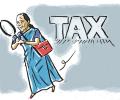
'When you need to revive the economy, when you need to revive aggregate demand, you cut taxes.' 'But what's this government doing?' 'It's increasing taxes for the middle class and the vast majority of the poor on fuel, which has a ratchet effect on most other products.'
Use a mix of instruments that will beat both the wholesale and consumer price indices
While the average CPI hovers at 10 per cent for five years now, our tax benefits are almost a decade old.
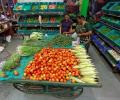
The rate of price rise for consumer foods eased to 4.7 per cent in January, from 4.96 per cent in December.

The revision of the consumer price index and GDP base years from 2011-12 and 2012, respectively, were dependent on the outcomes of the consumer expenditure survey of 2017-18 that the government decided to junk recently.
The Consumer Price Index based inflation was at 10.91 per cent in February.

The vegetables basket in Dec. recorded the highest inflation of 25.71 per cent.

The retail inflation was 9.90 per cent in November and 9.75 per cent in October.

The wholesale price-based inflation hovered over seven per cent through 2012, down from 10 per cent inflation seen in the previous year, reflecting the impact of tight money policy of the Reserve Bank of India.

MMFs are a good option for the current environment, observes Sarbajeet K Sen.

Inflation in protein-based items -- egg, meat and fish -- stood at 14.36 per cent during the month. In oils and fats segment, it stood at 11.72 per cent.
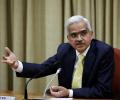
The government on Wednesday asked the Reserve Bank to maintain retail inflation at 4 per cent with a margin of 2 per cent on either side for another five-year period ending March 2026. To control the price rise, the government in 2016 gave a mandate to the RBI to keep the retail inflation at 4 per cent with a margin of 2 per cent on either side for a five-year period ending March 31, 2021.

Analysts at Barclays pitched for a 0.25 per cent cut to generate demand advising the central bank to throw caution to the wind.

Both across India and the four regions - north, south, east and west - it is found that the absolute prices of a vegetarian thali have decreased significantly since 2015-16 though the price has increased in 2019.

The employment situation remains dire. Whatever can be done to promote greater low-skill employment should be pursued aggressively, advises former chief economic adviser Shankar Acharya.
 © 2026 Rediff.com - Investor Information - Advertise with us - Disclaimer - Privacy Policy - Sitemap - Feedback - About us - Terms of use - Grievances