
If Prachanda is prudent and mature, he won't let relations with India be marred by anti-India posturing. Will he be able to do that? India's long border with Nepal has seen an unusual growth in madarssas and jihadi activities. Will Prachanda's Nepal help handle that?

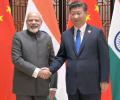
Prime Minister Narendra Modi raised the issue of Chinese incursions with the visiting Chinese President Xi Jinping during their meeting on Wednesday night.
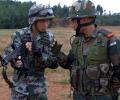
The soldiers were mixed together and they helped each other learn their skills. Col Budhwar said one platoon from India and two from China were mixed together to carry out some of the exercises together.
The Chinese and the Indian troops were engaged in a standoff for 73 days in Doklam.
Rajeev Srinivasan on how the Congress lost Tibet.

'The logical step is to challenge the very legitimacy of the Chinese claim over Tibet,' recommends Inspector General Gurdip Singh Uban (retd).
The claim came a day after Indian government sources said the Chinese army personnel recently demanded removal of two bunkers on the border in Sikkim, which was rejected outright.

Official sources said Tuesday's incident at Pangong and ways to maintain peace and tranquility along the Sino-India border in Ladakh were discussed at length at the border personnel meeting.

The Defence Minister's reply came in response to a question on whether satellite images have revealed that China has constructed seven helipads in Doklam besides deploying tanks and missiles in the area.
Nabam Rebia said the Chinese army had demolished a Buddha statue in Tawang and that constant incursions by Chinese troops had instilled a sense of insecurity in the people of Arunachal Pradesh.
Conceding that people in the bordering areas do move into the neighbouring nation's territory at times, he termed it a common phenomenon on borders and said, "There is no danger from such movement."

Ahead of the Parliament session, beginning Monday, the government is apparently aiming to build a consensus to deal with its biggest neighbour as well on Kashmir issue.

A new book reproduces original Chinese maps that contradict Chinese propaganda. The book reveals Chinese intelligence admissions that Beijing never maintained any army base, customs office or other government function in the disputed area until 1983.

Addressing the party workers and people of Bihar through a virtual rally, he attacked the opposition Rashtriya Janata Dal saying the growth rate of the state was just 3.9 per cent when the party was in power, but it rose to 11.3 per cent under the NDA.

The issue "will not affect" the "long-standing" economic and cultural ties between the two countries, a top Chinese official said.
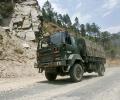
In 2005, the Border Road Organisation was asked to construct 73 roads in the strategically important regions along the Sino-India border but there has been huge delay in implementation of the project which has apparently left the army unhappy.

He also said that the India-China standoff at Doklam is "not a very serious" issue
Chinese army personnel on Monday joined their Indian counterparts in celebrating the country's Independence Day at Chushul in Leh area, a defence spokesman said in Srinagar.\n\n
"After the tri-junction in Doklam in the Sikkim sector, this is the most important tri-junction along the Sino-India border."
The dead and wounded were members of a delegation from China's University of National Defence.
'Leaders of the two nations have reportedly agreed to set up a hotline between their respective military headquarters,' state-run Global Times daily reported on Wednesday.

We strongly urge India to take practical steps to correct its mistake, Wu said.
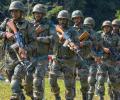
Military officials said India is also strengthening its surveillance mechanism to keep an eye on Chinese activities along the borders in the strategically sensitive Tibetan region and has even been regularly deploying choppers to carry out recce.

The External Affairs Minister said the Wuhan informal summit was held without any agenda and without having any objective to discuss any specific issue.

Arpi deserves to be complimented for the commitment and hard work that have gone into this production. The frustrations of seeking reliable documentation from the catacombs of the Indian bureaucracy did not deter him from going after the best information available, and the result is one that he can take much satisfaction in. Ambassador Prabhat P Shukla, Member Advisory Council, Vivekananda International Foundation, reviews Claude Arpi's The End of an Era: India Exits Tibet.

The visit by Gen Rawat, Ajit Doval and Vijay Gokhale was the first such high-level trip from India to Bhutan after the Doklam standoff.

A group of shepherds were asked to vacate the land by troops of the PLA.

The official cited it as an example of 'how the Chinese military is trying to resolve issues through dialogue mechanisms'.

The external affairs ministry said the talks were 'positive'.

This was the first round of talks for Wang after he succeeded State Councillor Yang Jiechi earlier this year.
Union Minister of State for Home Affairs Kiren Rijiju on Tuesday denied any incursion by China's People's Liberation Army in Taksing area of Arunachal Pradesh in recent times.

"In an unprecedented move, the ministry of defence (MoD) has decided to delegate substantial financial powers to the Armed Forces for undertaking works for perimeter security of sensitive military installations," the ministry said in a statement.

The government keeps an eye on Chinese presence in Pakistan-occupied Kashmir and has asked China to "cease such activities" there, Defence Minister Arun Jaitley informed Lok Sabha on Friday.
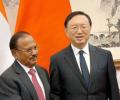
NSA Doval is set to travel to Beijing this week to attend the BRICS NSAs meeting scheduled to be held from July 27-28

Both sides are fielding the same number of troops for the joint exercises, which will culminate on October.

The nation has the fifth largest defence budget in the world, at $52.5 billion in 2017 ($51.1 billion in 2016), overtaking the UK whose defence budget fell from $52.5 billion in 2016 to $50.7 billion in 2017.
He blamed policies of the Congress-led governments for the Kashmir issue remaining unresolved.

A committee tasked by Prime Minister Manmohan Singh to assess the situation on the China border is understood to have reported that Indian troops are not being allowed to patrol up to the perceived Line of Actual Control by Chinese army.

'India is a huge market for Chinese goods. I don't think a war stands to logic when you have economic compulsions, but then Chinese are known to do illogical things.'

At the border personnel meeting, China also accused the Indian side of damaging its road building equipment when a road laying party left its gear in Tuting in December last year following a protest by India.
 © 2026 Rediff.com - Investor Information - Advertise with us - Disclaimer - Privacy Policy - Sitemap - Feedback - About us - Terms of use - Grievances