
The market capitalisation of BSE-listed companies reached an all-time high of Rs 261.73 lakh crore on Thursday, helped by a massive rally in the equities where the benchmark Sensex zoomed 958 points to end at a fresh lifetime peak. The 30-share BSE benchmark jumped 958.03 points or 1.63 per cent to settle at its new closing peak of 59,885.36. During the day, it gained 1,029.92 points to touch an intra-day record high of 59,957.25.

Experts say companies wanting to launch IPOs will have to scale back their expectations given the fall in valuations.

BharatPe co-founder and managing director Ashneer Grover, who was recently embroiled in a controversy over purportedly using abusive language against Kotak Mahindra Bank staff, has taken a voluntary leave till March-end. Grover informed the company's Board about his decision to proceed on leave earlier in the day, as per a statement issued by the fintech company on Wednesday. "For now, the Board has accepted Ashneer's decision which we agree is in the best interests of the company, our employees and investors, and the millions of merchants we support each day," it said. It added that the company will continue to be led by its CEO Suhail Sameer and its management team.
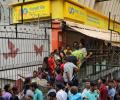
Customers of stressed Punjab & Maharashtra Co-Operative Bank (PMC Bank) will not get up to Rs 5 lakh insurance cover in the first lot as the multi-state co-operative bank is under the resolution process. Deposit Insurance and Credit Guarantee Corporation (DICGC) in the first lot will pay customers of 20 stressed banks except PMC Bank. For the first lot, the mandatory 90 days period concludes on November 30.

Retail investors-those investing up to Rs 200,000-lapped up all the four initial public offerings (IPOs) that opened for subscription on Wednesday. This is the first time since 2007 that four IPOs have been launched on a single day, according to information provided by Prime Database. KFC and Pizza Hut franchisee Devyani International (size Rs 1,838 crore); Diagnostic chains Krsnaa Diagnostics (Rs 1,213 crore), pharmaceutical firm Windlas Biotech (Rs 401 crore) and vitrified tiles manufacturer Exxaro Tiles (Rs 161 crore) are the four companies whose IPOs opened on Wednesday.

Initial public offerings (IPOs) by start-ups are bringing cheer to investors and investment bankers alike. After food delivery company Zomato, Nykaa has issued the fattest pay cheque to the managers of its share sale -- Rs 148 crore, or 2.8 per cent of its issue proceeds of Rs 5,300 crore. In absolute terms, this is the second-highest amount paid to investment bankers for handling an IPO, while in percentage terms, it is the highest for large IPOs (>$300 million) in the last one year, shows an analysis of the data provided by Prime Database, a primary market tracker.

The initial public offering (IPO) market has come to a grinding halt due to sharp correction in the broader markets and uncertain outlook created by the Russia-Ukraine offensive. So far this year, only three companies have managed to launch their maiden share sales. In comparison, close to 10 companies were able to come out with their IPOs during the same period last year. Investment bankers say it will be challenging to launch a single deal in March as large institutional investors have turned extremely risk-averse and don't wish to commit any capital.

Led by Trent, which hit its lifetime-high recently, apparel retailers have gained between 10 per cent and 36 per cent over the past three weeks. Given the network of physical stores, these stocks shall be major beneficiaries of the unlock theme, with most states doing away with Covid restrictions. Amid improving footfall, analysts expect the sector to post double-digit growth in FY23.

India's equity markets are on a roller-coaster ride, after delivering spectacular returns for two consecutive years - in 2020 and 2021. The benchmark National Stock Exchange's (NSE's) Nifty50 is down 1.5 per cent in the first nine months of the current calendar year 2022 (CY22) as foreign portfolio investors sold Indian stocks due to rising bond yields in the US and across global markets, including India. The sell-off in the Indian equity markets has, however, not been broad-based and largely limited to sectors facing earnings headwinds from rising interest rates, lower commodity and energy prices, and likely economic recession in advanced economies.

A total of 49 companies raised Rs 81,615 crore in Samvat 2077, more than the preceding four years and almost double the amount raised in the previous year. Samvat 2078 appears even more promising with mega issues of Paytm and Life Insurance Corporation (LIC) of India. However, Paytm's record could be short-lived as state-owned LIC is planning to launch a Rs 1-trillion IPO by March 2022.

'The recent price hike would only be beneficial if the airlines continue to operate at 80 per cent airline capacity. An increase towards 90 or 100 per cent airline capacity would again add pressure to the fares as demand remains muted. Also, we are in the fourth quarter of the fiscal year which is a seasonally weaker quarter,' says an analyst.

'The markets have corrected almost 8-9 per cent from their highs, so one can accumulate quality stocks at reasonable prices.'
It's raining IPOs, with eight issues hitting the market in a span of six days. However, the pace of new filings points to a deluge during the latter part of the year. So far this year, 58 companies have filed their draft red herring prospectus (DRHP) with the market regulator for initial public offerings (IPOs), exceeding the combined tally of 50 in the last two years. Industry participants said the filing count could cross 100 this year, setting a new benchmark in terms of amount mobilised in a calendar year.
Since the beginning of 2020, i-bankers have collected nearly Rs 1,800 crore by way of IPO fees. Interestingly, the India fees this year form just 1 per cent of the global fee pool of $13.7 billion from IPOs.

At BSE, 1,799 scrips declined and 714 advanced, while 184 remained unchanged.
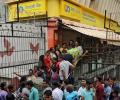
Suitors for Punjab and Maharashtra Co-operative Bank (PMC Bank) may have to infuse additional capital of nearly Rs 750 crore so that the payout per depositor is more than the Rs 5 lakh sum assured by the Deposit Insurance and Credit Guarantee Corporation (DICGC). The Reserve Bank of India (RBI) has also slotted its board meeting on March 19 in Mumbai - a fortnight short of the current deadline to find a resolution for the beleaguered bank and the moratorium placed on it comes to an end. Sources close to the PMC Bank transaction said that the central bank wants the suitors "to go the extra mile so that depositors can get more than the Rs 5 lakh insured by the DICGC". This is also to ensure that the new owners of the bank - who are to be issued a small finance bank (SFB) licence - are serious and have deep pockets.

Private equity (PE) is set to play a bigger role in banks. Of 21 recommendations accepted by the Reserve Bank of India (RBI) out of 31 made by its Internal Working Group (IWG), its stance on non-promoter holdings in private banks is seen with excitement, though it doesn't refer to PEs explicitly. On non-promoter holdings in these banks, the RBI said this will be capped at 10 per cent of the paid-up voting equity share capital in the case "of natural persons and non-financial institutions and entities"; and "at 15 per cent for all categories of financial institutions, entities, supranational institutions, public sector undertaking, or the government." While this is a modification of the IWG's stance for the non-promoter holding in banks at up to 15 per cent, it does open up a huge window for PEs, all the same. This is because, while the RBI has remained silent on the eligibility of industrial houses for bank licences, fresh high-quality capital in large amounts can only come from PEs.

Business is down to such an extent that last year these firms could not even meet RBI's capital norm of Rs 50 million for partnerships and Rs 100 million for public and private firms in this line of business.

They are small town boys who went on to make it big in global financial powerhouses.

The draft amalgamation scheme of Punjab and Maharashtra Co-operative (PMC) Bank with Unity Small Finance Bank (SFB) allowed quick relief to depositors with savings of up to Rs 5 lakh, but a long wait for those who had their nest egg with the scam-tainted bank. If the scheme gets approved, 96 per cent (or 880,000 of 924,000) depositors will get their full money straightaway after PMC is merged with Unity SFB. According to the draft scheme, retail investors may get up to Rs 5 lakh from the Deposit Insurance and Credit Guarantee Corporation (DICGC) instantly, and then some more in phases till they can recall their full deposits after 10 years.
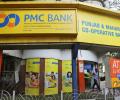
Mired in corruption, politics and with a history of suicides by its hapless depositors, PMC Bank's revival is a challenge very different from Yes Bank and LVB, both for the regulator and the rescuer, observes Tamal Bandyopadhyay.

The world's biggest lockdown that shut a majority of the factories and businesses, suspended flights, stopped trains and restricted movement of vehicles and people, may have cost the Indian economy Rs 7-8 lakh crore during the 21-day period, analysts and industry bodies said.

'In the business of money, where you are regulated, the liability lies on the head of the acquirer.' 'It is not a good thing when you cannot spot the risks.'

'Some business families would probably have to revert to their core businesses, which the IBC will ensure.'

At the BSE, 1,879 companies declined, while 685 advanced and 131 remained unchanged.


Some private banks offer easier platform to transfer money abroad, like ICICI's Money2World.
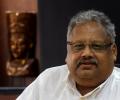
The duo bought additional shares in pharmaceutical companies Lupin and Jubilant Life Sciences, along with Agro Tech Foods and NCC during Q2FY21

Defending champion Ajay Jayaram continued his dominant run at the Dutch Open, reaching the semi-finals of the men's singles competition of the $55,000 Grand Prix tournament in Almere, Netherlands.

From the 30-share pack, 24 companies fell, with Yes Bank emerging as the top loser, dropping 8.36 per cent, followed by NTPC, M&M and Vedanta.

'In the short term, we may see some disruptions due to Covid, but in the medium-to-long term, we should keep an eye on US inflation and 10-year bond yields.'

Investors became richer by over Rs 6.34 lakh crore on Monday as markets gave a big shout-out to the Budget 2021-22, which analysts termed as 'unprecedented' against the backdrop of the pandemic-induced slowdown. Cheering the Budget proposals, the BSE benchmark Sensex zoomed 2,314.84 points or 5 per cent to close at 48,600.61. During the day, it jumped 2,478.63 points to 48,764.40. This was the best Budget-day gain for the markets since 1997, analysts said. Following the extremely positive market sentiment, the market capitalisation of BSE-listed companies rallied Rs 6,34,069.67 crore to Rs 1,92,46,713.70 crore.

RailTel Corporation of India, Indigo Paints, Home First Finance Company, Indian Railway Finance Corporation, and Suryoday Small Finance Bank are among the companies looking to tap the market.

The Sensex was mainly dragged by Tata Motors, ICICI Bank, Bharti Airtel and Reliance Industries -- shedding as much as 4.60 per cent.

In the Sensex pack, Bharti Airtel was the top performer, surging 4.61%. Other gainers included ICICI Bank, IndusInd Bank, L&T, Sun Pharma, RIL, HDFC duo, Tata Motors and M&M -- climbing up to 3.69%.

IndusInd Bank was the biggest gainer in the Sensex pack, rallying 5.23 per cent, followed by Hero MotoCorp, Coal India, Yes Bank, PowerGrid, ICICI Bank, HCL Tech, L&T, Kotak Bank and Bharti Airtel, rising up to 1.56 per cent.

Bucking the overall downtrend, shares of RIL rallied nearly 10 per cent, capping the Sensex loss to a large extent.
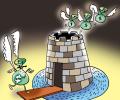
While a coordinated aggressive monetary easing from the central banks is most likely to offer some respite in the near-term, it is unlikely to improve the sentiments.

Analysts expect Colgate's overall volume growth to remain in single digits (around 5-6 per cent) for the next two years.
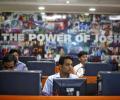
The reduction in hiring indicates a shift in the business model from hiring thousands of people to write code cheap to using artificial intelligence for repeatable tasks.
 © 2026 Rediff.com - Investor Information - Advertise with us - Disclaimer - Privacy Policy - Sitemap - Feedback - About us - Terms of use - Grievances