
India's fiscal deficit soared by 34 per cent to Rs 3.5 lakh crore in the first ten months of the financial year against Rs 2.62 lakh crore a year ago, mainly on account of the stimulus measures taken by the government to prop up the economy hit by the global financial crisis.

Ahead of the general elections, a slew of states and also the Centre had doled out sops to the marginalised sections, including the farmers and the poor.

Under the 11th Five-Year Plan (2007-12), Rs 550 crore (Rs 5.5 billion) was provided for promoting exports through Market Access Initiative scheme.

The ministry of finance has assured the Planning Commission of at least 15 percent increase in gross budgetary support for 2010-11, over the 2009-10 budget estimates.

This was due to a planned expenditure being revised
Anticipating an adverse impact in view of a bad monsoon, Finance Minister Pranab Mukherjee on Tuesday set an ambitious direct tax collection target for the current fiscal, revising it upward to Rs 4 lakh crore, up Rs 30,000 crore (Rs 300 billion) over the Budget estimates.
Several questions arise on the appropriateness of the measure in the already strained fiscal scenario, says M Govinda Rao.
The Budget estimate of 2009-10 includes a sum of Rs 35,000 crore as expected revenue from auction of 3G spectrum, finance minister Pranab Mukherjee said in Budget papers.
The Budget gave a big boost to power reforms programme by increasing allocation to Rs 2,080 crore (Rs 20.80 billion), or a rise of 160 per cent from the previous fiscal.
The states will be able to raise additional open market loans of about Rs 21,000 crore (Rs 210 billion) in the current year, according to the 2009-10 Budget estimates presented on Monday. According to Budget estimates of 2009-10, the states' share of taxes and duties is expected to increase to Rs 1,64,361 crore (Rs 1,643.61 billion) against Rs 1,60,179 crore (Rs 1,601.79 billion) in 2008-09.

They may be on the same side of political power, but that did not stop Railway Minister Mamata Banerjee and her predecessor Lalu Prasad from taking pot-shots at each other during the presentation of Railway Budget in the Lok Sabha.
M Govinda Rao hopes the Budget will contain the deficit while continuing to create conditions for pushing growth.

The bid for pan-India spectrum for 3G telephony on Thursday crossed Rs 15,000 crore (Rs 150 billion) and is still rising.

Can the finance minister manage our expectations, asks A K Bhattacharya.
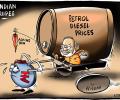
The oil sector has been quite lucky for the Modi government. It has often provided an opportunity to the government to mend its finances, notes A K Bhattacharya.
High crude oil prices in 2008 have left the government richer by a few thousand crore rupees. In 2008-09, the government earned "windfall profits" from the petroleum sector as crude oil prices spiked, touching a high of $147 in July 2008.
Refraining from tinkering with tax and duty rates in the interim Budget, Finance Minister Pranab Mukherjee on Monday made a huge allocation of Rs 30,100 crore (Rs 301 billion) to government's flagship rural employment programme and many other schemes in a bid to counter the economic recession.

Clearly, the extra borrowing of Rs 4.2 trillion the government has planned so far will not be enough to meet the shortfall in revenues which could be between Rs 8 trillion and Rs 10 trillion, points out A K Bhattacharya.

The Indian Railways will earn a profit of Rs 951 crore (Rs 9.51 billion) in 2009-10, down 93 per cent from the 2007-08 level.
16% jump in unrealisable tax demands that are not under dispute.
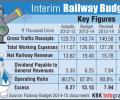
Anticipating healthier economic growth, the Railways has targeted a record Rs 1.6 lakh crore in revenue for the next financial year, while no increase has been proposed in passenger fares and freight rates.
A substantial expected increase in the Treasury Bill floatation could also contribute to a tightening liquidity situation, the report said. These included a 0.50 per cent cut in cash reserve ratio with effect from January 17, a 1 per cent reduction in the reverse repo rate with immediate effect and a slashing of the repo rate by 1 per cent from 6.5 per cent to 5.5 per cent.
India's fiscal deficit has crossed the government's initial estimate of 2.5 per cent of Gross Domestic Product in the eight months up to November 2008.
The government is likely to revise downwards indirect tax collections target for the current financial year by at least Rs 20,000 crore.
The collections stood at Rs 98,202 crore in the month, against Rs 1.02 trillion in July. The figures indicate continuation of economic slow down which was reflected in the gross domestic product (GDP) growth which plummeted to a 25-quarter low of 5 per cent in the first quarter of 2019-20, experts said.
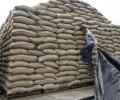
Wheat will be now be sold to the schemes at Rs 2 per kg, while rice would be given at Rs 3 per kg.

The government further said the gross tax revenue as a per cent of GDP is expected to increase to 12.1 per cent of GDP in 2019-20 and stabilise at that level in 2020-21 before climbing up to a level of 12.2 per cent of GDP.
Government has allocated Rs 988 crore (Rs 9.88 billion) in Budget estimates for 2007-08 for increasing infrastructure of IIT institutions.

This amount will include Rs 13,100 crore that Economic Affairs Secretary Subhash Garg has been publicly seeking from the central bank's contingency reserve fund since 2017-18 (FY18).
Enthused by over 36 per cent increase in direct tax collections during 2007-08, Finance Minister P Chidambaram on Monday asked the department to aim for higher collections this fiscal than the Rs 3,65,000 crore (Rs 3,650 billion) estimated in the Budget for 2008-09.
Central Board of Direct Taxes officials claim the figure has surpassed indirect taxes for the first time.

CBDT feels 30% growth in income-tax not feasible.

'They want (the ownership and management of PSU banks) to pass into the hands of a private sector entity.' 'Ownership of these banks will go from the public sector to private sector.'

Because of the economic slowdown, the actual corporation tax collection in 2012-13 was at Rs 3,56,326 crore (Rs 3,563.26 billion), up 10.4 per cent year-on-year as against 15.6 per cent estimated in the Budget.
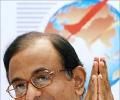
Buoyed by a 60 per cent growth in income tax collection in Mumbai, Finance Minister P Chidambaram on Friday said he expected the country's financial capital to do even better in the next fiscal.Mumbai is the third city to have an LTU after Bangalore and Chennai. Delhi and Kolkata would be the next centres to have LTUs which provide single-window to corporate to pay all central taxes.
"The higher realisation of taxes in third quarter was associated with reduction in revenue and fiscal deficit," Minister of State for Finance S S Palanimanickam informed Rajya Sabha while tabling the statement on third quarterly review of receipts and expenditure for 2007-08.
Central ministries as a whole are expected to get an increase of only 15 per cent in gross budgetary support for 2008-09, much lower than the 62 per cent increase they had demanded.

FPIs are currently capped at 5 per cent of the total outstanding government dated securities, and own 4.5 per cent
Asia's first Special Economic Zone, the Kandla Special Economic Zone (KASEZ), will go completely wi-fi in the next few months.
 © 2026 Rediff.com - Advertise with us - Disclaimer - Privacy Policy - Sitemap - Feedback - About us - Terms of use - Grievances