Planning Commission on Friday said there is no case for providing stimulus to the industry to arrest moderating growth as the fiscal deficit is high and may exceed the Budget estimate of 4.6 per cent by about one percentage point.
Crosses Budget Estimate by 5.5%, govt expected it to be 4.6% of GDP for current financial year

Leaving behind apprehensions of a rise in interest rates and petro duty cut impacting budget numbers, the officials are now confident of keeping the fiscal deficit within the targeted 4.6 per cent of the gross domestic product.

'Given the 50 per cent or thereabouts increase in borrowing that has been announced, it is a reasonable estimate to say that at this time, an increase of 1.7-1.8 per cent on the 3.5 per cent budgeted fiscal deficit target is being anticipated,' Chief Economic Adviser Krishnamurthy Subramanian said on Friday.

The income tax department estimates total collection to be between Rs 10.5 trillion and Rs 10.7 trillion against the revised target of Rs 11.7 trillion.

Unperturbed by the rise in the fiscal deficit, Finance Minister P Chidambaram on Thursday exuded confidence that it would remain within the target of 4.8 per cent of GDP in the current financial year.

The economic growth slowed to 6.9 per cent in the second quarter against 8.4 per cent in the same period last year.

When Finance Minister Nirmala Sitharaman tables her Budget on February 1, the numbers could be something to cheer.

'Let us hope that this Budget delivers.' 'It needs 10 per cent plus real GDP growth in 2021-22, the rebound year,' notes Omkar Goswami.

Over 60 per cent of these borrowings are slated to be mopped up in the festival season.

The government plans to raise resources to finance capital spending beyond the Rs 3.10 lakh crore budgeted for 2017-18 through higher borrowing or divestment receipts.

Current account deficit in 2010-11 will be well below 3.0 per cent of GDP.

Despite crude comfort, heavy spending cuts needed to offset Rs 80k-cr revenue shortfall

The net direct tax collections jumped by 18 per cent to Rs 43,391 crore during the first two months of the current fiscal.
The government on Monday sought Parliament approval for gross additional expenditure of Rs 44,945 crore in the current financial year. Of this, the net cash outgo will be Rs 19,812 crore, while the rest will be met by savings of the ministries or enhanced receipts. A significant part of this additional grant would be spent on food and fertiliser subsidy.
In recent years, excise duty collections had always played truant to the expectations.

With Mamata Banerjee leaving passenger fares untouched and announcing a slew of concessions for technicians of regional film industry, cancer patients and press correspondents, railways' earnings from passenger operations may be strained further.

Majority of respondents feel that the government in the forthcoming Budget will increase the standard deduction and give more incentives for housing loans.

Beside manufacturing, deceleration was also witnessed in sectors like agriculture, construction and electricity, gas and water supply.

Several critics including some rating agencies have doubted prospects of meeting this ambitious fiscal deficit target.

The Centre's fiscal deficit, the gap between the government's expenditure and income, stood at Rs 1 trillion during April-May, constituting over one-fourth of the budget estimate for the entire 2010-11 fiscal.

Amid speculations of partial roll back of stimulus in the upcoming Budget, a key finance ministry official said the government's kitty from indirect tax collections will fall short of the projected figures for this fiscal.

'The rupee falling from 69 to 72 was not normal or justified by the fundamentals.' 'And therefore I treat this as temporary.'

The government had set the direct tax collection target of Rs 3.70 lakh crore (Rs 3.7 trillion) in the budget for 2009-10, which was later revised upwards to Rs 3.87 lakh crore (Rs 3.87 trillion).
Finance ministry tells PM fiscal deficit target will be met, capex expenditure won't be cut and GDP growth will surpass 7.5%.
Pranab Mukherjee proposed the enhancement of the overall plan budget for higher education by Rs 2,000 crore over the Interim Budget estimates. He further announced the allocation of Rs 2,113 crore for IITs and NITs, which includes a provision of Rs 450 crore for new IITs and NITs. The finance minister also proposed to allocate Rs 827 crore for opening one central university in each uncovered state.

The appointment of new expenditure secretary comes a month-and-a-half ahead of the Budget for 2020-21 to be presented on February 1.

On the revenue front, the finance ministry was expecting higher proceeds from non-tax revenue.

The government is committed to restrict the fiscal deficit at 3.4 per cent of GDP as envisaged in the Budget.

The highest collection target has been given to Mumbai at Rs 4.39 trillion, followed by Delhi and Bengaluru.

The government on Tuesday exuded confidence that revenues from sale of spectrum for 3G telephony and broadband may touch Rs 50,000-55,000 crore (Rs 500-550 billion), beating the budget estimates of Rs 35,000 crore (Rs 350 billion).

Direct tax collections fell Rs 12,000 crore (Rs 120 billion) short of the Rs 3.87 trillion target last fiscal, largely owing to lower realisation from corporate tax payers.

As much as Rs 61,920 crore of tax refunds have been issued during April-July
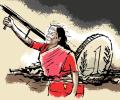
'But can it afford to present a scenario within the existing legal framework of fiscal consolidation?', asks A K Bhattacharya.
The worst of recession could coincide with the run-up to the elections.
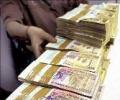
India's fiscal deficit shot up over 23 per cent to Rs 3.80 lakh crore in the first eleven months of this fiscal
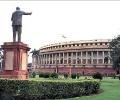
To help compare numbers better, FinMin might retain the interim Budget Estimates with the new ones.

The government would fall short of its target for direct tax collections for the second consecutive year, with the revenue department estimating its direct tax receipts at Rs 3,70,000 crore (Rs 3700 billion) for 2009-10.

Because of global economic meltdown and stimulus packages provided to industry.

Going by available indications from North Block, Mr Mukherjee may like to do a Chidambaram when he presents the Revised Estimates on February 27, 2010
 © 2026 Rediff.com - Advertise with us - Disclaimer - Privacy Policy - Sitemap - Feedback - About us - Terms of use - Grievances