
The Budget outlay for health and well being is Rs 2.23 lakh crore in 2021-22 as against BE of Rs 94,452 crore and marks an increase of 137 per cent," she said while presenting 2021-22 Budget in the Lok Sabha.
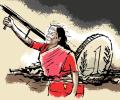
The number of centrally sponsored schemes have increased to 35 in FY22 from 30 in FY21 and central sector schemes have increased to 704 from 685 in the previous year, reports Dilasha Seth.

Sitharaman also said that the government's capital expenditure was on track and Budget estimates would be met.

In absolute terms, the fiscal deficit -- the difference between expenditure and revenue -- was Rs 6.12 lakh crore during April-November 2017-18
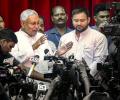
Various indicators make it amply clear that there are grave challenges facing the new government of Chief Minister Nitish Kumar, reports Indivjal Dhasmana.

Only 80.6 per cent of the Rs 6-trillion allocation has been spent by February, data from the Controller General of Accounts shows.

While the likelihood of these states going the Lanka or Greece way may be an alarming assessment, the financial situation of some states such as Punjab and West Bengal is indeed quite weak.

She also took a swipe at the Bharatiya Janata Party over its defeat in the just-concluded Himachal Pradesh assembly elections, saying the ruling party's president could not hold on to his home state. "Who is the Pappu now?" she asked.
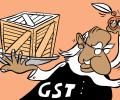
If other states follow suit, it is going to become difficult for the GST Council to decide on the next stage of reforms.

Amid rising demand for coal freight and an aggressive push towards diversifying its freight basket, Indian Railways is planning to buy 100,000 more wagons over the next three fiscal years. The procurement plan will majorly comprise BOXN wagons, which are used to transport coal, said a senior Ministry of Railways official. Notably, the railways recently floated a sizeable tender worth Rs 35,000 crore of wagons, which had been in the pipeline since 2018. "Our Budget Estimates for freight increase were conservative.

Finance Minister Nirmala Sitharaman on Friday pitched for front loading of capital expenditure, saying it is critical for revitalisting the economy post the coronavirus pandemic. During a virtual meeting with senior government officials to discuss the infrastructure roadmap ahead, she also asked ministries to aim to achieve more than their capital expenditure (capex) targets. The Union Budget 2021-22 provided a capital outlay of Rs.5.54 lakh crore, a sharp increase of 34.5 per cent over the Budget Estimate of 2020-21.

The Reserve Bank's growth projection for next financial year is lower than 8-8.5 per cent projected by the finance ministry in the recent Economic Survey which was tabled in Parliament on January 31. Unveiling the bi-monthly policy, RBI governor Shaktikanta Das said, "Recovery in domestic economic activity is yet to be broad-based, as private consumption and contact-intensive services remain below pre-pandemic levels."

The states will forego around Rs 44,000 crore of tax revenue after they reduced VAT on petrol and diesel in the reminder of the fiscal but higher central tax devolution of Rs 60,000 crore will offset the losses, according to a report. After months of calls for lowering the taxes on the fuels, the Centre on November 4 cut excise duty on diesel by Rs 10 a litre and by Rs 5 on petrol. Following this, as many as 25 states and Union territories have lowered value-added tax (VAT) on these fuels.

India's gross tax collections soared to a record high of Rs 27.07 lakh crore in the fiscal year ended March 31, led by impressive growth in corporate tax and customs, taking the tax-to-GDP ratio to an over two-decade high of 11.7 per cent, Revenue Secretary Tarun Bajaj said on Friday.

If the Centre and states are keen on spending more to meet the COVID-19 challenges in the coming year, they must bear in mind the need to raise more resources through taxes and non-tax revenues, suggests A K Bhattacharya.

Over two lakh posts are estimated to be created by the Central government in its various departments.

The finance ministry on Friday withdrew expenditure curbs on various departments and ministries imposed in June in the wake of the COVID-19 second wave, reflecting improvement in public finances and the urgency to step up growth.

Revenue from divestment has fetched Rs 40,000-50,000 crore against target of Rs 2.10 trillion.

In the midst of third wave of COVID-19, Finance Minister Nirmala Sitharaman has come up with an impactful Budget which is balanced, fiscally prudent and growth-oriented, the USA India Chamber of Commerce has said. President of the Boston-based USA India Chamber of Commerce (USAIC) Karun Rishi, however, said it is a matter of concern that the budget lacks tangible measures to increase revenue generation. "Opting to keep the fiscal deficit at 6.9 per cent and increase capital expenditure by 35 per cent is a masterstroke. "The annual budget estimates the effective capital expenditure of Rs 10.68 lakh crore in 2022-23, making up about 4.1 per cent of the GDP," he said. "A phenomenal increase in the government's capital expenditure is likely to facilitate the expenditures on infrastructure and create jobs.

A communiqu sent by the department of investment and public asset management (DIPAM) to the heads of all PSUs, said the move would help the government to get predictable and periodic dividends before Budget estimates are firmed up.

The government's subsidies on food, fertilisers and petroleum are estimated to decline by 39 per cent to Rs 4,33,108 crore this fiscal and fall further by 27 per cent to nearly Rs 3.18 lakh crore in 2022-23. In its revised Budget (RE) estimate for the 2021-22 fiscal, the government has pegged total subsidies to be at Rs 4,33,108 crore against the actual Budget estimate of Rs 7,07,707 crore in the previous financial year. Out of which, the food subsidy is estimated to decline to Rs 2,86,469 crore in the current fiscal from Rs 5,41,330 crore in 2020-21, while petroleum subsidy is estimated to fall to Rs 6,517 crore from Rs 38,455 crore in the said period.
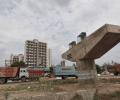
These could include strengthening the public-private partnership (PPP) dispute resolution mechanism, uniform PPP institutional framework, easier terms for infrastructure companies accessing bond markets, and tax sops, Business Standard has learnt. Investment in infrastructure projects with high multiplier effect has been the Centre's main plank to revive the economy, create employment and boost consumption.

IThe fiscal deficit target for 2020-2021 was originally set at 3.5 per cent of GDP. But the government's revenues have collapsed and its expenditure burden will only increase over the Budget estimates.' With the government having already planned for an additional borrowing of over Rs 4 trillion, the fiscal deficit for the current year would be much higher than the Budget estimate, notes A K Bhattacharya.
Days after cutting the salaries and other allowances of MPs and ministers, the government has passed instructions to all departments to reduce their expenditure by as much as 60 per cent from their first-quarter spending plans.

A ramp-up in COVID-19 vaccination, healthy advance estimates of kharif (summer) crop and faster government spending were the factors which led to the revision, the agency said in a statement. It can be noted that after the 7.3 per cent contraction in 2020-21, there were expectations of a higher growth number in 2021-22.
The government's food subsidy in the ongoing fiscal year is expected to be a little less than Rs 4 trillion.
The budgetary allocation for the sector is Rs 60,908.22 crore, with Rs 6,400 crore earmarked for the centre's flagship health insurance scheme Ayushman Bharat- Pradhan Mantri Jan Arogya Yojna (AB-PMJAY).

Finance Nirmala Sitharaman on Friday asked various ministries to try to spend more than their capital expenditure targets as well as explore public private partnerships for viable projects. During a meeting with senior government officials to discuss the infrastructure roadmap, she also urged the ministries and their CPSEs to ensure clearance of Micro, Small and Medium Enterprises (MSME) dues at the earliest. This was the fifth review meeting by the finance minister with ministries and departments on the infrastructure roadmap.

If there is no third wave of the pandemic, the fiscal position of the Centre and the states will be much better than budgeted for FY22 and the states may garner Rs 60,000 crore more in tax collections at Rs 8.27 lakh crore this fiscal year than they have budgeted, a report said. The report by SBI Research on Monday bases its optimism on GST collection so far this fiscal, which has been the best ever in spite of the fact that the two months bore the maximum brunt of the second wave -- with April setting a record Rs 1.41 lakh crore and May collection a tad low at Rs 1.03 lakh crore. The report also said overall government finances do not look overstretched as GST collections have continued to maintain pace so far and the additional fiscal impact arising from free vaccination and more food supplies will only be around Rs 28,512 crore.

In absolute terms, revenue receipts stood at Rs 9.07 lakh crore at the end of October. For the entire 2019-20, the revenue receipts have been pegged at Rs 19.62 lakh crore.

'Short term volatility is likely due to various factors, global and domestic; investors may use this as an opportunity to increase the allocation to equities.'

At the customary post-Budget media interactions, Finance Minister Nirmala Sitharaman and her topmost bureaucrats touched upon a number of issues. The minister said the government taxing income from digital virtual assets did not give them legitimacy and that issue was being dealt separately in the planned cryptocurrency Bill. She also expressed confidence that the Budget targets were achievable.

NSO Group, an Israeli surveillance software company, has been under increasing attack following allegations that its Pegasus phone spyware was used for surveillance on journalists, activists and political leaders in several countries including India. NSO has denied any wrongdoing.
There are two ways: Deliver a rapidly growing economic pie or reform GST and close corporate tax loopholes, suggests T N Ninan.

Revenue buoyancy of GST will be key to improve the resource position of both central and state governments.

After the RBI surprised the Centre with a record Rs 99,122 crore in surplus transfer for FY21, analysts said this will help the government tide over the revenue losses from lockdowns and extend more support to the pandemic hit industries and to the poor people. In fiscal 2020, the RBI had paid only Rs 57,128 crore in dividend to the government and the finance minister had budgeted only Rs 45,000 crore from the central bank. The higher payout followed the Bimal Jalan panel report that had set a new economic framework capital buffer for the central bank along with the contingency risk buffer at 5.5 per cent.

The combined fertiliser, food and petroleum subsidy budgeted estimate for FY19 is Rs 2.64 trillion, while the revised estimate is Rs 2.66 trillion. If the carrying forward to FY20 does not happen, the revised estimates for the major subsidies could actually cross Rs 3 trillion for the first time ever.
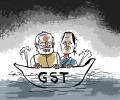
Rates may be raised from 5 per cent to 8 per cent and 12 per cent to 15 per cent. The Council can explore possibility of merger of slabs to bring down the number of slabs to three. The Central GST collection fell short of the Budget Estimate by nearly 40 per cent during the April-November period of 2019-20

The government had last fiscal exceeded the direct tax collection target set in the Budget.

It had declined by slightly over 4 per cent in December. The city contributes 37 per cent to the total direct tax revenues. If the trend continues, it could affect the Budget estimates of Rs 13 trillion for the current fiscal year.
 © 2026 Rediff.com - Advertise with us - Disclaimer - Privacy Policy - Sitemap - Feedback - About us - Terms of use - Grievances