
The Centre could better its fiscal deficit at 6.6 per cent of GDP in this financial year on stronger-than-expected revenue buoyancy, even if the budgeted disinvestment target is not met, Fitch Ratings has said. The international rating agency had last week kept the sovereign rating unchanged at 'BBB-' with a negative outlook, and said that the risks to India's medium-term growth outlook are narrowing with rapid economic recovery from the pandemic and easing financial sector pressures. In an email interview with PTI, Fitch Ratings Director (Asia-Pacific Sovereigns) Jeremy Zook said the two key positive triggers that could lead to a revision of the outlook to stable are implementation of a credible medium-term fiscal strategy to lower debt burden and higher medium-term investment and growth rates without the creation of macroeconomic imbalances, such as from successful structural reform implementation and a healthier financial sector.

Finance Minister Nirmala Sitharaman is scheduled to address the post-budget meeting of the RBI's central board on Monday and highlight key points of the Union Budget 2022-23, including the fiscal consolidation roadmap and high capex plan. It has been a custom that the finance minister addresses the RBI board, consisting of RBI Governor and existing four deputy governors, after the Budget. The meeting has been scheduled for February 14 where she would be addressing the board members and talk about announcements made in the Budget to perk up growth hit by three waves of COVID-19, sources said.

Finance Minister Nirmala Sitharaman will be presenting her fifth Budget that may do a tightrope walk between staying fiscally prudent and meeting general public expectations of lower taxes and a wider social security net, while at the same time firing the engines of the economy.

Union finance secretary T V Somanathan recently said the Centre had saved Rs 10,000 crore in FY22 on interest payments after adopting new accounting mechanisms for central government agencies and centrally sponsored schemes (CSS) for state governments. Speaking at an event, Somanathan said due to these, there was an unspent balance of Rs 1.2 trillion with state agencies from CSS as on March 31, 2022. This means this amount will be reduced from the Centre's borrowing for now and it can be considered a short-term saving for the exchequer.

The central government is likely to further consolidate its fiscal deficit by 50 basis points (bps) to 5.9 per cent in FY24 from 6.4 per cent in FY23, according to a recent report released by Goldman Sachs on Tuesday. In the current fiscal year, there is going to be an upside of 0.5 per cent on the receipts side due to higher nominal GDP growth, and higher tax buoyancy because of the formalisation, the report said. The upside to expenditure is mainly going to come from incremental subsidies (0.8 per cent of GDP), in both food and fertilizer, it said. The upcoming pre-election Budget will carry forward the trend of the increased capital expenditure seen in recent years.
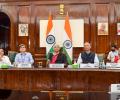
Seven of the meetings will be held in late November or early December at the finance ministry, as is the norm.

According to the third batch of supplementary demands for grants tabled in the Lok Sabha, approval is being sought for gross additional expenditure of over Rs 1.58 lakh crore.

Instead, 2019-20 could be the base from which the Budget estimates for next year are calculated.

The Reserve Bank of India on Thursday kept the benchmark interest rate unchanged at 4 per cent and decided to continue with its accommodative stance against the backdrop of an elevated level of inflation.

Per capita income has more than doubled to Rs 1.97 lakh in around nine years. Indian economy has increased in size from being 10th to 5th largest in the world in the past nine years. Seven priorities of the Budget, 'Saptarishi', are inclusive development, reaching the last mile, infrastructure and investment, unleashing the potential, green growth, youth power and financial sector.

The finance ministry will kick-start the exercise to prepare the Union Budget for financial year 2022-23 (FY23) from October 12, according to an official notification released on Monday. "The pre-Budget meetings as well as the meetings to discuss the revised estimates will start from October 12 and will continue till the second week of November," according to the Budget circular of the Department of Economic Affairs' Budget Division. The Union Budget is expected to be announced on February 1, as has been the practice of the past few years.

'In equities, it has diversified portfolios.' 'So the short-term movement of individual stocks does not impact them.'

Gross collection of tax on corporate and individual earnings jumped nearly 24 per cent so far in the current fiscal year that started on April 1, the tax department said on Sunday. The gross collection of taxes on corporate earnings rose 16.74 per cent during April 1 to October 8, while personal income tax collection jumped 32.30 per cent, the tax department said in a statement. Direct tax collection came at Rs 8.98 lakh crore between April 1 to October 8, 2022, 23.8 per cent higher than the gross collection in the corresponding period a year ago.

The government's subsidies on food, fertilisers, LPG and kerosene are pegged at Rs 5.96 lakh crore in the current fiscal, over 2.5-fold jump from the initial budget estimates as the Centre distributed additional foodgrains free of cost to help poor mitigate the impact of COVID-19 pandemic. In February 2020 Budget, presented in the pre-COVID scare, the government had estimated the subsidy bill at Rs 227,794 crore. However, all the budget estimates, have undergone major revisions as the country imposed strict lockdown to check the spread of COVID-19.

The Union government's fiscal deficit works out to be Rs 5.47 lakh crore or 36.3 per cent of the budget estimates at the end of October 2021 on the back of improvement in revenue collection, according to the data released by the Controller General of Accounts (CGA) on Tuesday. The deficit figures in the current fiscal appear better than the previous financial year when the gap between expenditure and revenue had soared to 119.7 per cent of the last year's Budget Estimates (BE) mainly on account of a jump in expenditure to deal with the COVID-19 pandemic. In absolute terms, the fiscal deficit was Rs 5,47,026 crore at the end of October, the CGA said.

After the Covid-19 pandemic that derailed the economy since 2019, the Durga Puja festival in West Bengal is back with an estimated 20-30 per cent jump in festive spending. Retail sector is the key contributor to the state's Durga Puja economy which was Rs 32,377 crore in 2019, according to a British Council study conducted for the state government. Retail accounts for 85 per cent of the total puja economy and the rest is shared among pandal making, decoration, illumination, entertainment, advertisement, food & beverage and others.

The Delhi government's budget size for 2022-23 was Rs 75,800 crore and Rs 69,000 crore in the preceding year.
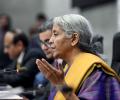
Let's wait for the monetary policy on February 8 -- to see how it complements the fiscal commitments, points out Tamal Bandyopadhyay.
When Nirmala Sitharaman announced her new privatisation policy, there were serious doubts if the move had the BJP's full political backing. All those doubts were dispelled when her initiatives were endorsed by Modi in Parliament, observes A K Bhattacharya.

The government expects indirect tax collection to be lower than the Budget Estimate (BE) of Rs 13.38 trillion this fiscal year, despite prospects of netting goods and services tax (GST) in large amounts, Revenue Secretary Tarun Bajaj has said. "Indirect tax collection may see lower realisation than budgeted on account of cuts in excise and customs duties. "We could see a shortfall of about Rs 1.5 trillion on account of those," he told Business Standard.
The finance ministry will kick-start the exercise to prepare the annual Budget for 2023-24 from October 10, in the backdrop of revival of the Indian economy and fears of recession in developed countries. The budget for the next year will have to address critical issues of high inflation, job creation, boosting demand, and putting the economy on a sustained 8 per cent-plus growth path. On Wednesday, finance minister Nirmala Sitharaman said inflation is no longer "red-lettered" and the priority for the government now is job creation and boosting growth.
Fiscal deficit had soared to seven-year high of 4.6 per cent of GDP in 2019-20, mainly on account of poor revenue realisation which dipped further towards the close of March because of the lockdown.
Sliding for the fifth straight session, the rupee fell 3 paise to close at a fresh lifetime low of 79.06 against the US dollar on Thursday amid a strong greenback overseas and unrelenting foreign fund outflows. At the interbank forex market, the local unit opened at 78.92 against the greenback and witnessed an intra-day high of 78.90 and a low of 79.07. It finally settled at 79.06, down 3 paise over its previous close of 79.03.

HDFC was the top gainer in the Sensex pack, climbing nearly 4 per cent, followed by PowerGrid, Sun Pharma, Tata Steel, Tech Mahindra and Bajaj Finserv. NSE Nifty surged 234.75 points to 17,401.65.

The Centre's capital expenditure (capex) outlay for the April-June quarter (first quarter, or Q1) of 2022-23 (FY23) could be close to Rs 1.5 trillion, Business Standard has learnt. As a percentage of full-year capex Budget Estimates (BE) of Rs 7.5 trillion, this could be at similar levels to the trends in the past few fiscal years. It is in the July-September quarter (Q2) of FY23 that capex is expected to pick up, when a bulk of the long-term capex loans to states are expected to be expended.

'This government has always been fiscally conservative. It never resorted to fiscal profligacy.'
Fiscal deficit for 2020-21 was at 9.3 per cent of the gross domestic product (GDP), lower than 9.5 per cent estimated by the finance ministry in the revised Budget estimates, according to the CGA data. Unveiling the revenue-expenditure data of the Union government for 2020-21, the Controller General of Accounts (CGA) on Monday said that the revenue deficit at the end of the fiscal was 7.42 per cent.

The Centre and states are likely to budget for higher market borrowings to the tune of Rs 2.3 lakh crore next fiscal even though the Union budget may peg a lower-than-expected fiscal deficit for the Centre at 5.8 per cent of GDP, says a report. Icra Ratings anticipates higher redemptions will lead to gross market borrowings of the Centre to rise to Rs 14.8 lakh crore and of the states to jump by Rs 1.6 lakh crore to Rs 9.6 lakh crore, taking the combined borrowings (of the Centre and the states) to Rs 24.4 lakh crore in FY2024, up by 2.3 lakh crore from FY23 combined. In FY23, the Centre's gross borrowings are budgeted at Rs 14.1 lakh crore and of the states at Rs 8 lakh crore, or a combined borrowing of Rs 22.1 lakh crore, according to the agency.

Allocation of portfolios would be the immediate vexatious issue for the party, with supporters of Virbhadra Singh already feeling sidelined after the elevation of the late chief minister's professed rival Sukhu.
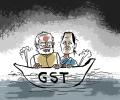
CAG recommended fixing a definite time frame for rolling out simplified GST return forms.

The government wants new domestic companies to set up their manufacturing units fast and hence the concessional tax rate of 15 per cent has been extended by a year till March 2024, revenue secretary Tarun Bajaj said on Friday. Stating that direct and indirect tax collections are going up and have good buoyancy, Bajaj said it means that the corporate sector is also doing well, and India's tax to GDP ratio could be "highest ever" in the current year. The Budget 2022-23 presented on February 1 has proposed that the concessional 15 per cent corporate tax rate would be available for one more year till March 2024 for newly incorporated manufacturing units.

'The road ahead for the government's fiscal management will be full of many new challenges,' warns A K Bhattacharya.

Finance minister Nirmala Sitharaman on Wednesday exuded confidence that inflation would further decline and the government is on track to meet its budgetary target for deficit and said that there is no fear of stagflation in India. Replying to the debate on first batch of Supplementary Demands for Grants 2022-23 in Lok Sabha, the finance minister said inflation has come down and it is now in the tolerable band of the RBI. Inflation has been declining since April 2022 and it is declining further, she said.

For 2017-18, the government aims to bring down the fiscal deficit to 3.2 per cent of GDP. Last fiscal, it had met the 3.5 per cent target.

Fiscal deficit is a reflection of government borrowings, which is used to bridge the gap between revenue and expenditure.

Here are the key numbers to watch out for in the Budget for 2022-23, which is widely expected to boost spending towards policies that create jobs, boost manufacturing, helping rural and agri-economy and infrastructure creation. Sitharaman, who had in her first budget in 2019 replaced leather briefcase -- which had been in use for decades for carrying budget documents -- with a traditional red cloth 'bahi-khata', has spurt in tax collections to her aid in the budget that is expected to a spend-all budget.

Maharashtra is the BRS' first target.

Amid FY23 Union Budget's focus on investments, leading domestic credit rating agency Crisil on Wednesday said that the capital expenditure is "not as high as it sounds". It, however, was quick to add that considering that governments usually tend to cut capex during a crisis, the government has maintained its focus on growth-spurring initiatives amid the pandemic. The research wing of the agency said, if one excludes the Rs 1 lakh crore of loans to states for capex included in the headline figure of Rs 7.50 lakh crore or 2.91 per cent, the actual spend in FY23, will go down to 2.58 per cent of GDP, which is barely at par with the revised estimate of FY22.

While the tax-to-GDP ratio of 9.88 per cent has been assumed for FY21, the same as last year, when it touched a decadal low, for FY22 a ratio of 10.7 per cent has been assumed, an average of the last five years.

For 2017-18, the government aims to bring down the fiscal deficit to 3.2 per cent of the GDP. Last fiscal, it had met the 3.5 per cent target.
 © 2026 Rediff.com - Advertise with us - Disclaimer - Privacy Policy - Sitemap - Feedback - About us - Terms of use - Grievances