
Indian equities are experiencing their sharpest rebound in years, with the BSE 500 index rallying 12.1 per cent so far this month, echoing Covid-era recoveries despite ongoing geopolitical uncertainty and earnings risks.

Only 17 per cent of boards play an active role in shaping company strategy, said a survey by the Indian School of Business (ISB). According to the survey, 83 per cent of the boards remain passive, playing no active role in the company's management.
Share prices of Nestle India, Asian Paints, Bandhan Bank, Tata Technologies, AU Small Finance Bank and Avenue Supermarts, all a part of the BSE 500 index, have hit their respective 52-week lows on the BSE in Thursday's intra-day trade after a sharp correction in the equity markets.

'Defence, capital goods, engineering, capital market-related stocks, autos, and cement sectors are my bullish bets for Samvat 2082.'

India's 25 venture capital and private equity backed "new-age" companies, that listed between May 2020 and June 2025, reveals a sobering reality behind the hype: barely a third have delivered sustained outperformance against the market.

Equity benchmarks face a key test as investors weigh consumption revival hopes against tariff pressures and weak earnings. Amidst this, HSBC has outlined tailwinds and risks that could cap gains.

The S&P BSE 500 index, which accounts for 94% market capitalisation of BSE listed companies, has gained 45% from its March 24 low. However, out of the BSE 500 index stocks, 225 have underperformed the index by gaining less than the broader index during this period.

The top 20 fund houses held 6.8 per cent of their portfolios in cash as of May 31, down from a record high of 7.2 per cent in April 2025.


Around 75 per cent, or 372 stocks, that are part of the BSE500 are trading at least 10 per cent below their all-time high levels, despite the index hitting a record high 20,515 points on the BSE in intra-day trade on Wednesday, surpassing its previous high of 20,390 touched in March 12. The index, which accounts for 93 per cent of BSE listed companies' market capitalisation, has gained 8 per cent from its recent low of 18,983, touched on April 19. In comparison, the benchmark S&P BSE Sensex gained 6 per cent over the same period, but is still nearly 4.5 per cent away from its all-time high of 52,517 that it hit on February 16.

Mid-cap information technology (IT) stocks dominate the list of companies that are trading significantly above their 200-DMA

The list of companies skipping dividends in FY19 includes some of the country's largest firms and industry leaders such Tata Motors, Avenue Supermart, Future Retail and Vodafone Idea, among others.

Infrastructure and real estate prominently feature as wealth destroyers.

Data shows of the 385 companies, which had announced their latest shareholding, fund houses cut their stake in about 200.

'The market's sharp decline recently has shaken the confidence of retail investors, leading to increased selling.'

Only 13 have seen a turnaround while 17 have been in the red in this quarter as well as the corresponding quarter of last year.

'India's top companies currently lack the organisational wherewithal to hire and train 2 million interns annually, given their current scale of operations and existing employee base.'
The Central Board of Direct Taxes is considering a proposal to restrict the exemption on long-term capital gains only to companies constituting the BSE-500 index.

Profits of India's top listed companies have been growing at a faster pace than those of their American peers, but when it comes to revenue growth, the order has reversed recently. The combined net profit of the S&P 500 companies was up 14.1 per cent year-on-year (Y-o-Y) during the trailing 12 months (TTM) ended December 2023, as against 17.4 per cent profit growth logged by the BSE 500 companies in the same period. This is the second consecutive year of faster profit growth for the BSE 500 companies.

Shareholders of industry giants Adani Enterprises, Reliance Industries, and Tata Motors - the latter two are part of the Sensex - will decide on combined related-party transactions of more than Rs 2.68 trillion proposed for this financial year and later. Related-party transactions for BSE 500 companies touched at least a six-year high of Rs 42.1 trillion in FY23, the Capitaline data shows. The Rs 42.1 trillion includes related-party transactions both at balance-sheet and profit-and-loss levels.
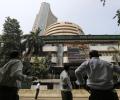
75 companies can dole out Rs 1.1 trillion from the 'extra cash' to shareholders.

Riding on a strong market sentiment, these stocks have outperformed the bellwether. The flip side is, they can fall faster when the tide turns.

The outflows could be a result of a mix of factors led by the underperformance of some of the larger funds amid elevated return expectations.

More than 10% (40 of 498 companies) have lost at least half their market value.

Business cycle funds aim to optimise returns by aligning their portfolios with different phases of the economic cycle. First-time investors, those who prefer stable sector allocations, and those averse to volatility should steer clear of them.

The S&P BSE Sensex has dipped five per cent, thus far, in CY15.
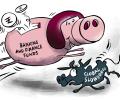
Companies in the banking, finance sector and insurance (BFSI) sector have underperformed on the bourses despite leading the earnings growth charts in the post-pandemic period. This has created a dichotomy between their earnings and share prices. BFSI companies have never been less expensive than the rest of the equity market.

The last four years, the best for corporate profits in a long time, have not been as impressive for corporate capital expenditure. The combined net profits of India's top listed companies excluding banks, financial services, and insurance (BFSI) increased at a compound annual growth rate (CAGR) of 32.4 per cent since FY20, a sharp jump from the 7.4 per cent in corporate earnings between FY14 and FY19.

The Street will thus keep an eye on the operating profit margins over the next couple of quarters.
The post-Covid pandemic boom in corporate revenues appeared to have faded away in 2023-24. Yet, companies have reported a sharp recovery in their profits in FY24, driven by high margins. Their combined net sales, including gross interest income for lenders, rose by a modest 4.8 per cent year-on-year (Y-o-Y) in FY24.

As many as 267 of 453 companies from the BSE500 index are trading above their consensus price targets, according to the data compiled by Bloomberg. Not all companies in the BSE500 index are tracked by analysts.

Domestic new-age companies are making their presence felt at India Inc. According to a study done by Credit Suisse, only 15 per cent of the companies in the BSE500 index were formed after the year 2000. By comparison, nearly 90 per cent of unicorns - a start-up with a value of over $1 billion - were set up after 2000.
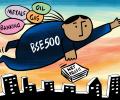
The biggest jump in earnings and decline in P/E multiples has occurred with top companies in metals and mining, corporate banking, and the oil and gas sectors.

rediffGURU Ramalingam Kalirajan answers your personal finance queries.

Corporate margins and profits in India remain vulnerable to changes in crude oil prices in the international market. Historical quarterly data from listed companies (excluding banks, finance and insurance, oil and gas, and power sectors) indicate an adverse correlation between corporate margins and crude oil prices.
An investment worth Rs 1,000 in Reliance Industries' initial public offer about 35 years earlier is now worth Rs 778,000, said its chief, Mukesh Ambani, on Thursday.

Earnings growth, attractive valuations and change in FPI flows from negative to positive over the next 12 months are some of the key triggers for an upside. "A poor monsoon, high inflation and further rate hike are some of the key risks

The past 18 months have seen a resurgence in the real estate industry, with developers regaining the ground lost to the Covid-19 pandemic. But it is once again adding inventory at a pace faster than sales. The industry's inventory rose by 28 per cent year-on-year (Y-o-Y) in H1FY24, com-pared to a 25.5 per cent year-on-year increase in net sales during the same period.

One of the biggest advantages of index funds and ETFs is their low cost, points out Sarbajeet K Sen.
 © 2026 Rediff.com - Advertise with us - Disclaimer - Privacy Policy - Sitemap - Feedback - About us - Terms of use - Grievances