
Leading oil companies dedicated the second day of India Energy Week (IEW) 2025 to announcing strategic deals and business agreements across the supply chain - from sourcing more crude oil supply to deploying more domestic ships and building gas distribution capacity.

The government is likely to provide a subsidy of Rs 35,000 crore to state-owned Indian Oil Corporation Ltd (IOC), Bharat Petroleum Corporation Ltd (BPCL), and Hindustan Petroleum Corporation Ltd (HPCL) to make up for losses they incurred on selling the fuel this fiscal, sources said.

Brokerages expect a further slowdown in Indian firms' revenue and earnings growth in Q4FY25, following low single-digit growth in the preceding three quarters, as factors like weak consumer demand and credit growth linger on.

The Centre may overshoot the Rs 56,260 crore target for dividend receipts from central public-sector enterprises (CPSEs) set for FY25 and is likely to end up getting around Rs 65,000 crore this financial year, according to a senior government official. This excludes dividend from nationalised banks and financial institutions. As on October 21, the Centre collected Rs 28,913 crore as dividend and other investment from CPSEs, accounting for over 50 per cent of the Budget Estimate for FY25.

The wide-ranging sanctions imposed by the US on the Russian oil sector have started to dent near-term oil flows to India with state-owned Bharat Petroleum Corporation Ltd (BPCL) saying not enough cargoes are available for March.

Among the new entries, the largest by market capitalisation are LIC, Avenue Supermarts (DMart), Adani Green Energy, Zomato and Jio Financial Services.

However, copious oil supplies amid growing global output and slowing Chinese oil consumption will put India in a better bargaining position with Gulf suppliers.
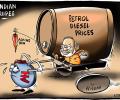
Price of international crude oil - the raw material for making petrol and diesel - dropped to a three-year low before marginally recovering but a revision in domestic petrol and diesel rates is likely only if lower rates are sustained, industry sources and officials said. Global oil benchmark Brent crude futures fell below $70 per barrel on Tuesday - the first time since December 2021 - but gained thereafter after Hurricane Francine hit crude supply in the Gulf of Mexico. Brent rose above $71 a barrel on Thursday while West Texas Intermediate advanced to trade near $68.

Even as Russia and West Asia have been slugging it out for market share in India to sell their crude oil, the US is quietly making its moves on the sidelines. The US has doubled its share of the Indian crude market in the past few months, according to industry sources and ship-tracking data. Some of the increase in America's market share may have come at the expense of Russia, India's biggest crude oil supplier, said industry sources.

The operation went on for 66 hours after a giant 120 feet x 120 feet hoarding collapsed on a petrol pump in the Chheda Nagar area during gusty winds on Monday evening, the official said.

'There's significant interest from both existing and new sponsors who recognise the value of associating with Olympic athletes.'

India may have to lean more on West Asian nations for supplies of liquefied petroleum gas (LPG), a cooking fuel, in the coming years after Indian state-run refiners drew up big plans to diversify into producing more profitable petrochemicals. This shift leads to reduced LPG output, Indian refining executives said. The mantra for state-run oil companies, from Indian Oil Corporation (IndianOil) to liquefied natural gas (LNG) importer Petronet LNG, which are looking to diversify their businesses from lower-margin fuels, has been value-added petrochemicals.

The market responded positively to the Q1 results of oil marketing companies (OMCs), Bharat Petroleum Corporation (BPCL) and Hindustan Petroleum Corporation (HPCL) despite numbers being weaker than consensus. BPCL's reported gross refining margin (GRM) was in line at $7.9 per barrel (bbl) in Q1FY25, which implies marketing margin stood at Rs 4.8 per litre. Standalone profit after tax or PAT at Rs 3,000 crore was down versus consensus due to under-recoveries in LPG business.

International oil prices continue to be extremely volatile, falling on one day and rising thereafter, a top oil ministry official said explaining the reason behind no reduction in petrol and diesel prices despite softening in input cost, but could not say if the rates will be cut before Maharashtra elections. Global oil benchmark Brent crude futures fell below $70 per barrel last week -- the first time since December 2021 -- but gained thereafter. Brent was trading at $74.58 per barrel on Thursday while West Texas Intermediate advanced to trade at $71.71.
Indian imports of Russian crude oil may stabilise or even decline in 2024 from record 2023 levels amid shrinking discounts, lower output, and a rebound in West Asian supplies, according to the ship-tracking data and industry executives. This may impact the billions of dollars in annual savings that India made last year. Imports of Russian oil jumped by a record 140 per cent in calendar 2023 to 1.79 million barrels a day (b/d) from 740,400 b/d in 2022, when Russia marched into Ukraine in February, and from just 102,000 b/d in 2021, according to the data from Paris-based market intelligence agency Kpler.

'The Paris Olympics has once again blessed the Indian sports marketing landscape with fresh faces and promises.' 'Expect at least one biopic.'

This is the case even though the benchmark index is only 5 per cent below its all-time high. The list of stocks trading at a discount primarily consists companies in the automotive, banking, oil and gas, insurance, healthcare, and metal sectors.

'We are in a position to start due diligence and private data room access shortly.'

Indian Oil Corporation (IOC) on Tuesday reported halving of its March quarter net profit largely because of losses in the petrochemical business and shrinking margin after it announced a pre-election fuel price cut despite rising input costs. The net profit of Rs 4,837.69 crore in January-March compared to Rs 10,058.69 crore a year back and Rs 8,063.39 crore in the preceding October-December quarter, according to a stock exchange filing by the company.
Escalation of the conflict in West Asia between Israel and Iran has had a direct impact on the energy markets, and more broadly on the financial markets as well as the global economy.

Billionaire Mukesh Ambani's Reliance Industries has maintained its highest ranking among Indian corporates in the latest Fortune Global 500 list, jumping 16 places to rank at number 88. Reliance was ranked at number 104 in the 2022 ranking and in the 2023 ranking it is placed at number 88, according to the publication. The company has gained a whopping 67 places in the last two years from number 155 in 2021.

Indian imports of Russian oil plunged by a record in August month-on-month (M-o-M) as discounts on the fuel shrank in tandem with rising Brent oil prices. Higher crude prices will drive inflation or hurt earnings at oil companies and India's fiscal position if such spikes are not passed on to consumers. Indian purchases of Russian crude declined by around 24 per cent in August from July to the lowest level since January, with refiners expecting volumes to drop further amid rising rates of Russian benchmark Urals grade, substantial stocks at refiners, and planned maintenance at Indian refineries, according to ship tracking data and industry officials.

The top-notch faculty at Crotonville, including Noel Tichy, Ram Charan, Vijay Govindarajan, along with GE's top leaders Jack Welch, Gary Reiner, Bill Conaty, Jeffrey Immelt and Susan Peters, together delivered sought-after programmes on leadership to generations of early-stage leaders, mid-tier and senior managers from all over the world, recounts Indrajit Gupta.

Notwithstanding the recent sharp decline in the stocks of public sector companies, analysts at Jefferies remain bullish on this segment. State Bank of India, Coal India, and NTPC are their top picks in this space, they said in a recent note. The public sector undertaking (PSU) or state-owned enterprise (SOE) index, with a 70-percentage-point outperformance versus the National Stock Exchange Nifty50 over the past 12 months, comes after a decade of underperformance before 2020.

Truck drivers protesting against a provision in the new penal law on hit-and-run road accidents, called off their strike in Nashik district of Maharashtra on Tuesday after the local authorities assured to look into their demands.

Stocks of Hindustan Petroleum Corporation Limited (HPCL), Bharat Petroleum Corporation Limited (BPCL) and Indian Oil Corporation Limited (IOCL) have more headroom left despite the sharp run in the last few weeks, suggests a recent report from Morgan Stanley. Stocks of these oil refining and marketing companies (OMCs), it believes, are seeing multiples re-rate as investors reassess long-term growth prospects. "IOCL trades at one year forward P/BV of 1.2x, 19 per cent below +1 standard deviation (SD); BPCL trades at one year forward P/BV of 1.5x, near historical averages; HPCL trades at one year forward P/BV of 1.5x, near +1SD," Morgan Stanley said.
India's crude oil imports from Russia fell for a second straight month in January to its lowest in 12 months but the nation's insatiable appetite for Russian crude remains for the long term, according to data from energy cargo tracker and industry officials. Russia supplied 1.2 million barrels per day of crude oil to India in January, down from 1.32 million barrels in December and 1.62 million barrels in November 2023, according to data from energy cargo tracker Vortexa. Russia however continues to remain India's top oil supplier, accounting for a little less than a quarter of 4.91 million barrels a day of oil that the world's third largest energy consumer imported in January.
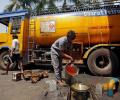
Investors shunned shares of oil marketing companies (OMCs) on Friday as they feared that the government's decision to cut retail prices of petrol and diesel could hurt the companies' profit margins in the near term. On Thursday, the government announced that OMCs will reduce pump prices of petrol and diesel after a record 22 months, making them cheaper by Rs 2 per litre in the national capital. The changes were effective from Friday.

Operating margins have been the primary driver of corporate earnings in India in recent quarters, despite revenue growth suffering from weak consumer demand. Companies across sectors have reported a sharp improvement in earnings before interest, tax, depreciation, and amortisation (Ebitda) margins over the past two years, benefiting from lower commodity and energy prices. Higher margins more than compensated for slower revenue growth, resulting in double-digit growth in net profit for five consecutive quarters.
There is no payment problem for Russian crude, Petroleum and Natural Gas Minister Hardeep Singh Puri said on Wednesday. He said there is no proposal to cut retail fuel prices at the moment. Addressing a press conference, the minister said India enjoys a buyers' position and foreign suppliers are approaching Indian companies with offers to sell oil.

Jet fuel or ATF price on Wednesday was cut by almost 6 per cent after four rounds of monthly increases since July, while commercial cooking gas (LPG) rates were raised by a steep Rs 101.5 per 19-kg cylinder in line with international benchmarks. However, the price of domestic LPG - used in household kitchens for cooking purposes - remained unchanged at Rs 903 per 14.2-kg cylinder. Aviation turbine fuel (ATF) price was cut by Rs 6,854.25, or 5.79 per cent, in the national capital to Rs 111,344.92 per kl from Rs 118,199.17, according to a price notification of state-owned fuel retailers.

Notwithstanding concerns about lofty valuations, smallcaps recorded their most significant monthly gain in nearly three years in November. The National Stock Exchange Nifty Smallcap 100 finished the month with a 12 per cent gain, the most since February 2021 when it rose by 12.2 per cent. After declining by 4.1 per cent in the preceding month, the Nifty Midcap 100 rose by 10.4 per cent, the most since July 2022.

State-owned fuel retailers are losing close to Rs 3 per litre on selling diesel while the profit on petrol has trimmed due to recent firming up in international oil prices, industry officials said detailing reasons for continuing to hold retail prices. Indian Oil Corporation (IOC), Bharat Petroleum Corporation Ltd (BPCL) and Hindustan Petroleum Corporation Ltd (HPCL), who control roughly 90 per cent of India's fuel market, 'voluntarily' have not changed petrol, diesel and cooking gas (LPG) prices for almost two years now, resulting in losses when input cost was higher and profits when raw material prices were lower.
The oil industry experienced three upheavals between 1973 and 1991, which seem to be etched in the memory of the industry's decision makers. Naturally, at the sign of a new crisis, the decision makers like to dip into those tumultuous decades to find ways to deal with the new shock, in addition, of course, to expert reports and forecasts. So, the industry bigwigs turned the pages of history to get a peek into the future of oil price movements after Russia invaded Ukraine in 2022, Israel attacked Gaza in 2023, Iran-linked Houthi rebels pounded tankers crossing the Red Sea in support of Palestine the same year, and Iran rained missiles on Israel in 2024.
After a spike in crude oil and gas prices in October following the Hamas terror attack, prices eased down 9 per cent month-on-month in November. The Organization of the Petroleum Exporting Countries (Opec) and Opec+ agreed to a further voluntary production cut in January-March 2024 to try and support global crude prices. The best guess here is that crude prices (currently at $75/barrel, or bbl) will not likely cross significantly above $80, and gas prices are also likely to remain subdued unless there's a further escalation in the Israel-Hamas conflict.
Petrol and diesel prices were cut by Rs 2 per litre each as state-owned oil companies ended a nearly two-year-long hiatus in rate revision, just hours before the general election schedule was announced.
Even as banks and finance companies are reporting record-high earnings, their weighting in the benchmark National Stock Exchange Nifty50 Index has seen a downward trajectory. Investors expect a stronger performance from other sectors in the new year. Currently, banking, financial services and insurance (BFSI) companies collectively hold a weighting of 34.5 per cent, down from 36.7 per cent at the end of December 2022 and a record high of 40.6 per cent at the end of December 2019. This represents the sector's lowest weighting in the index since December 2021 when it stood at 33.7 per cent.

The Centre could further moderate its divestment target for 2024-25 (FY25), as it does not expect large receipts from asset sales - except some ongoing strategic ones, including IDBI Bank, which could spill over into next financial year. Also, it may drastically reduce its FY24 divestment target of Rs 51,000 crore. "We are still evaluating the Budget estimates for FY25. "New big-ticket asset sales are unlikely.

Airfares in the country are set to rise, with IndiGo on Thursday introducing a fuel charge of up to Rs 1,000 based on a flight's distance, in response to the significant rise in aviation turbine fuel (ATF) prices in the last three months. The Indian aviation sector experiences its peak travel season between October and December. The inclusion of a fuel charge component in airfares is anticipated to have a sizable impact on IndiGo's passengers, according to experts.
Jet fuel or ATF price on Tuesday was hiked by a steep 8.5 per cent - the second increase in a month, while commercial cooking gas rate was cut by Rs 100 per cylinder in line with divergent trends in international benchmarks. Aviation turbine fuel (ATF) price was increased by 7,728.38 per kilolitre, or 8.5 per cent, in the national capital to Rs 98,508.26 per kl, according to a price notification of state-owned fuel retailers. Rates, which vary from state to state depending on the incidence of local sales tax or VAT, have been increased on firming up of global rates that followed four months of decline.
