
Gold prices have surged nearly 18 per cent, so far, in the calendar year 2022 (CY22) to around $2,050 per ounce against the backdrop of the ongoing Russia-Ukraine war and there is more headroom over the next few months, believe analysts at Goldman Sachs who expect the yellow metal to become costlier by another 25 per cent to $2,500 an ounce by the year-end. Goldman Sachs, earlier, had raised its 12-month gold price forecast to $2,150 per ounce considering that an impending US growth slowdown would lead to increased concerns of a US recession and incentivise 300 tonnes of inflows into gold ETFs. At the beginning of the Russia-Ukraine tensions, Goldman Sachs had suggested the resultant rally in commodities could deteriorate the developed market (DM) growth-inflation mix, increase concerns of a American recession, and push gold ETF inflows to 600 tonnes and, in turn, lift gold prices to $2,350 an ounce in 12 months.

Equity markets began the new financial year with smart gains on Friday, with the Sensex rallying over 708 points to recapture the crucial 59,000-mark following gains in index majors HDFC twins and Reliance Industries, along with foreign fund inflows. On the first day of trading in the new financial year, the BSE barometer rallied 708.18 points or 1.21 per cent to settle at 59,276.69. During the day, it jumped 828.11 points or 1.41 per cent to 59,396.62. The broader NSE Nifty advanced 205.70 points or 1.18 per cent to settle at 17,670.45.

In twin blows to Indian economic revival, higher food prices drove retail inflation to a five-month high of 7.4 per cent while factory output fell for the first time in 18 months. The second consecutive month of rise in consumer price index (CPI)-based inflation will add to the pressure on the Reserve Bank of India (RBI) to again raise interest rates to tame high prices. Inflation has been above the targeted zone for the ninth month in a row and as per statute, the RBI will now have to explain to the government in writing why it failed to keep prices below 6 per cent.

'I never thought that a first-timer like me would enter any chart, let alone one of the Billboard charts.'

Reacting sharply to Banerjee's fulminations, the Congress struck back pointing out that Prime Minster Narendra Modi's and her stand were similar, with one seeking a 'Congress 'Mukt' (Free) India' and the other, an 'Opposition coalition sans Congress'.

The Budget oration of the finance minister and the confidence with which she delivered it, along with the measures and the recent upsurge in the economy would all contribute to unleashing the storied 'animal spirits' and help the economy run on the growth path quite smoothly. Or so the government hopes, notes Shreekant Sambrani.

India's industrial production growth slowed down for a fourth straight month in December to 0.4 per cent mainly due to a poor performance by the manufacturing sector. The manufacturing sector, which constitutes 77.63 per cent of the Index of Industrial Production (IIP), contracted by 0.1 per cent in December, according to the data released by the National Statistical Office (NSO) on Friday. In December 2021, the mining output rose by 2.6 per cent, and power generation increased by 2.8 per cent.

The interim application says that police force was saying in Marathi "inko maaro maro maro".

The protesters first assembled at the Sheikhpora area of Budgam district, in central Kashmir, and then tried to proceed towards the airport but were stopped by a posse of police personnel, they said.

Investors' wealth jumped over Rs 59.75 lakh crore in the 2021-22 fiscal, helped by a largely buoyant trend in domestic stocks with benchmark index Sensex surging over 18 per cent during the period. Braving many headwinds in the latter part of the current fiscal, Sensex closed the 2021-22 financial year with a gain of 9,059.36 points or 18.29 per cent. Mirroring optimism in equities despite worries related to geopolitical tension, inflation concerns, FII selling, the market capitalisation of BSE-listed firms rallied by Rs 59,75,686.84 crore to Rs 2,64,06,501.38 crore in the entire 2021-22 fiscal.
The Centre's decision to not reduce the face value of shares of India's Crown Jewel - Life Insurance Corporation (LIC) - was taken to make shareholders feel they are acquiring something 'precious'. The face value of LIC's shares was retained at Rs 10, quoted in the draft prospectus, as it would also align the insurer's shares with those of its private sector peers. Even as the LIC Act was amended to "consolidate or reduce the nominal or face value of the shares", with the Centre's approval, it was decided to stick to the current face value of shares at Rs 10 without splitting the existing 6.32 billion shares.

'Bharat has been leading, but it cannot carry India as the bulk of the sales come from India in terms of volume and profitability.'
IndusInd Bank was the top gainer in the Sensex pack, rallying over 7 per cent, followed by SBI, ICICI Bank, HDFC twins, Axis Bank, Bajaj Finserv and UltraTech Cement. NSE Nifty soared 245.35 points to 14,923.15.
Industrial production grew 11.9 per cent in August mainly due to a low-base effect and good performance by manufacturing, mining and power sectors that surpassed the pre-COVID level. The manufacturing sector, which constitutes 77.63 per cent of the Index of Industrial Production (IIP), grew 9.7 per cent in August, according to the data released by the National Statistical Office (NSO) on Tuesday. The mining sector output rose 23.6 per cent in August, while power generation increased 16 per cent.

The 50-scrip NSE barometer Nifty declined 43.80 points, or 0.41 per cent, to close at 10,570.55

On the Sensex chart, IndusInd Bank, Axis Bank, Tech Mahindra, HDFC, ICICI Bank, HCL Tech, HDFC Bank, SBI and ITC were prominent gainers.

On the Sensex chart, index heavyweight HDFC rallied over 8 per cent. Other prominent gainers were IndusInd Bank, Mahindra and Mahindra, Asian Paints, Bajaj Finance, HDFC Bank and Ultratech Cement.

Stock market barometers Sensex and Nifty ended marginally higher on Monday as rise in wholesale inflation capped early gains despite a positive trend in global markets. The 30-share index settled 32.02 points or 0.05 per cent higher at 60,718.71 with half of its constituents ending in green. The broad based Nifty edged up 6.70 points or 0.04 per cent to close at 18,109.45.
India's industrial production rose 3.1 per cent in September, according to official data released on Friday. As per the Index of Industrial Production (IIP) data by the National Statistical Office (NSO), the manufacturing sector's output surged 2.7 per cent in September 2021.

Investors turned cautious as trade war concerns between the US and China escalated and a persistent weakness in the rupee became lingering concerns leading to volatility in the market

Dr Reddy's, Maruti, Bharti Airtel, Bajaj Auto, Infosys, TCS and Bajaj FinServ were the major losers. On the other hand, IndusInd Bank, Sun Pharma, ICICI Bank and HDFC Bank ended with gains.

India's industrial production growth remained subdued for the second straight month and expanded by 3.2 per cent in October, mainly due to the waning low base effect while mining, power and manufacturing sectors performed well. The manufacturing sector, which constitutes 77.63 per cent of the Index of Industrial Production (IIP), grew two per cent in October, according to data released by the National Statistical Office (NSO) on Friday. The mining sector output rose 11.4 per cent in October, while power generation increased 3.1 per cent.

On the Sensex chart, IndusInd Bank, SBI, Dr Reddy's, NTPC, ICICI Bank, HCL Tech and Bajaj FinServ emerged as major laggards.
Top performers were PowerGrid, ONGC, Ultratech Cement, Asian Paint, Kotak Bank and Titan. Nifty settled with a gain of 232.40 points at 14,761.55.

'The nervousness is to deliver and if we do well, the nervousness will be, what do we do from here.'

Ultratech Cement, TCS, Kotak Mahindra, M&M, Maruti, IndusInd Bank and Bajaj Auto were the prominent gainers. On the other hand, ICICI Bank, Nestle, Asian Paints, ONGC and ITC ended in the red.
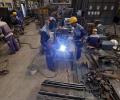
Industrial production growth entered positive territory after a gap of two months with a record 22.4 per cent rise in March this year, mainly due to the low-base effect and good show by manufacturing, mining and power sectors. The manufacturing sector -- which constitutes 77.63 per cent of the index of industrial production (IIP) -- grew by 25.8 per cent in March 2021, as per the data released by the National Statistical Office (NSO) on Wednesday. The mining sector output too grew 6.1 per cent in March, while power generation increased by 22.5 per cent.

Industrial production surged by 13.6 per cent in June mainly due to a low-base effect and good performance by manufacturing, mining and power sectors but the output remained below the pre-pandemic level. The manufacturing sector, which constitutes 77.63 per cent of the Index of Industrial Production (IIP), grew by 13 per cent in June this year, according to the data released by the National Statistical Office (NSO) on Thursday. The mining sector output rose by 23.1 per cent in June while power generation increased by 8.3 per cent.

The crime branch has so far arrested 12 persons, including Republic TV's distribution head and owners of two other channels, in connection with the case.

Raising slogans against Lt Governor Manoj Sinha and the administration, the demonstrators, mostly government employees posted in the troubled valley and their kin, demanded that they be provided adequate security or be transferred to Jammu. The employees also threatened en masse resignation from their jobs.

'Making money in such markets is typically harder and investors need to put in considerable effort to identify stock ideas over the year.'

Among major Sensex movers, Ultratech Cement rose over 4 per cent, Bajaj Finance by 2.63 per cent and Maruti by 2 per cent. BSE Sensex closed up by 133.14 points at a record high of 47,746.22. NSE Nifty rose by 49.35 points at its lifetime high of 13,981.95.

'Dasgupta misused his official position and manipulated TRP of specific news channels broadcast by ARG Outlier Media Pvt Ltd such as Republic Bharat Hindi and Republic TV English,' the police alleged in its remand note.
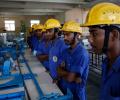
January 2019 saw the maximum number of employment being generated since the data from September 2017, reports Indivjal Dhasmana.
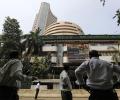
Kotak Bank was top loser among Sensex stocks, dropping by 3.28 per cent. HDFC Bank declined by 1.86 per cent, HDFC by 1.28 per cent and ICICI Bank by 0.99 per cent. SBI fell 0.5 per cent while Bajaj Finance by 0.72 per cent. Larsen & Toubro dropped 0.16 per cent.

TCS was the top loser in the Sensex pack, falling over 3 per cent, followed by Titan, ICICI Bank, SBI, ITC and Bharti Airtel. On the other hand, Sun Pharma, NTPC, IndusInd Bank and Bajaj Finance were among the top gainers.

On the Sensex chart, Bajaj Finance, HUL, RIL, ONGC and HDFC emerged as the top gainers.

Industrial production contracted by 1.9 per cent in November, entering the negative territory after a two-month gap, mainly due to poor showing by manufacturing and mining sectors, official data showed on Tuesday. The manufacturing sector -- which constitutes 77.63 per cent of the index of industrial production (IIP) -- recorded a contraction of 1.7 per cent in November 2020, as per data released by the National Statistical Office (NSO). Mining sector output too witnessed a decline, shrinking 7.3 per cent.

Five years after demonetisation, which sought to curb black money and reduce cash circulation in the economy, 70 per cent of respondents said they paid a large component of the total payment towards a real estate transaction in cash. About 16 per cent said they paid over half the amount in cash, observes Shyamal Majumdar.
The 50-share NSE Nifty slipped below the 10,200-mark by falling 47.20 points, or 0.46 per cent, at 10,192.95 after hovering between 10,169.85 and 10,296.55.
 © 2026 Rediff.com - Advertise with us - Disclaimer - Privacy Policy - Sitemap - Feedback - About us - Terms of use - Grievances