
India and the United States are destined to be partners at the world stage due to their shared common values and outlooks on a wide range of issues, the Pentagon has said as US Deputy Secretary of Defence Ashton Carter concluded his highly successful trip to New Delhi.

'Of all the areas that define the future for a strong US-India partnership, none is more important than our defence and security ties.'

Vikram J Singh, the highest-ranking Indian American at the Pentagon is quitting his administration job to head up the national security division at the Center for American Progess -- a Washington, DC progressive think tank with close links to President Obama -- which has at its helm another Indian American, Neera Tanden.
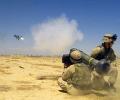
The defence ministry is finalising a decision to allow the FGM-148 Javelin missile, built by US companies Lockheed Martin and Raytheon, into a contest to supply the Indian Army with anti-tank guided missiles. This is bad news for Israelis

Carter has said India's designation as a 'major defence partner' would allow the US to cooperate with it --

Admiral Samuel J Locklear III, Commander of the US Pacific Command, has not ruled out militants fighting in Afghanistan today switching their attention back to Kashmir post-US and NATO withdrawal of its troops from Afghanistan, and expressed concern over the recent terrorist attacks across the Line of Control that has exacerbated tensions between India and Pakistan.

New Delhi remains a priggish suitor to Washington's overtures, but it has begun appreciating potential tech benefits to ties with the US.

There's still little indication of forward movement in Indo-US defence relations.

With the United States delivering an increasing share of India's arms imports, New Delhi must work with it to retain control of our regional waters

If the aim is to become a player with some strategic space of its own, not just in the Indian Ocean region but also in the adjoining region, then greater interaction with China is desirable, even necessary.

Ever pragmatic, the Americans are convinced that the future is in the Indo-Pacific.
There is a new Indo-Pacific century, and India has to decide whether it has its eyes on the prize, says Rajeev Srinivasan.

'One lesson to emerge out of the Modi-Putin summit is that India can be more self-confident that it possesses inherent strengths to leverage its interlocutors to influence Pakistani policies,' says Ambassador M K Bhadrakumar.

Instead, increases in foreign-direct-investment levels; and reforms to make labour, land and capital more mobile.

'We use the word "historic" perhaps too much, but the prime minister's visit certainly was historic in so many ways.'

'If there's one administration that would be likely to put the squeeze on Pakistan, it's the Trump administration.' 'This is an administration that views terrorists as a black and white issue (kill them all, no questions asked), and will have little patience for Pakistan's selective policy toward terrorism.'

'Clearly, from the Indian viewpoint, the US retrenchment from Asia cannot be happening as good news.' 'The abandonment of the US' pivot to Asia exposes the US-Indian partnership to be a mere transactional relationship,' says Ambassador M K Bhadrakumar
 © 2026 Rediff.com - Advertise with us - Disclaimer - Privacy Policy - Sitemap - Feedback - About us - Terms of use - Grievances