
The Supreme Court Wednesday refused to entertain pleas seeking time-bound probe, including by an apex court-appointed commission, into the tractor rally violence in the national capital on the Republic Day saying the government is already inquiring the matter and the Prime Minister has stated that law will take its own course.

Two pleas were filed in the Supreme Court on Wednesday over the tractor rally violence on Republic Day, with one seeking the setting up of a commission, headed by a retired apex court judge, to inquire into the incident, while the other urged it to direct the media not to declare farmers as "terrorist" without any evidence.

'This four-member committee cannot supersede the four-five member ministerial committees, 25 top-level government bureaucrats, with whom we have had nine rounds of discussions each of which lasted for more than six-seven hours.'

'Nehru wanted to strengthen industries by exploiting agriculture and that policy was continued by successive governments.'

'Political parties are following the Divide and Rule policy to break the unity of farmers.'

With the talks between the Centre and the agitating farmer unions stalled since January, Agriculture Minister Narendra Singh Tomar on Wednesday expressed readiness to resume the dialogue to resolve their objections to the three new agri laws, but the unions remained adamant on their demands for a repeal of the legislations and a legal guarantee on the minimum support price.
The new governments will have to spend much more than Rs 220 billion in Rajasthan, more than Rs 160 billion in MP, and nearly Rs 30 billion in Chhattisgarh.

The next meeting has been scheduled for January 22, a day after the farmer unions hold their internal discussions on Thursday, farmer leaders said after the 10th round of talks ended at Vigyan Bhawan in New Delhi after nearly five hours of talks, including two breaks.

Finding itself trapped in a cul de sac, all things considered, a negotiated climbdown at this juncture seems the only sensible course available for the Centre, suggests Virendra Kapoor.

A key committee member and president of Maharashtra-based Shetkari Sanghatana, Anil Ghanwat said the farm sector reforms are much needed and no political party in the next 50 years will ever attempt them again if these laws are repealed.

The government's predicament is a result of its own doing: That of not ensuring adequate buy-in by the stakeholders before passage of the laws, notes Vivek Gumaste.

Much of the rural recovery story is based on the premise of agriculture doing well. Even if it clocks a growth of 2.5-3 per cent this year, it is still just around 15 per cent of the overall GDP. The non-farm sector, which constitutes a bigger portion of the overall rural economy, is now hampered by disruptions and lockdowns.

'We will resist it.' 'Farmers will not let that happen.'

Farmer leader Joginder Singh Ugrahan said told reporters after the meeting that the unions urged the government to repeal the three laws, but the Centre was unwilling to do so. "We decided to meet again on January 19 at 12 pm," he said.

The government's negotiations with protesting farm unions hit a roadblock on Friday as the farmer leaders stuck to their demands for a complete repeal of three farm laws they find pro-corporate and a legal guarantee for minimum support price (MSP), even as the Centre asked them to reconsider its proposal for putting the Acts on hold for 12-18 months.

The Supreme Court on Tuesday ordered a stay of the implementation of the contentious three new farm laws hoping this will end the prolonged protests by the farmers and also constituted a four-member panel of agri experts to resolve the impasse between their leaders and the Centre.

Kiran Vissa, co-convenor of National Alliance for Sustainable Agriculture, said that amendments to the EC Act have nothing to do with farmers' welfare but instead meant to please big players and agriculture companies. This is because small and marginal farmers don't have the storage capacity to attract provisions of the EC Act.

Telangana govt currently provides the state's 5.83 million farmers an income support of Rs 4,000 per acre per season, irrespective of the size of their land holding

'Electronic media splash sensational headlines of the bulb prices about to cross the three-figure mark and focus on customers looking longingly at baskets full of onions, bemoaning their misery without this essential staple of their diet,' notes Shreekant Sambrani.

Officials in the weather department said the monsoon is expected to be below normal because of the El-Nino effect.

Experts will give their inputs for Budget.

Governments make budgets to retain and consolidate their hold on power, not to please opponents or economists. They do so by trying to gratify as many as possible without causing harm to the others, says Shreekant Sambrani.

A five-seven per cent agriculture growth in 2013-14 would mean farming might exceed the 12th Five-Year Plan annual growth target of four per cent, if the trend continues.

Agriculture and processed food exports dropped to a five-year low of $24 billion in 2015-16.
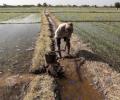
Despite the growing clamour from the central government on India turning digital, and banks requesting direct bank account transfer, the state government decided to hand over cheques to the farmers, which can be immediately converted into cash.
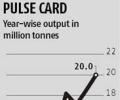
The India Pulses and Grains Association estimates production of kharif pulses at seven mt this year.

The government has the upper hand in the ongoing negotiations, and it is unclear if a real debate will happen, observes Tulika Narayan.

Ahead of his government's first full year budget, Prime Minister Narendra Modi on Friday sought ideas from economists to attract investments, create jobs and finance infrastructure to put India back on high growth path.

'Government is saying that I will not be responsible for ensuring you get MSP but traders and large corporate will be responsible. 'India now is the only country that is saying such things'

The agriculture sector is likely to grow in the range of 5.2-5.7 per cent in 2013-14, nearly three times more than the last year as good monsoon has raised the prospects of bumper harvest, a CACP discussion paper said.

Now, government is also contracting imports.

More than 127 million new bank accounts have been opened.

'This announcement is big foolishness.' 'The government has no idea of economics. They are just announcing what comes to their mind.' 'Let them implement what they have announced and just see what will happen in two years.'

Allegations abound that traders milked the scheme to artificially keep prices down, while a significant amount of growers didn't even register owing to multiple difficulties in registration and were deprived of the payout.
Critics argue that much more could have been done and that the government was slow to react to many events.

Cabinet note being readied, on basis of study, to ensure against foodgrain shortage; might require buffer of up to 50% more.
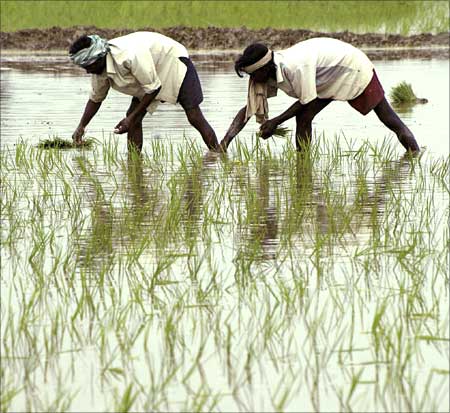
'It is quite natural for our farmers to go for rice and cane when both power and water are almost free.'

'Urjit Patel was not quite the picture of courage, but even he turned, he had to turn.' 'Perhaps there is something that is far more sinister than what we are aware of, which is the reason for his resigation.'

Happiest Minds expects revenue to touch $100 mn in 3 years, the fastest in India's tech services sector.
If the fight against black money seems half hearted, the same is not the case with gau raksha, says Subir Roy.
