
India successfully test-fired two Pralay missiles in quick succession off the coast of Odisha, paving the way for its induction into the military. The missile is indigenously developed and features a state-of-the-art navigation system.

India successfully test-fired the newly-developed tactical missile Pralay, capable of carrying conventional warheads, from APJ Abdul Kalam island off the coast of Odisha. The missile, developed by DRDO, has a range of 150 to 500 km and a payload capacity of 500-1,000 kg.

'Government officials use Gmail and ordinary phones without basic security consciousness.' 'Interoperability, especially in joint exercises with countries like the US, worries me.' 'It often means we open our systems to them, but they don't reciprocate.' 'They could have kill switches in their systems and might even be able to affect ours.'
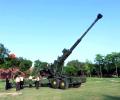
The ATAGS has a range of 35-45 kilometres, depending on the ammunition used, and achieved a 47-km firing range during trials.

The ministry said the rocket system has been upgraded with advanced technologies enhancing the range to meet the emerging requirements.

It said the ATGM has been developed with a capability to launch from multiple platforms and is currently undergoing technical evaluation trials from 120 mm rifled gun of MBT Arjun.

The conversion facilitated range enhancement and improvement in Pinaka's accuracy.

The laser-guided anti-tank guided missile is likely to significantly enhance the fire-power capability of the Indian Army particularly along the frontiers with Pakistan and China, the officials said.

In a major boost to indigenous defence capabilities, the Indian army has assured the Defence Research and Development Organisation an order for over 140 howitzers once the premier research agency proves its artillery guns which are under development.
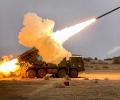
The rocket systems that were tested at Pokharan field firing ranges were manufactured by a private industry following transfer of technology by the Defence Research and Development Organisation.
Defence sources said two rounds of 'Pinaka' were test fired between 1215 IST and 1245 IST.

A salvo from a Pinaka battery brings down on the enemy more than seven tonnes of high explosive in just 44 seconds.
 © 2026 Rediff.com - Investor Information - Advertise with us - Disclaimer - Privacy Policy - Sitemap - Feedback - About us - Terms of use - Grievances