
In a culture where children take up the profession of their father, her becoming a politician was seen as natural and acceptable.

Mrs Gandhi's power ebbed and peaked with the times. Mr Modi's has almost been constant, barring the few months of hard dip after the 240 seats of 2024, points out Shekhar Gupta.
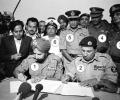
According to recent media reports, a portrait capturing what one general called India's greatest military achievement in 1,000 years -- Pakistan's surrender on December 16, 1971 -- has been removed from the army chief's lounge and been replaced by another painting.

Besides his strategic and tactical acumen, it was his amazing personality, quick wit and ability to remain unflustered under any circumstances that stood him apart from almost any leader one has read about or known, recalls Lieutenant General Syed Ata Hasnain (retd).

'...they were shocked to learn that just 352 Indian soldiers had made 3 brigadiers, 2 colonels, 170 officers, 290 JCOs and 8,000 troops surrender to the Indian Army.'

'The 1971 War was our greatest military victory.' 'It had so many stories of exceptional valour and leadership.'

'We are ready to surrender,' Lieutenant General A A K Niazi said over the phone from Dhaka.

'Beyond the 'sir' and the 'salute', there was a man who cared about his soldiers and that's what made him a great leader.' Field Marshal Sam Manekshaw's grandson Jehan remembers the man who was the soldier's soldier.
'There was plenty of pushing, pulling and jostling going on as everyone wanted to see what was going on at the table.'
On December 10, Kissinger began to encourage the Chinese to take action against India: 'If the People's Republic were to consider the situation on the Indian subcontinent a threat to security, and if it took measures to protect its security, the US would oppose efforts of others to interfere with the People's Republic.' On the 50th anniversary of India's greatest military victory, Claude Arpi recalls how the US suggested that China intervene militarily on Pakistan's side.
December 3, 2021 marks 50 years since the beginning of the 1971 War which ended in a decisive military victory for India and the liberation of Bangladesh. Most analysts of the 1971 War agree that the IV Corps dash across the mighty Meghna river led by the brilliant General Sagat Singh was the turning point in the war, recalls military historian Colonel Anil A Athale (retd).
'You have been surrounded from all directions, if you want the safety of your troops and your personal safety, we will give you eight hours to make up your mind to surrender.'
 © 2026 Rediff.com - Investor Information - Advertise with us - Disclaimer - Privacy Policy - Sitemap - Feedback - About us - Terms of use - Grievances