

In a culture where children take up the profession of their father, her becoming a politician was seen as natural and acceptable.

January 24 will mark the 60th anniversary of Mrs Indira Gandhi becoming the third and the first woman Prime Minister of India.
She was also only the second woman in the world to become prime minister: Sirimavo Bandaranaike of Ceylon (now Sri Lanka) was the first, becoming PM in July 1960.
The fact that the first two women prime ministers in the world came in South Asia is not because women enjoy a better status as much as the fact that dynasty and family lineage are overriding factors.
Indira was elected president of the Congress in 1958
Indira Gandhi was the daughter of India's first prime minister, Jawaharlal Nehru. For years, it was rumoured that Nehru was grooming her to be his successor.
Like many stories pertaining to Nehru, this is just half-true. Indira Gandhi was staying at Teen Murti, New Delhi, with her father, not her husband, to help out in the absence of her mother Kamala who had passed away in February 1936.
Living in the house with the prime minister and essaying the role of hostess whenever dignitaries came visiting gave her tremendous influence, which was not missed by others.
In 1959, the then Union home minister, Gobind Ballabh Pant, asked Indira Gandhi to become president of the Congress party.
Earlier, when Pant mentioned this to Nehru, he did not encourage Pant and later, when Indira sought her father's permission, he seemed cool.
Nevertheless, in February 1958, she did become the president of the Congress party, thereby further cementing her place as a political leader of some importance.
In a culture where children take up the profession of their father, her becoming a politician was seen as natural and acceptable.
But political scientists and historians agree; if she did not have her lineage, there was nothing remarkable about Indira Gandhi and even if she had become a politician, it is most unlikely she would have ever become prime minister.
In 1964, after the demise of Nehru, the top leaders of the Congress debated his successor, and the choice was between Lal Bahadur Shastri (who was chosen) and Morarji Desai. Indira Gandhi's name did come up, but not in a serious way.
She was appointed minister of information and broadcasting in Shastri's Cabinet. According to her biographer Katherine Frank, who authored Indira: The Life Of Indira Nehru Gandhi, a prime motive for accepting this position was her desire for a house and income, since Nehru had left her with little.
But it is also likely that while Indira Gandhi often spoke about leaving politics, she was much too involved to actually do so.
In January 1966, after Shastri's sudden demise, the leadership cabal within the Congress did not want Morarji Desai and decided to support Indira Gandhi. Unlike her reluctance in 1964, she did not hesitate and won easily against Morarji Desai to become prime minister.
ALSO READ: What If Lal Bahadur Shastri Had Not Died In 1966
Since it is virtually impossible to encapsulate her nearly 16 years as prime minister in an article with a limited word count, let's just look at The Best, The Worst, and The Last years of her reign.
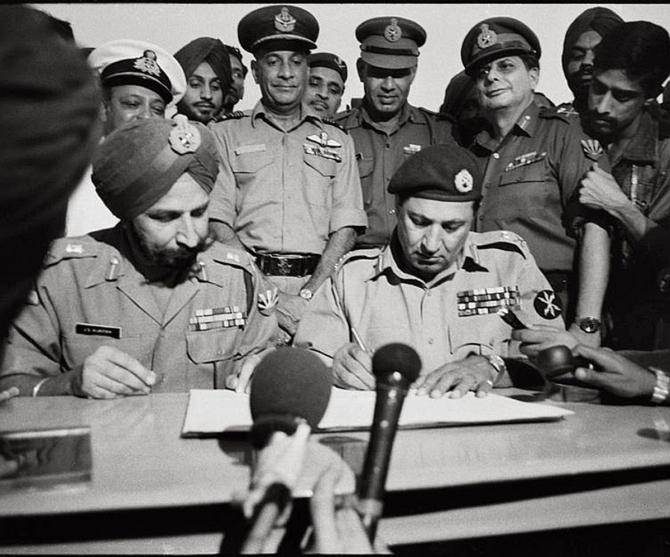
Among the Indian military officers present: Eastern Army Commander Lieutenant General Jagjit Singh Aurora, Major General J F R 'Jake' Jacob, Chief of Staff, Eastern Command, Lieutenant General Sagat Singh, General Officer Commanding 4 Corps and the general who 'liberated' Bangladesh, Air Marshal Hari Chand 'Harry' Dewan, Commander in Chief, Eastern Air Command, Vice Admiral Nilkanta Krishnan, Flag Officer Commanding-in-Chief, Eastern Naval Command. Photograph: DPR Photo Division Archives
Indira Gandhi's Finest Hour
Indira Gandhi's finest hour was the 1971 India-Pakistan war. In March 1971, the military junta ruling Pakistan refused to accept the election result that gave a thumping majority to the Awami League, which had swept what was then the Bengali-speaking East Pakistan.
Egged on by Zulfikar Ali Bhutto, a civilian politician from Sindh, the Pakistani army cracked down on the Awami League and the protestors in East Pakistan, killing and jailing thousands.
The West Pakistani-dominated army's atrocities drove millions of East Pakistan's Bengali refugees into India.
It was a humanitarian crisis of gargantuan proportions, and one that India simply couldn't afford.
With the world not heeding India's pleas to put pressure on Pakistan to stop the carnage, New Delhi had little choice but to act on its own.
With the US and the West sympathetic to Pakistan and Beijing having already formed a friendship with Islamabad, Indira Gandhi reached out to the Soviet Union to form an alliance, thus taking care of any adventure that China may be tempted to undertake. Next was the question of striking Pakistan.
The story goes that Indira Gandhi wanted to attack Pakistan in April 1971 itself, but the then chief of army staff, General Sam Maneckshaw, said the army wasn't yet ready.
As the situation worsened, she demanded the army move into East Pakistan in August, but General Maneckshaw refused, pointing out that in the monsoons it would be difficult to move tanks across flooded rivers that run through East Pakistan.
Finally, when in November, she asked if the army was ready, General Maneckshaw said they were, and awaiting her signal.
The army was already helping the Mukti Bahini, the Bengali rebels fighting the Pakistani army in East Pakistan.
Indira Gandhi didn't have to give the signal to attack. Pakistan launched pre-emptive air strikes on the evening of December 3, 1971. India responded by declaring war and the army moved into East Pakistan while engaging with the Pakistani forces in the west.
With brilliant tactics and moving rapidly, the Indian Army reached Dhaka on December 16 1971. The 14-day war changed the map of the world. A new country, Bangladesh, was born.
The victory reverberated across India and the world. The shame of 1962 was buried and Pakistan clearly reduced to a second-rate power in South Asia. Indira Gandhi was hailed across India and the world.
Jan Sangh leader Atal Bihari Vajpayee called her 'Durga', Indians saw her as 'Shakti', and an American Gallup poll found that she was the most admired person in the world (do remember, the Nixon administration had not supported India during the war)!
The only problem about being at the pinnacle of success is that all roads lead down. It came quickly, too quickly.
Crisis Time For Indira
India suffered a drought in 1972, even as it was still grappling with the pending bills of the 1971 War and the millions of refugees still stuck in India.
Adding to India's woes was a decision by OPEC (Organization of Petroleum Exporting Countries), an organization few cared about before 1973 and which no one would forget post 1973.
OPEC, comprising many Arab nations and who were still seething from their defeat to Israel in 1967 and the Six Day War in 1973, decided to double the price of petroleum. Overnight.
Transportation costs soared as did inflation. India, dependent on petroleum imports, was hit hard. Food prices hit the roof, followed by strikes across India as workers demanded higher wages.
The most impactful was the railway strike in May 1974, called by trade unionist George Fernandes that nearly paralysed India.
In 1975, things got worse. The judgment of a case, Raj Narain vs Indira Gandhi, in the Allahabad high court was coming up. It was a weird case.
Raj Narain was Indira Gandhi's opponent in the Rae Bareli Lok Sabha constituency in the 1971 election. He, of course, lost, but claimed that Indira Gandhi used government resources during her campaign.
India's laws do not permit the use of government resources in elections to give all contenders an equal chance.
The judge, Justice Jaganmohanlal Sinha, ruled against Indira Gandhi. Forget being the PM, Indira Gandhi's position as an MP was under threat. Her many enemies were baying for her to resign.
Indira Gandhi responded by imposing a state of Emergency, citing internal threats to the unity and integrity of India. Overnight, Opposition leaders were jailed and a strange calm descended upon India.
When elections were due in 1976, a pliant Parliament voted to delay elections, which was possible since the Constitution was suspended.
In 1975 and 1976, India was rocked by strikes and rallies, post July 1975 and in 1976, the nation was peaceful. As the wags noted, trains ran on time!
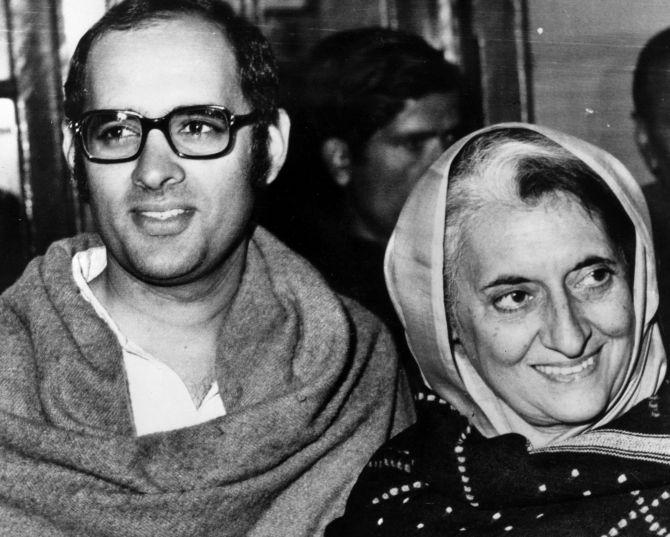
But beneath the calm, the waters were roiling. Indira Gandhi's younger son Sanjay began exercising power while holding no official or political post.
Particularly egregious was his sterilisation drive to bring down India's population. Government doctors and officials were given daily targets to achieve, and in their desperation, they began rounding up people on the streets and sterilising them.
The anger, especially among the poor, who found themselves at the receiving end of the sterilisation drive, was phenomenal.
In March 1977, Indira Gandhi lifted the Emergency and called for elections, believing she would win. She was wrong.
The various Opposition parties got together with the singular aim of defeating her. The excesses of the Emergency were still fresh and in the ensuing elections, the Congress (I) was wiped out in north India, though it did perform better in south India.
Nearly 30 years after Independence, India had its first non-Congress government. India had overcome the assault on its democracy.
The Return Of Indira Gandhi
The Janata Party, which defeated Indira Gandhi in 1977, had too many internal contradictions and soon fell.
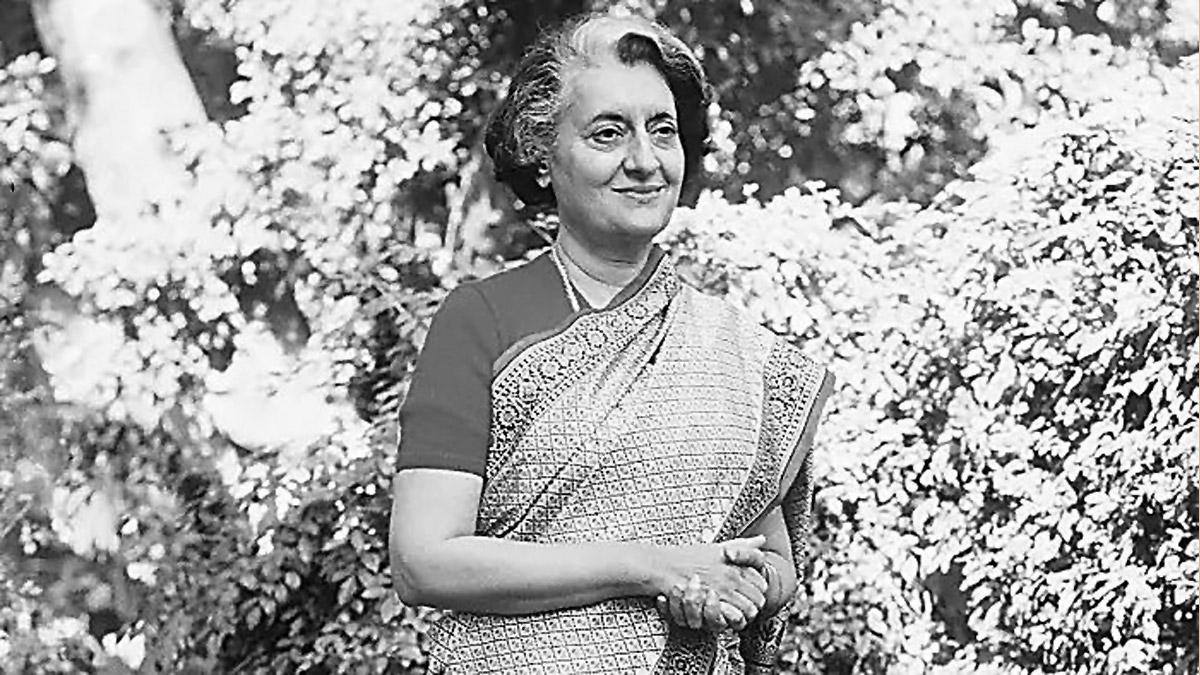
Elections were held in January 1980 and Indira Gandhi returned to office, becoming prime minister once more on January 14, 1980.
Her son Sanjay too was elected, but died just a few months later, in June 1980, in an air crash while trying out aerobics.
This led to the entry of her elder son Rajiv, till then a pilot with Indian Airlines, to don the politician's cap.
The impression was clear: He would succeed her (and he did). This was dynastic politics at its peak.
In the late 1970s and early 1980s, the long dormant movement for a separate Sikh country, to be called Khalistan, gained new life, supported by wealthy members of the Sikh diaspora.
The movement turned violent in Punjab, with hundreds of Hindus and Sikhs killed by terrorists, all ostensibly to advance the cause of Khalistan.
Indira Gandhi appeared unable to control the situation in Punjab. As Mark Tully and Satish Jacob write in their book, Amritsar: Indira's Last Battle, the Congress party played a duplicitous role by supporting the Sikh extremists just to get one-up on the Shiromani Akali Dal, the Congress party's main Opposition in Punjab.
Never before had such shortsightedness hurt so many so much.
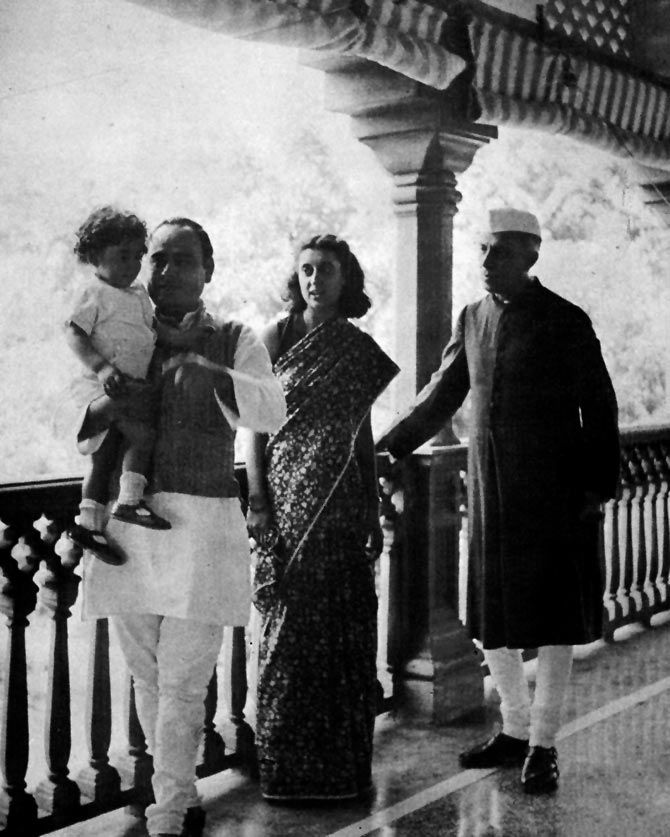
Jawaharlal wanted Indira to add 'Nehru' to Rajiv's name. Photograph: Kind courtesy Wikimedia Commons/Kind courtesy Juggernaut
In 1982, the extremist elements, led by Jarnail Singh Bhindranwale, lodged themselves within the Golden Temple, considered the holiest Sikh shrine.
From the precincts of the temple, they led the movement for Khalistan, with people being killed every day.
In 1984, the emboldened terrorists were on the verge of declaring an independent Khalistan state, which would have been recognised by Pakistan.
The country appeared helpless; Indira Gandhi even more so. In desperation, she finally asked the army to flush out the terrorists.
In June 1984, the army successfully carried out Operation Blue Star, but sending troops into the Golden Temple was a tactic that angered millions of Sikhs, including many who had never supported the Sikh extremists.
It was perceived as a violation of their faith. The operation achieved its purpose: The extremists hiding within the Golden Temple complex were taken out, but the scar was deep.
On October 31, 1984, two Sikh bodyguards of Indira Gandhi assassinated her, in revenge for Operation Blue Star.
Ironically, when her security officers were keen to transfer out her Sikh bodyguards in the aftermath of Op Blue Star, she had refused.
Most Indians grieved deeply, convinced that she was martyred for saving a united and integrated India.
Feature Presentation: Aslam Hunani/Rediff



 © 2026