
Kwatra termed India's successful launch of an American communication satellite on Wednesday as a 'very important and big day' for partnership between Washington and New Delhi, saying it caps a series of achievements in 2025 in bilateral space cooperation between the countries.
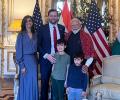
Prime Minister Narendra Modi met with US Vice President J D Vance and his family, Estonian President Alar Karis, and UN Secretary General Antonio Guterres on the sidelines of the AI Action Summit in Paris. The meetings focused on bilateral relations, AI collaboration, and trade opportunities. Modi also invited Estonia to explore opportunities in India's growth story. He concluded the summit by expressing India's willingness to host the next AI Action Summit.
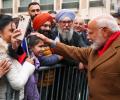
Prime Minister Narendra Modi arrived in France on a three-day visit during which he will co-chair an AI Action Summit with French President Emmanuel Macron and hold bilateral talks with him. Modi will also be warmly greeted by the Indian community and address the India-France CEO's Forum. The visit will include a visit to the Mazargues War Cemetery and the inauguration of the new Indian Consulate General in Marseille.
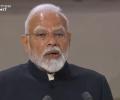
Prime Minister Narendra Modi advocated for a global framework for artificial intelligence (AI) based on open source, emphasizing the need for trust, transparency, and the elimination of biases. Co-chairing the AI Action Summit with French President Emmanuel Macron, Modi highlighted the transformative potential of AI across various domains, including politics, economics, security, and society. He stressed the importance of democratizing technology, addressing concerns about cyber security and disinformation, and developing quality data sets free from biases. Modi also acknowledged the need for open-source AI ecosystems to foster trust and transparency, while emphasizing the importance of localized technology for effectiveness and usefulness. Recognizing the potential of AI to improve health, education, and agriculture, Modi proposed pooling resources and talent to leverage the technology for sustainable development goals. Addressing concerns about job displacement, he emphasized that while the nature of work may evolve, technology creates new opportunities. Modi highlighted India's leadership in AI adoption and data privacy solutions, emphasizing the nation's readiness to share its expertise and contribute to an AI future that benefits all.

Prime Minister Narendra Modi paid homage to the memory of freedom fighter V D Savarkar in Marseille, France, where Savarkar had attempted a daring escape from British custody in 1910. Modi also inaugurated a new Indian Consulate in the city, marking a significant step in strengthening India-France ties. The prime minister's visit includes a series of engagements with French President Emmanuel Macron, including a visit to the Mazargues War Cemetery to honor Indian soldiers who died in the World Wars. They will also tour the International Thermonuclear Experimental Reactor (ITER) project.
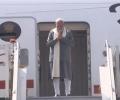
'We will work together for the mutual benefit of the people of our two countries and shape a better future for the world.'
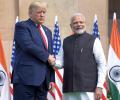
Prime Minister Narendra Modi will pay a two-day working visit to the US from February 12 during which he will meet President Donald Trump, the external affairs ministry announced. The visit will give further impetus and direction to India-US bilateral relationship. Prior to his US visit, Modi will be in France from February 10-12 to co-chair the AI Action Summit with French President Emmanuel Macron. He will also visit Cadarache, the site of the International Thermonuclear Experimental Reactor of which India is a partner. During his visit to France from February 10-12, Modi and Macron will also address the India-France CEOs forum. The prime minister and Macron will travel to Marseille where they will inaugurate the Consulate General of India. The leaders will also visit the war cemetery and pay tribute to the sacrifices made by Indian soldiers in World War 1. Modi and Macron will visit Cadarache, the site of the International Thermonuclear Experimental Reactor (ITER). There has been a very close rapport between Trump and Modi, dating back to the US leader's first term. There is a clear convergence of interests between the two countries in several areas, including trade, investment, technology, defense cooperation, counterterrorism, Indo-Pacific security, and people-to-people relations.
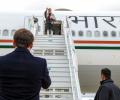
Prime Minister Narendra Modi has concluded his visit to France, which included co-chairing an AI summit and bilateral talks with French President Emmanuel Macron. He is now headed to the US for a bilateral meeting with President Trump. Modi's visit to France included discussions on trade, defense, energy, and cultural linkages. He also inaugurated India's new consulate in Marseille. During his visit to the US, Modi will also interact with business leaders and members of the Indian community.
Modi will try to impress upon the Trump administration the importance of appreciating its sensitivities and political implications on the issue of deporting undocumented Indians in military aircraft.
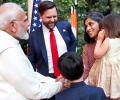
Prime Minister Narendra Modi and US Vice President JD Vance have expressed satisfaction with the progress made in negotiations for a bilateral trade agreement. The two leaders met in New Delhi and discussed a range of bilateral issues, including cooperation in energy, defense, strategic technologies, and other areas. They also exchanged views on regional and global issues of mutual interest.
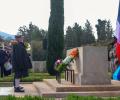
Marseilles was the base of the Indian troops in France during the 1914-18 war and throughout the War the Royal Navy, the Merchant Navy, British troops and labour units worked in the port or passed through it, the CWGC website said.
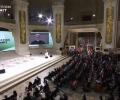
'Its nature changes, new types of jobs are created.' 'We need to invest in skilling and re-skilling our people for an AI-driven future,' Prime Minister Narendra Modi said in his opening speech at the AI Action Summit in Paris, co-hosted by India.
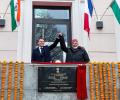
Prime Minister Narendra Modi and French President Emmanuel Macron have called for enhancing trade and investment ties between their countries and committed to further deepening their engagement in the Indo-Pacific. They discussed a full spectrum of bilateral relations, including key global and regional issues, and stressed the urgent need for reform in the United Nations Security Council. The leaders also underscored their commitment to ensuring the global AI sector can drive positive social, economic, and environmental outcomes.
 © 2026 Rediff.com - Investor Information - Advertise with us - Disclaimer - Privacy Policy - Sitemap - Feedback - About us - Terms of use - Grievances