Analysts predict continued volatility in Indian equity markets due to domestic macroeconomic data, F&O expiry, global developments including US tariff policies, and geopolitical tensions.

The Indian rupee depreciated by 52 paise to settle at 93.35 against the US dollar, driven by failed US-Iran peace talks, surging crude oil prices due to a potential US blockade of Iranian ports, and a global flight to the greenback. This geopolitical uncertainty is also leading to foreign capital withdrawal from domestic equities.

India's pharmaceutical exports have shown robust growth, reaching over USD 28 billion, despite global economic challenges. The sector is projected to reach USD 130 billion by 2030.
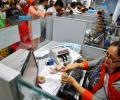
Indian bank credit expanded by 16.08 per cent year-on-year in FY26, marking its fastest pace since FY24, while deposits grew by 13.47 per cent, according to RBI data. Experts caution that year-end figures may be inflated due to reporting date changes, but acknowledge strong momentum in corporate, MSME, and retail segments.

'In investing, poor sentiment is always a good vintage to build a portfolio.'
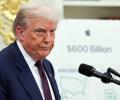
As one of the federal appeal courts in the United States ruled that most of tariffs imposed by Trump administration are not accordance with the laws, US President Donald Trump on Friday (local time) affirmed that all tariffs imposed on the countries will remain in effect, calling a recent ruling by a 'highly Partisan Appeals Court' incorrect.
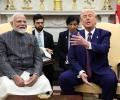
Prime Minister Narendra Modi and US President Donald Trump discussed the West Asia crisis and the importance of keeping the Strait of Hormuz open and secure. They also reviewed progress in bilateral ties and anticipated upcoming deals in the energy sector.

The government has suspended its directive requiring airlines to offer at least 60% of seats on flights without additional charges, following industry concerns about the impact on fares and pricing structures.
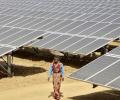
Shares of Waaree Energies and Premier Energies are under pressure after the US imposed initial duties on Indian solar imports. The article examines the impact on green energy stocks and market sentiment.
Indian officials will visit the US to finalise the legal text for an interim trade agreement, expected to be signed in March, focusing on duty concessions and reciprocal tariffs.

Trump made the announcement in response to what he described as China taking "an extraordinarily aggressive position on trade" by sending "an extremely hostile letter to the world."

'The West Asia or the Gulf crisis has shown that what we develop as national infrastructure when things are not as bad as they could be, we forget to plan for adversities.'

The crisis may not be as visible this time, but the stakes are just as high, points out Rajeswari Sengupta.

The imposition of a 100 per cent tariff by the US on imports of branded and patented pharmaceutical products starting October 1 may not significantly hurt Indian drug makers, with Sun Pharma being exposed to some headline risk but with limited earnings impact, according to analysts. Among Indian companies, only Sun Pharma has sizeable sales from patented drugs in the US (about 17 per cent of 2024-25 revenue), HSBC Global Investment Research said in a report.
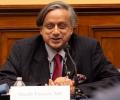
Senior Congress leader Shashi Tharoor says US tariffs are negatively impacting India, leading to job losses, and criticizes President Trump's diplomatic behavior.

AICC President Mallikarjun Kharge criticised Prime Minister Narendra Modi's relationship with US President Donald Trump, alleging that Modi is acting as Trump's 'slave' and jeopardising India's interests on trade, oil and foreign policy.

India's new manufacturing project announcements more than halved in the fourth quarter of FY26, falling 60 per cent sequentially and 78 per cent year-on-year to approximately 1.7 trillion, driven by global uncertainties, geopolitical conflicts in West Asia, and existing unutilised manufacturing capacity.
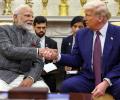
Amidst escalating tensions with Iran, the US has granted India a temporary 30-day waiver to continue purchasing Russian oil, aiming to stabilise global energy markets and encourage future US oil imports by India.
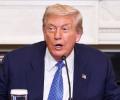
Donald Trump's tariffs, meant as political punishment, have avoided the predicted chaos, lifting US growth, weakening rivals, and letting him claim victory in a resilient global economy, observes T T Ram Mohan.

'Traders and exporters will have to explore alternative markets.'

One of the most uncivilised characteristics of this war has been the total disregard for international law and the laws of armed conflict, asserts Vice Admiral Biswajit Dasgupta (retd).

Brave statements such as we will continue to be the fastest growing large country are of no consolation, because the direction of trade also determines the flow of investment, points out M Govinda Rao.

'We will be able to anticipate the full picture of the impact after August, which is also the time when demand for a year begins to peak ahead of the December holidays and Valentine's Day.'

Commerce and Industry Minister Piyush Goyal on Sunday said Indian goods will have a competitive advantage in US markets compared to products from China and other competitor countries, which face higher levies, following the reduction in reciprocal tariffs to 18 per cent.
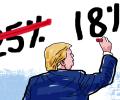
'Trump says India will buy over $500 billion of US goods.' 'At present, India's annual imports of goods and energy from the US are under $50 billion.' 'Reaching $500 billion would likely require more than 20 years, suggesting the figure refers to a long-term aspiration rather than a near-term commitment.'

Commerce and Industry Minister Piyush Goyal announced that an interim trade agreement between India and the US is likely to be signed in March and operationalised in April, with chief negotiators meeting in Washington to finalize the details.
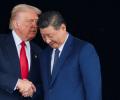
Speaking to reporters aboard Air Force One, Trump stated, "We have a deal," referring to the trade pact which will be routinely extended. "Every year we'll renegotiate the deal, but I think the deal will go on for a long time, long beyond the year. We'll negotiate at the end of the year," he added.
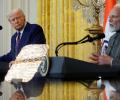
The Trump administration has told the US Supreme Court that it imposed tariffs against India for purchasing Russian energy products as part of its strategy to address the war in Ukraine.
Both countries commit to provide each other preferential market access in sectors of respective interest on a sustained basis

The White House has revised a fact sheet on the interim trade deal between the United States and India, removing the reference to "pulses" from the list of American products on which India would eliminate or reduce tariffs. The revised sheet also changed "committed" to "intends" regarding India's purchase of American products.

Indian companies, however, are now paying a premium of $6-$7 a barrel for Russian oil, compared with discounts of $8-$10 a barrel before the start of the conflict.

Despite India's electric passenger vehicle market experiencing an 83.6% year-on-year surge in FY26, new foreign entrants VinFast and BYD have significantly outpaced Tesla, which struggles with high import duties, a limited retail footprint, and a lack of local manufacturing commitment.

Ratings firm Crisil said on Wednesday that the uncertainties surrounding the US tariffs might be a new hindrance to capital expenditure decisions in the current financial year. The additional 25 per cent tariff imposed by US President Donald Trump on India for its purchases of Russian oil came into effect on Wednesday, bringing the total amount of levies imposed on New Delhi to 50 per cent.

Donald Trump claims his use of tariffs prevented a nuclear war between India and Pakistan, a claim India has repeatedly refuted.
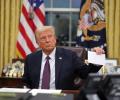
President Trump announces 100% tariffs on movies made outside the US, potentially impacting the Indian film industry. The move follows similar tariffs on pharmaceutical products.
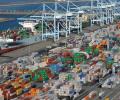
India's merchandise exports to the US contracted 21.77 per cent to $6.6 billion in January due to high tariffs imposed by America, according to the Commerce Ministry data. Exports contracted in September, October and December last year also. However, it rose 22.61 per cent in November.
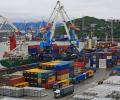
US and India will promptly implement this framework and work towards finalising the interim agreement with a view to concluding a mutually beneficial bilateral trade agreement.

'Just as we cannot surrender the interests of our farmers and dairy industry, Trump is also looking for markets for the produce of the farmers in the Midwest, which are his support base.'
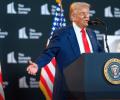
Trump said California has been particularly "hard hit" because of this, blaming democrat Gavin Newsom, the Governor of California, for this loss, calling him "weak and incompetent."