
India's annual defence production has reached an all-time high of Rs 1.78 lakh crore in FY 2025-26, marking a significant 15.6 per cent growth over the previous fiscal year. This achievement reflects a 110 per cent increase since 2020-21 and highlights the country's expanding defence industrial base, driven by policy support and increased private sector participation.

'They talked bad about our leaders. They said India was a dead economy. They were not sensitive to the Indian psyche.'

The ongoing conflict in West Asia is severely disrupting Bikaner's food exports, causing delays, rising costs, and impacting the supply of popular snacks like bhujia and papad to Gulf and European markets.

Union Steel Minister HD Kumaraswamy has urged the Indian steel industry to adopt advanced technologies like AI, Machine Learning, and IoT to enhance global competitiveness and productivity. Speaking at a Chintan Shivir, he highlighted that digitalisation is crucial for achieving ambitious steel capacity targets by 2035 and addressing challenges such as operational efficiency, decarbonisation, and export competitiveness. The minister also emphasised how technology can improve safety and reduce downtime in steel plants.

A gas leak at a seafood processing facility in Tamil Nadu's Tiruvallur district has resulted in the deaths of nine women, with 69 others hospitalised. The victims, primarily from Odisha and Assam, suffered severe ammonia inhalation symptoms. Authorities are investigating the cause and monitoring the health of those affected.

Indian rice exporters are seeking urgent government support to mitigate the impact of shipping disruptions caused by the Iran crisis and instability in key maritime routes. The disruptions have led to increased freight rates, insurance premiums, and fuel costs, impacting domestic prices and exporter profitability.

India's manufacturing sector experienced a moderation in growth during June, with the HSBC India Manufacturing Purchasing Managers' Index (PMI) falling to 54.2 from 55.0 in May. This slowdown is attributed to softer increases in new business orders and international sales, leading to reduced expansions in buying levels, employment, and output.
Researchers have identified a new process, 'chronoferroptosis', where excess iron in neurons reduces their resilience to stress, increasing vulnerability to neurodegenerative diseases. This discovery highlights iron accumulation as a critical target for predicting, preventing, and treating conditions like Alzheimer's.

Beijing clearly intends to extend the China-Myanmar Economic Corridor to Bangladesh as part of its larger Maritime Belt and Road Initiative to boost its Indian Ocean presence.

India's pharmaceutical exports have shown robust growth, reaching over USD 28 billion, despite global economic challenges. The sector is projected to reach USD 130 billion by 2030.

A couple in Mumbai has been arrested for allegedly defrauding eight individuals of Rs 6.71 crore through a fraudulent import-export scheme promising high returns.

Dell Technologies is significantly expanding its domestic manufacturing in India, with a majority of its servers now produced locally, driven by data sovereignty and AI adoption. The company also launched new AI infrastructure solutions, including PowerStore Elite, designed for secure on-premises data management and AI workflows, while asserting that AI creates more jobs.

India significantly increased its crude oil imports from Russia and the United Arab Emirates in June, securing supplies as the Strait of Hormuz began to reopen, with Russian barrels remaining attractive due to discounts and UAE supplies offsetting earlier uncertainties.
Crude oil prices are projected to fall significantly this year, driven by hopes of a peace deal between the US and Iran, which could lead to the reopening of the Strait of Hormuz, and a notable drop in Chinese demand for seaborne crude imports.

'Why not aspire for 8 or 9 or even 10 per cent?'

Sarvam AI, an Indian full-stack sovereign artificial intelligence company, has achieved unicorn status after raising $234 million in a Series B funding round led by HCLTech and Bessemer Venture Partners, with HCLTech acquiring a 10.46 per cent stake.

The remarkable rise of smallcaps reflects the emergence of a broad set of specialised businesses operating in industries where the sectoral tailwinds remain considerably stronger than macroeconomic headwinds, points out Debashis Basu.

India strongly criticised Pakistan at the United Nations, labelling it a "Frankenstein state" for its alleged support of terrorism. The remarks came after Pakistan and the OIC raised the Kashmir issue, which India firmly rejected, reiterating Jammu and Kashmir's integral status. India also deemed the Indus Water Treaty "outdated" given Pakistan's policies.

'Actual implementation of the 14-point agreement is proving hard to achieve let alone striking and sustaining a long-term treaty or deal.'

The report notes that equities had faced pressure from elevated valuation premiums, subdued nominal gross domestic product (GDP) and earnings growth, sustained foreign portfolio investor (FPI) selling, artificial intelligence (AI) infrastructure euphoria, and external shocks including US tariffs and a spike in crude oil prices due to geopolitical tensions in West Asia. However, several of these factors are now reversing.

India achieved a current account surplus of USD 7.1 billion, or 0.7 per cent of GDP, in the January-March quarter of 2025-26, primarily boosted by robust services exports and increased remittances from overseas Indians, according to recent Reserve Bank of India data.

In a major shift in Middle Eastern energy and security dynamics, the US Department of the Treasury on Monday issued a temporary 60-day general licence authorising transactions related to the production, delivery, and sale of Iranian crude oil, petrochemicals, and petroleum products.

Wayne Chung, senior investigator at the city's Intellectual Property Investigation Bureau, told reporters on Thursday that 230,000 items had been seized.

US Secretary of State Marco Rubio on Friday (local time) announced a US-mediated framework agreement between Israel and Lebanon aimed at achieving "lasting peace and security".

The Reserve Bank of India (RBI) has reported a significant increase in the use of the Indian Rupee (INR) for import and export invoicing and settlement, highlighting its growing internationalisation and mutual benefits for trading partners.

The Central Board of Indirect Taxes and Customs (CBIC) has eliminated the Rs 10 lakh value cap per consignment for courier-based commercial exports, effective April 1, aiming to significantly boost e-commerce shipments, particularly for MSMEs and artisans.

India's defence exports reached a record high of Rs 38,424 crore in fiscal year 2025-26, marking a significant increase of over 62 per cent compared to the previous year, according to Defence Minister Rajnath Singh.
'When I look at India's relative valuations, these are by far the lowest I have seen in my 35-year career.' 'The relative 12-month trailing performance is among the weakest I have seen, and foreign investor positioning is at a 16-17 year low.'

'The share of the private sector is at its all-time high of around Rs 42,000 crore in FY26, reflecting its expanding role in the defence ecosystem.'

The World Bank has increased India's economic growth projection for FY27 to 6.6 per cent, citing resilient domestic demand, while simultaneously cutting its global economic growth outlook due to the conflict in West Asia.

Why would a country that requires close to $90 billion in net foreign capital annually to create jobs, build productive capacity, and sustain rapid growth permit $30 billion of capital to flow abroad, thereby contributing to pressure on the rupee? asks Debashis Basu.

We who were dreaming of being the third largest economy in dollar terms, have slid back to sixth, thanks to the falling rupee. We are moving about with begging bowls for investments and trade opportunities, which will be a while in materialising, if ever, notes Shreekant Sambrani.

The reopening of the Strait of Hormuz, following a ceasefire agreement between the US and Iran, is expected to significantly ease India's crude oil supply risks, lower freight costs, and reduce inflationary pressures, as global oil prices have already dropped.

Indian pharmaceutical companies are strategically increasing investments in the US market, focusing on specialty drugs, complex generics, respiratory products, and local manufacturing, despite a nearly 10 per cent fall in exports to the US in FY26 due to pricing pressure and competition in traditional generics.

Global oil prices fell on Thursday to their lowest levels since before the outbreak of the Iran conflict, offering a significant economic tailwind for India, the world's third-largest crude importer, by easing inflation risks, reducing the import bill and improving the government's fiscal position.

Amazon CEO Andy Jassy has announced a significant expansion of the company's quick commerce business, Amazon Now, to over 300 Indian cities, aiming to build the country's largest delivery-in-minutes network. This move follows a recent USD 35 billion investment commitment by Amazon in India.
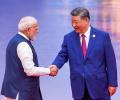
India's dual pursuit of a robust strategic partnership with Washington and a pragmatic, tension-management policy with Beijing represents the essence of modern multi-alignment. By embracing economic pragmatism, learning to compartmentalize political differences, and engaging in continuous dialogue, India can secure its borders, grow its economy, and contribute to a stable, multipolar Asian century, points out Ambassador Rajasekhar.
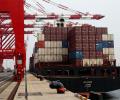
The Directorate of Revenue Intelligence (DRI) has successfully intercepted and seized 512 kg of red sanders at Cochin Port, preventing its illegal export to China. The red sanders were concealed within a consignment declared as rubber core veneer.

For the foreseeable future, the most likely outcome remains continuation of the status quo. Taiwan will remain self-governing without formally declaring independence, while China continues to apply sustained pressure short of war, predict Krishnan Srinivasan and Manoj Mohanka.

In view of the disruptive situations, the Central government has also announced a financial relief package of Rs 497 crores aimed at helping exporters affected by disruptions in West Asia.
