

'We should learn from the wild world on how they live harmoniously.'

For the last 20 years, the United Nations have been awarding those who work to protect the environment with the Champions of the Earth award.
Among the five awardees of 2025 is Supriya Sahu -- Tamil Nadu's additional chief secretary in charge of environment, climate change and forest department -- for heat adaptation and restoration in Tamil Nadu under 'Inspiration and Action'.
"We should think that what we leave behind should be something we can be proud of," Supriya Sahu tells Rediff's Shobha Warrier.

From the Director General of Doordarshan to the MD of the AIDS Control Society to the MD of The Tamil Nadu Small Tea Growers' Industrial Cooperative Tea Factories' Federation to environment, how did these diverse roles enrich you as a person?
It has been such a fascinating journey.
The organisations might have changed, but I see a common thread in all these roles whether it was Doordarshan or the health department or the small tea growers' federation or environment.
And the common thread was the policy behind the functioning of all these organisations. It was very strong, and was based on ground realities.
I have seen that any work will be impactful if the partnership between policymakers and the community, is strong.
More than six years of my career was with the health department and it was the longest.
How was it working as the MD of AIDS control society when HIV/AIDS was still an unknown area, and ART was just reaching people?
It was transformational. It was a learning experience.
You realise that you can bring positivity into the system through policies. You learn that when you work in consultation with the local community, it can create strong momentum.
We were the first to roll out ART to the community.
I still remember visiting the Tambaram TB hospital where I met an HIV positive child who also had TB. He was sitting on the hospital bed and was eager to talk to me. He was old enough to know that he was HIV positive.
When I asked him how he was, he replied with a smile, 'I know I am HIV positive, but I know I will become alright. Once I am okay, I want to continue studying and one day, I will become a collector!'
His positive outlook to life was a revelation for me.
I came back to my office, sat silent for some time, and then decided, every single patient should get ART and get well.
When you moved from one job to another, did you ever feel that you left behind some unfinished work and could have done better?
Always. I will not hesitate to admit that.
When you reflect, you always get the feeling that you could have done better.

Now that you are in charge of environment and forest, you must have visited the interiors of Tamil Nadu and the forests, what did you learn which you didn't know before?
This is one of the most beautiful chapters in my professional and personal journey.
Of all the work that I have done, this will always remain the most impactful, both personally and professionally.
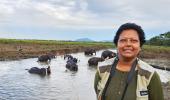
When you go to an interior forest area, and look at the animals, you learn so much from them.
For example, when you watch a herd of elephants, you will see that they are the most humble animals.
Human beings have a lot to learn from the values they follow and the community feeling they have.
When a baby elephant is born, all the other elephants surround the baby and oversee that it is eating well, sleeping well and growing well.
And the head of the herd will be a matriarch who leads the herd to greener pastures and water, and keeps them safe.
The leadership quality lessons that cannot be taught in books or management schools, you can watch them and learn.
In fact, I feel every human being has something to learn from elephants.
Also, look at the tiger. It never kills another animal for pleasure, it kills only when it has to eat.
You will see that each animal plays a role and contributes to keep this planet in balance. If you remove even one animal, the entire ecosystem collapses because each one has an important role to play.
Those who live inside the forests, are the role models on how to live in harmony with nature.
It is time for us to learn from those communities.
It is time for us to have the fundamental understanding that our own existence depends on how we treat nature and wildlife.
Man-animal conflict and development at the cost of wildlife and nature is happening in many areas in India. For example, recently 7-8 elephants crossing a railway track were mowed down by an express train.
We need to understand why this is happening. And it is happening in all the states in India.
From my experience, I can say that we have been able to map and identify high conflict zones, medium conflict zones and low conflict zones in Tamil Nadu. And our strategies are different for each conflict zone.
That was how we identified the high conflict areas in Coimbatore, Hosur and Nilgiris.
If you take Madukarai in Coimbatore, you will see that there are two railway tracks that criss-cross the forest which is famous for elephants. And the elephants do cross the railway tracks when they move from one forest area to another.
So, we have installed 15 AI enabled towers in Madukarai which are continuously monitoring the elephant movements and transmit the data in real time to the control rooms which are sent to the loco pilots. This gives time for the loco pilots to either stop or slow down the train.
In Gudalur where there is a huge landscape, we have installed AI towers to prevent human-animal conflicts, crop damage, and elephant deaths by tracking wildlife movement in real time and providing early warnings to both officials and local residents.
In the Hosur forest area, we use thermal drones to detect the movement of elephants to warn the farmers in advance to prevent human-elephant conflicts.
We also have marine elite forces in Ramanathapuram and Chennai.
Different areas require different technology and different approach.
When you map such areas where human-animal conflict occurs, you have to also look for solutions for each area. There is no one tailor-made solution for all areas. It varies.
We have realised that the problem here is infrastructure passing through the protected areas.
So, in future what we should do is, we should avoid any linear infrastructure development in such areas. That should be our effort.
Now, Tamil Nadu has become one state where linear infrastructure is avoided in forest areas.

Wild animals entering villages and destroying farms, and villagers in turn attacking animals are reported quite often. Don't you think it is because humans have encroached upon the habitats of animals that it is happening?
There is no doubt about it. It is due to the biotic pressure put on wildlife by humans due to deforestation, people encroaching forest areas, and so on.
Another important reason why human-animal conflict is increasing is because of invasive plant species like Lantana camara.
40%-44% of India's forest cover is under this invasive shrub.
Lantana also threatens the tiger habitat.
We see that Lantana is taking over many forest areas by not letting the grass and native species of trees to grow.
Lantana grows wild at the cost of native species. This results in many animals coming out of the forest areas.
So, we need to remove the invasive species, and bring back native grass and trees.
We are doing it in a big way in Tamil Nadu.
Then, climate change is leading to wildfire which destroys the forests, thus making animals to come out.
So, it is a combination of factors that lead to human-animal conflict.

Now, about the UNEP Champions of the Earth award you won recently. The UNEP statement said, 'Her initiatives have created 2.5 million green jobs, expanded forest cover, and integrated heat adaptation into infrastructure, benefiting 12 million people and setting a model for climate resilience'. Can you please tell us about these initiatives?
We had embarked on four important missions.
The first mission was the Green Tamil Nadu mission. It is a massive afforestation drive to increase the state's forest and tree cover from the existing 23.7% to 33% by 2031.
We first established 1200 nurseries- in the district headquarters, bock panchayats, panchayats etc. These nurseries are mostly taken care of by local men and women. So, it provides livelihood opportunities also for the local communities.
The mission plans to plant 265 crore seedlings over 10 years across various land types, including farmlands, government land, coastal areas, and urban spaces.
Under the Tamil Nadu Coastal Restoration Mission, we are also restoring mangroves in a very big way.
Then, we have the Tamil Nadu Wetlands Mission.
Under the Green Schools programme, we have created 297 green schools where children are involved in the green initiatives, so that they move to green energy transformation. Many of these schools have brought down their energy consumption by 50%.
Then, we have a Tamil Nadu Climate Change Mission.
We have made all these missions as people's missions.

Don't you think unless there is awareness among all sections of people, protection of environment will not work? For example, people living in a hill station like Ooty know that they have to protect their land. But tourists litter the place with plastic bags and bottles. Even Mount Everest is littered by visitors...
What you are saying is absolutely correct. Unless it comes from within, it will not work.
I started an anti-plastic movement 25 years ago in Nilgiris, and it became a people's movement.
Till today, people of the Nilgiris district do not allow plastic bags and plastic bottles.
It is too tall a claim to say that it is 100% plastic-free but you can say, Nilgiris is a district that is plastic-free.
It happened because the government regulations became a people's movement.
It is a tough task because it takes a long time to change the mindset of the people. It should become a habit for people to go out with bags, like our earlier generation did, and not accept plastic bags.
That's why we started the Manja Pai (yellow cloth bag) movement. Manja Pai was only a symbol, reminding people of the days when they went shopping with an yellow cloth bag.
All the initiatives also need a lot of follow-up action. In the government system, we need to strengthen the follow-up actions more. We also need to invest more in people's movements.
Even if there is a ban on plastics here, it is not uniformly enforced across India. So, plastic will find its way, somehow or the other to the states that have banned plastic.
It is very important for our generation to correct whatever wrong has been done till now, so that we leave a better environment for the future generation.

What will be your message to people?
Generally, people think if they use plastic or litter, it doesn't matter. It is not like that.
Every action matters.
Every individual matters.
And every action and contribution of every individual matters.
Like every single species is important in the ecosystem.
My message will be, we should learn from the wild world on how they live harmoniously. If we do so, we can also bring about a change collectively.
We should think that what we leave behind should be something we can be proud of.
Feature Presentation: Ashish Narsale/Rediff






 © 2026