

Lieutenant Colonel C Dwarakesh is the only completely blind officer to continue in the Indian Army after losing his eyesight while in service.
In his remarkable journey after disability, he enhanced his education qualification, scaled the Siachen Glacier and found purpose in sport.
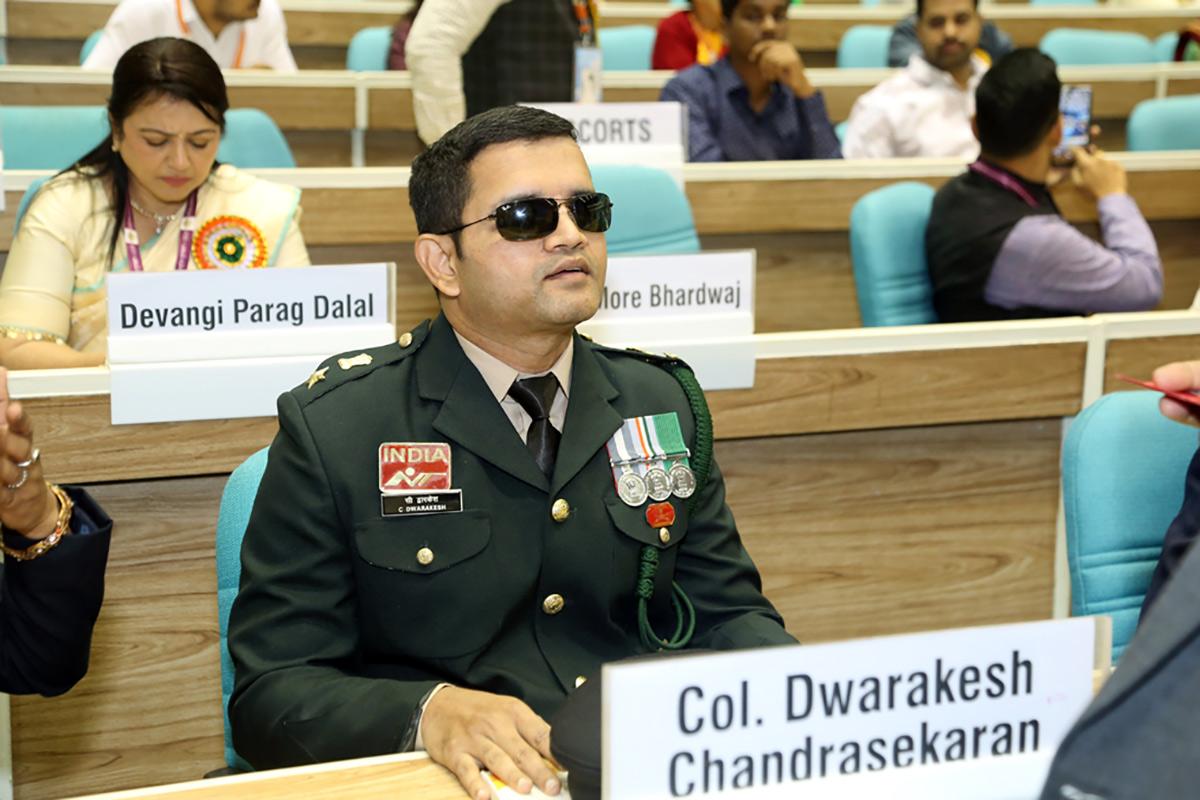
Lieutenant Colonel C Dwarakesh is no ordinary soldier. He is the only completely vision impaired officer to continue in service after losing his eyesight in a military mishap.
He spent eight months in a military hospital and rebuilt his life, day by day, bit by bit.
In his remarkable journey after disability, he enhanced his education qualification, scaled the Siachen Glacier at 16,000 feet and found purpose in sport.
He started with para javelin, followed by swimming and holds the national record in the breast stroke.
Finally, he found his calling in shooting.
Last year, he set a world record in the 10 metre air rifle para event in the UAE, and follows a rigorous, disciplined daily training schedule at the Army Marksman Shooting Range in Mhow, Madhya Pradesh.
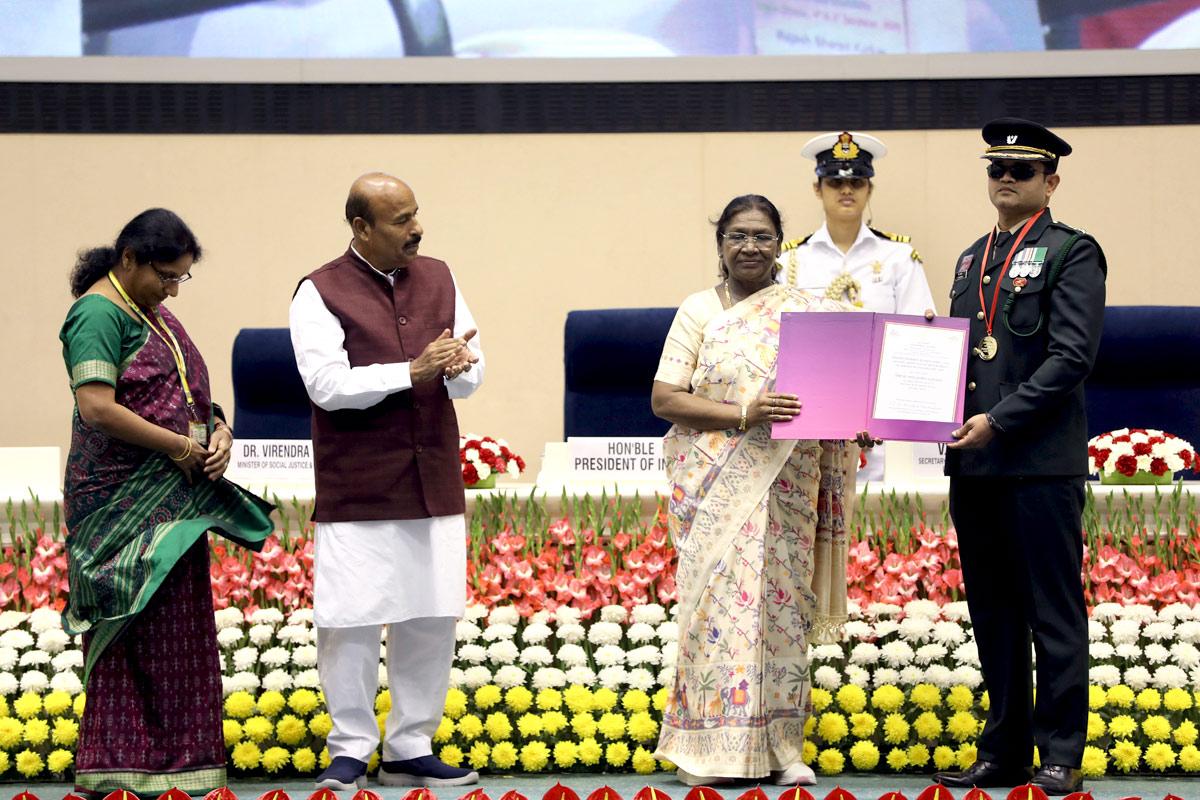
On December 3, he was awarded the National Award for Excellence at Rashtrapati Bhavan.
In an interview with Rediff's Archana Masih, Lieutenant Colonel Dwarakesh speaks about his remarkable journey, learning the guitar and scaling the Siachen Glacier despite his blindness.
What is a day in your life like?
I wake up around 4-4.30. Start my day with meditation and some mental exercises to prepare myself for training.
I reach the range at the Army Marksman Unit in Mhow at 9 am.
My coach is a JCO (Junior Commissioned Officer).
At midday, we have lunch, followed by a small nap to give the mind some rest after the constant buzzing of rifle shots and target system.
We resume at around 2.30 and go on till 5-6 pm depending on our tournaments.
I go to the gym or do yoga in the evening and then back home.
You must be a source of inspiration for so many people who train alongside.
It is an honour, if that be the case. We are all shooters.
The Marksmen Unit has elite shooters from the army.
There are also boys and girls 12 year onwards sponsored by the government.
There are regular soldiers from the army who train for rifle, pistol, shotgun shooting -- and also a para segment of 12.
I am the only one with vision disability. There are others with orthopaedic disabilities.
We mostly talk about mental management aspects. Everybody has different technical orientation, but the mental process is more or less the same.
Since I read about sports science, sometimes people ask me, but we don't cross each other's line or interrupt the coach's line of thought.
What shooting equipment do you use -- and how does it work?
I use a 10 metre air rifle. The same rifle is used in both Olympics and Paralympics competitions.
The target and scoring for both is the same. The only difference is that my infrared aiming system is imported from Austria. It has an IR sensor in the target and one on the rifle.
When you aim the gun and align yourself closer to the target, it starts giving a continuous sound. As you keep moving towards the centre -- 6, 7, 8 -- the pitch starts increasing, and when you get to 10, it gives a distinct high pitch sound for a micro second.
You have to hold and pull the trigger -- all this happens in a micro second.
How many international competitions have you participated in?
Two so far -- the UAE and Germany.
It's a game of nerves. So many shooters can reach the world number one score during training, but it is during a match that the real mettle is known.
The competition in Germany had a lot of learning for me. No amount of coaching or books can help you understand what you experience in an international competition.
You only started shooting in 2023? How did it all begin?
I was a sportsman from childhood and was a state-level basketball player at 14.
I actually began with the para javelin. It was part of the Paralympics programme, but got discontinued. I didn't want to waste the opportunity at the army's Paralympic node, so I decided to learn swimming.
I loved how swimmers move in the water -- effortless and beautiful. In swimming, you're independent; once you are in your lane, you don't need anyone's help.
Underwater you can't hear or see, and training a blind swimmer is hard. I realised blind swimming didn't have world-class scientific support in India. With limited access to technique and coaching, I knew I'd hit a plateau. I didn't want to take that risk
So I stepped away. I read a lot and through contacts and presentations to good people, we brought the infrared device to India, and that's how shooting began for me.
Being in the army was an advantage.
You went to the Siachen Glacier before you started pursuing sport in earnest. How did that come about because Siachen is so difficult even for able-bodied soldiers.
When I was offered the opportunity, I said yes without even thinking.
The expedition was organised by a group of veteran para commandos to showcase the strength of India's disabled population. The army and the ministry of justice supported it. Participants came from all walks of life. I was the only visually impaired person, along with one girl who later summited Mount Everest.
We trained and acclimatised at the base camp. We learnt ice craft, how to use the equipment etc. The expedition was 45 days, but the actual climb took about seven days.
There were boulders, melting ice, hard ice, soft ice, gravel. We could not speak speak much due to thin air, so we relied on cues and non-verbal communication like we do in military night operations.
At minus 30 degrees, with low oxygen, every step was a challenge. But I enjoyed the cold.
We faced weather problems too. Once, about two kilometres from the hut, it started raining heavily. Rain at that altitude is extremely dangerous. We had no place to stop, and we pushed through to make it to the shelter.
Nobody had major injuries, though we had some twisted ankles -- including mine.
How did the experience change you?
It changed how others saw me. I just needed someone to give me an opportunity. After Siachen, people finally asked me what I wanted to do.
I said sports.
Scaling the glacier despite disability must have strengthened you from within.
I think social stigma strengthened me much more. I have seen disabled and blind people being rejected at gyms, swimming pools, even when trying to get married.
Education is hard -- books aren't accessible, scribes aren't available. For sports, you need someone to take you to the facility every day.
These things are not easy. I have friends who are acid-attack survivors; I've seen the stigma they face too.
I've faced several forms of it myself. As an army officer, I don't want to get into personal details -- but yes, people do exploit disabilities. You learn to fight through all that.
How do you use AI software tools to help you in your daily life?
I use a JAWS screen reader and similar software for the mobile phone also. I can read messages, texts and convert text to speech. I do everything independently.
How did you cope during those 8 months in hospital?
I was only praying for some good to happen. I thought since I'm in hospital and never going to get this chance again, why not start studying and add on to my qualifications.
Then I understood it's not easy. Studying was easy but making it accessible for a blind man was hard.
It became a challenging task, but kept me going. It was a long journey and is still continuing.
What did it take to mentally overcome that trauma of what had happened?
An interesting aspect of getting blind as an adult is that you won't accept that you are blind.
When you lose a limb, you know, it's gone and you need a prosthetic. But if you have lost your eyesight, you still believe, maybe someday I'll get it back.
So for the first five years, I kept looking for treatment -- all sorts of national and international medicinal support -- you name it. After a point, it became a matter of self respect. I had read so many books about willpower and you can conquer mountains that I couldn't give up.
This went on for a long time and I bothered so many people which I think was the most debilitating.
Eventually, after five years, I realised I had to move forward. And sport was the way forward.
I realised every single thing counted -- whether a diploma certificate or a World Cup.
I needed credibility to create more opportunities, and this was one way to build it.
What advice do you have for young people about fitness and mental health?
If you want mental strength, the simplest way is to gain control over your body -- and that comes from working out.
Every muscle, joint, tendon, ligament needs to function daily to keep you healthy.
You need some activity every day.
What do you do to unwind?
I'm an audiophile. I love good music, home audio setups, speakers, and experimenting with settings.
I also learned to play the guitar after losing my eyesight. Sometimes I listen to audiobooks.
And these days, I'm constantly on ChatGPT -- deep-diving into things I'm curious about.
Earlier, I had to depend on people for answers; now I can get most things on my own, just on my phone.
In your personal journey post your accident, who have been the people who have been your inspiration?
Some of the leaders of the Indian Army and Navy became my mentors.
Then, of course, during Paralympic sport, I see girls who can barely move their neck and limbs, yet they are winning World Cup medals. They really inspire me.


 © 2026