

When elephants are identified close to or on the tracks, real-time alerts are sent to locomotive pilots, station masters and control rooms, allowing trains to slow down or stop in time.
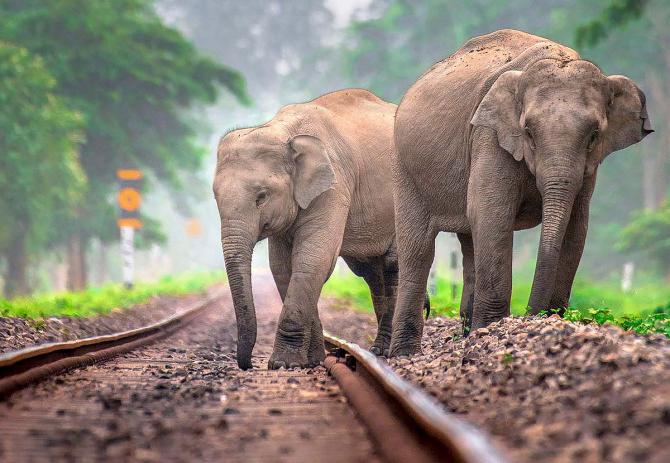
Artificial Intelligence-based surveillance systems deployed along railway tracks in the Northeast Frontier Railway zone have helped prevent train-elephant collisions, saving the lives of more than 160 elephants in 2025, railway officials said, marking a major breakthrough in wildlife protection in one of India's most accident-prone rail corridors.
The AI system -- known as an Intrusion Detection System -- uses a network of sensors and acoustic devices to detect elephant movement near railway tracks.
When elephants are identified close to or on the tracks, real-time alerts are sent to locomotive pilots, station masters and control rooms, allowing trains to slow down or stop in time.
Railway officials said the system has substantially reduced the risk of fatal encounters by increasing reaction time for train crews operating through forested stretches.
High-risk corridors under watch
The Northeast Frontier Railway zone includes some of the country's most vulnerable railway sections, cutting across elephant habitats in Assam, North Bengal and parts of the north east. These stretches have historically recorded a high number of elephant deaths due to train hits.
The AI-based system has so far been deployed across over 140 route kilometres identified as high-risk zones. Encouraged by its performance, Indian Railways has begun expanding the technology to additional forest sections across the country.
Lessons from past tragedies
The push for AI monitoring gained urgency after a series of fatal incidents, including the death of multiple elephants hit by high-speed trains in Assam in recent years. Some of these accidents occurred outside officially marked elephant corridors, underscoring the limitations of traditional safety measures.
Railway officials said AI surveillance fills a critical gap by continuously monitoring tracks, regardless of whether the area is formally designated as a wildlife corridor.
Alongside AI deployment, the Railways has introduced speed restrictions, improved signage, awareness programmes for train drivers, and closer coordination with forest departments in sensitive zones.
Officials stressed that technology is being used as part of a broader strategy to balance passenger safety, operational efficiency and wildlife conservation.
A model for wildlife-friendly railways
Conservationists have welcomed the results, calling the system a rare example of infrastructure adapting to ecological realities rather than overriding them.
With elephant populations under pressure from shrinking habitats and fragmented corridors, reducing deaths caused by trains is seen as a critical conservation priority.
As rail networks continue to expand, officials said AI-based wildlife detection systems could become a standard safety feature ensuring that development does not come at the cost of India's iconic species.
"This is not a new concept for us," an official of the Northeast Frontier Railway said. "The system is operational on a 141-km route where elephant movement is frequent. Based on its performance and recent events, we are now expanding it further to cover additional vulnerable sections."
How the technology works
The DAS-based system turns optical fibre cables laid along railway tracks into continuous virtual sensors. These sensors pick up vibrations and acoustic signals generated by animal movement.
Artificial intelligence and machine learning algorithms analyse the data to distinguish elephants from background noise such as rain, vehicles, or human activity.
"Elephants move in herds and generate a distinct vibration pattern," the official explained. "The system has been trained to recognise these patterns and send alerts within seconds. That response time is critical, especially for fast-moving trains."

Renewed focus after Hojai incident
The recent accident involving the Rajdhani Express in Hojai district has once again highlighted the risks faced by wildlife in the north east, where railway lines cut across traditional elephant corridors in Assam and adjoining states.
An Assam forest department official said closer coordination with the Railways was underway. "We are sharing real-time inputs on elephant movement, particularly during night hours. When combined with systems like DAS, this can significantly reduce fatalities," the official said.

Expansion across high-risk corridors
Following the Hojai tragedy, the Railways has identified additional high-risk stretches for deployment of the AI-based system, particularly in Assam, West Bengal, Odisha and Jharkhand.
"Based on the success of pilot projects and existing installations, the Intrusion Detection System will now be scaled up across more forested and elephant-prone routes," a railway official said. "Our aim is zero wildlife fatalities."

Part of a broader wildlife safety plan
Railway authorities stressed that technology is only one component of a wider strategy that includes speed restrictions in forest areas, awareness programmes for loco pilots, installation of warning signage, and regular coordination with state forest departments.
Wildlife conservationists have welcomed the expansion but urged a holistic approach. "Early warning systems are a positive step,," a conservation expert said, "but long-term mitigation requires scientific planning of railway alignments and protection of natural corridors."
Feature Presentation: Mahipal Soni








 © 2026