

The Maharashtra municipal elections showed a troubling shift, where votes were traded for cash, convictions no longer mattered, and ideology became an afterthought, observes Ramesh Menon.
Much before crores of voters had their fingers inked in the Maharashtra municipal corporation elections, crisp currency notes were handed out by political parties and candidates.
The figures varied from area to area. From hundreds to thousands of rupees. It depended on who you were and where you lived. Every voter had a price. More voters in a household meant more cash.
Voters accepted it as if it were okay.
The distribution of cash was not done in the shadows. It was blatant. It was as if this were the new norm.
It is cash that won. It was the voter who lost.
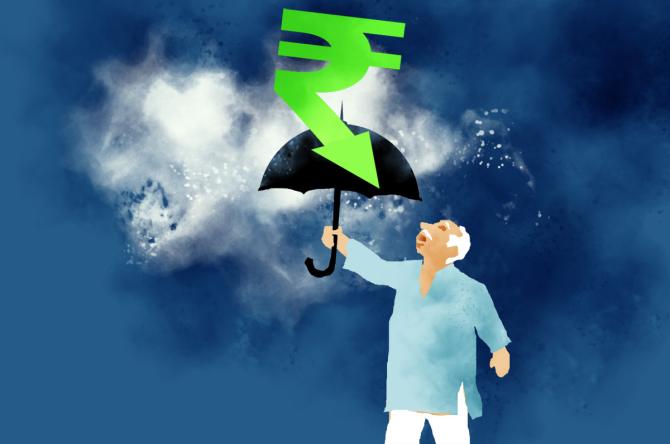
What we witnessed was a 'Transactional Mandate'. Votes were traded for cash or the promise of freebies.
With such a 'Transactional Democracy', we have plummeted. We are now choosing representatives based on how much they can pay for a vote, rather than on their plans to improve our lives.
When voters trade their mandate for the price of a family dinner, they lose the right to complain about crumbling roads. Sewage mixed with drinking water due to leaking pipes. Or schools that don't function. Or streets that flood with the first heavy rain.
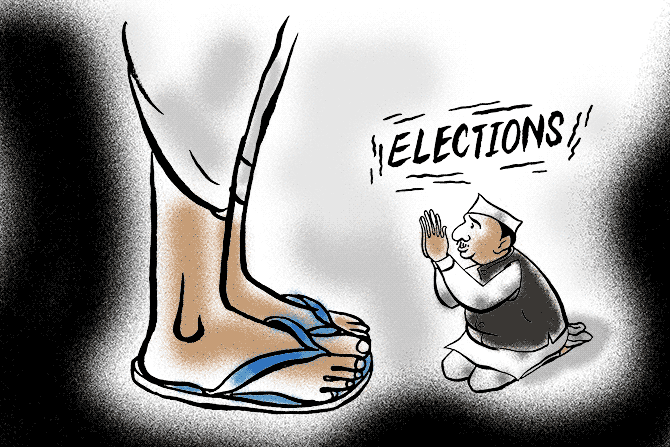
When cash starts talking, democracy is in danger
In this new reality, no honest candidate who cannot afford to pay voters will ever win.
Parties with hordes of cash will continue to win. Those with small cash reserves are bound to lose.
Why were candidates so desperate to contest? Was it because they wanted to serve the people, bring about change, and improve lives?
The truth: Politics and money are now synonymous
Ideology has been given a silent burial. It did not matter in this election. There were families where candidates contested from different parties. The idea was to keep power in the family.
Politicians switched parties, joining those they had fought against, because they did not get tickets from their own party. Party loyalty was a relic of the past. The politics of convenience is the new norm.
To hell with ideology.
What was the message such leaders were sending to the electorate?
So, it was not a battle of ideas. It was a battle to keep power within the household. What a selfish insurance policy.
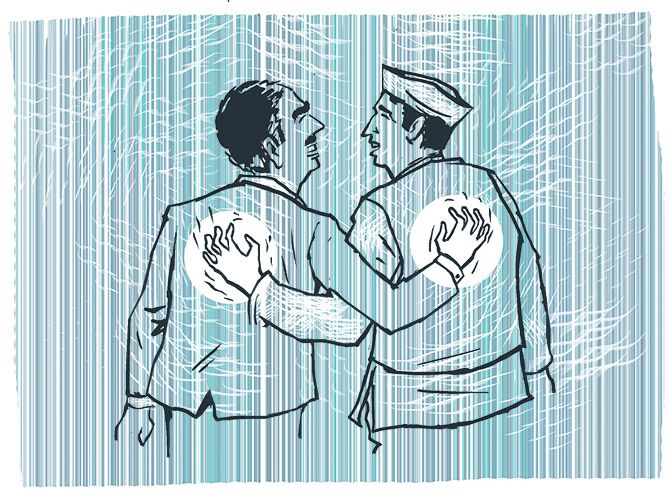
As cash has worked in Maharashtra, it will be replicated. Election after election. State after state. The domino effect is certain. What happened in Maharashtra will happen nationally.
Elections are becoming a contest of who can give more cash and 'revdis', rather than who can govern better.
As votes were largely 'bought', the voter has lost the moral right to hold candidates accountable.
Only the rich or those who have amassed wealth by dubious means can now contest.
Honest, middle-class, or grassroots workers have no chance. Even if they have the best ideas and the will to contribute, their entry is now impossible.
Those who win will invariably focus on how to recover what they spent. That cannot be achieved through perks and salaries. Even an illiterate voter can tell you that.
Candidates in jail on murder charges got elected. They must have laughed from behind the bars.
One of them was Shrikant Pangarkar, elected to the Jalna municipal corporation, accused of the murder of journalist Gauri Lankesh.
He did not hesitate to say that the murder charge in Karnataka had nothing to do with the Maharashtra election!
Candidates on bail for murder also won.
What does this say about the current political culture among parties and voters? It is an eloquent statement.
There is a deep reason to worry about the politics of the future. Yet, no politician is talking about this crisis. Nor is any political party.
While the high-decibel celebrations of electoral victories continued on January 16, the real story lay in the silence of the ballot boxes in Nashik's Ward 14.
Here, NOTA emerged as the 'winner.' It received 4,102 votes, defeating the closest candidate by 357.
This was a moral indictment.
It proved that even in an era of multi-crore freebies and midnight cash distributions, some held onto their dignity.
They knew the cash might help them through a difficult week, but it wouldn't fix their lives.
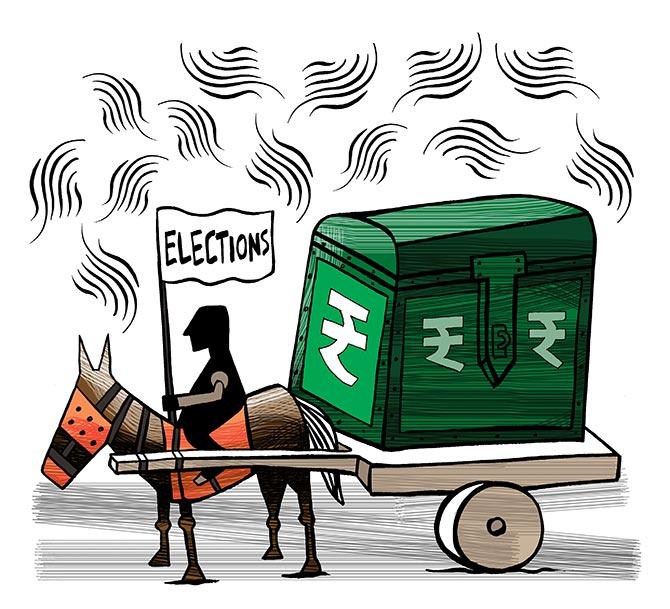
How is the Mahayuti coalition of the BJP, NCP, and Shiv Sena going to fulfil its extravagant promises in Mumbai and Pune? Where is the money going to come from?
Maharashtra is reeling under a debt of Rs 7.5 lakh crore. It is a figure most voters cannot even mentally imagine.
In the coming fiscal year, this debt is estimated to rise towards Rs 8 lakh crore.
When a city has no money left for development after paying for doles, administrative paralysis is inevitable.
The estimated cost of these populist schemes is around Rs 40,000 crore to Rs 60,000 crore annually.
The stage is now set for freebies to keep increasing. Voters now feel entitled to them.
Expect more schemes like Laadki Bahin, free electricity, free water, and free rides in various states where elections are scheduled.
They must fund the freebies to avoid an absolute backlash in the next election.
To cover these costs, governments will likely cut expenditure on schools, hospitals, and road repairs. They will starve garbage disposal and waste management systems.
The paradox for the voter is painful.
They will receive a monthly dole, but ironically pay for private water tankers as taps are dry.
They will lose precious hours and fuel on potholed roads.
They will cough up huge amounts for private hospitals because civic health services are underfunded and broken.
They will be among thousands of people who will apply for a measly government job, despite being highly qualified, as being employed is better than being unemployed.
We will end up living a mediocre life in what could have been a world-class city.
All this is the price of accepting that envelope on election eve
While victory processions choke the streets, few winners will worry about the next four years.
They are inheriting crumbling sewage systems, shrinking water tables, and a solid waste management crisis. They are inheriting cities whose lungs--the green spaces--are vanishing.
Election issues were largely about Marathi identity or cashing in on manufactured insecurities.
The discourse was driven by the Shiv Sena (UBT) and the MNS, rather than the reality of a crumbling political system.
Climate change was never discussed. Inflation and unemployment were ignored. As if they never existed.
The challenges for the winners are not just political. They are existential for the cities they must govern.
Newly elected corporators will soon realise they are entering a minefield of 'financial insolvency'.
The BrihanMumbai Municipal Corporation boasts of being the richest in India with a budget of Rs 74,000 crore.
But the stinging reality is that the civic body has issued work orders worth nearly Rs 2.5 lakh crore in the last four years.
Every rupee of future revenue is already committed to high-profile projects like the Coastal Road and various flyovers.
There will be no money left for the small, vital improvements in local wards.
For the last seven years, these administrations were run by bureaucrats, as there were no elections and therefore no elected representatives to fight for what people wanted.
Now, implementing localised solutions and listening to the people will be an uphill task.
Add to this the 50,000 vacancies in essential civic staff. Even if they are hired, where is the money for their salaries?
The challenge is delivering 'Smart Cities' when the reality is broken sewers, roads, and infrastructure.
Natural drainage channels like the Mithi eiver in Mumbai and the Mula-Mutha in Pune are choked with plastic and toxic waste. They are dying rivers. There is no money to revive them.
The BJP is already talking about the next assembly elections. They see the January 16 verdict as a template for a repeat performance.
The focus remains on the next power grab, not on making Maharashtra a premier state.
It is a tragedy. Maharashtra has all the potential to be world-class. If only it had a government that cared genuinely about the state, rather than just the next mandate.
Ramesh Menon is an author, award-winning journalist, educator, documentary filmmaker, and corporate trainer. He authored Modi Demystified: The Making of a Prime Minister.
Feature Presentation: Rajesh Alva/Rediff






 © 2026