

'Marathi-speaking people of Mumbai have now emerged as a consolidated vote bank standing firmly behind the Thackerays.'
'That would be the biggest strength of the Thackerays in the days to come and on which they can further strengthen the party.'

The Bharatiya Janata Party, no doubt, has spectacularly emerged as the single largest party in Mumbai's civic elections, securing 89 seats, yet the real story lies beneath these numbers. The Shiv Sena (Uddhav Balasaheb Thackeray) followed with 65 seats, while the Congress won 24.
What makes this election particularly fascinating is how it has reshaped Mumbai's political landscape, revealing fault lines between communities and exposing the strategic calculations -- and miscalculations -- of political heavyweights. The Thackeray cousins' reunion appears to have hugely mobilised Marathi voters in unexpected ways.
Meanwhile, the fragmentation of the original Shiv Sena continues to play out in unpredictable patterns.
Vivek Bhavsar, a senior political analyst based in Maharashtra, in this interview with Prasanna D Zore/Rediff offers his assessment of what these numbers truly mean for Mumbai's future and the broader political implications for the state.
"Despite the split in his party, despite not having the party symbol or the party name, Uddhav has shown that Mumbai is with him," says Bhavsar, assessing Uddhav Thackeray's performance in the BrihanMumbai Municipal Corporation elections.
With 65 corporators elected, the Shiv Sena (Uddhav Balasaheb Thackeray) has defied expectations and predictions that suggested it would not cross 35 seats.
Marathi voters across Dharavi, Dadar, Shivdi, Lalbaug, Mahim and Parel stood firmly with the Thackerays, while even Konkani voters in Mumbai -- contrary to predictions -- backed the SS (UBT) over Shinde's Shiv Sena.
The numbers tell a compelling story: Marathi voters, historically scattered across parties, have consolidated behind Uddhav in 2026, making him the real winner of Mumbai's civic battle, according to Bhavsar. It's a vindication that would have made his father and Shiv Sena founder Balasaheb Thackeray, whose birth centenary celebrations begin this week, proud.
How do you look at the BMC election mandate?
For the BMC specifically, I'd say the Marathi voters have given their mandate to the Thackerays and his Shiv Sena.
Now, even though Uddhav Thackeray's Shiv Sena hasn't secured sufficient numbers to claim the mayoral post outright, but if we combine the tallies of both the SS (UBT) (65) and Shinde's Shiv Sena (29), the numbers are substantially higher than what was achieved previously.
Could you break down the numbers for us?
Last time, the undivided Sena bagged 84 seats. This time around, the SS (UBT) has 65 seats and Shinde's faction has 29. That's a combined total of 94 seats for the Thackeray camp, if you will.
Now, many of those corporators who initially joined Shinde's Sena after the split -- they haven't performed as expected.
The BJP, for all their claims that they'd cross 100-plus seats, managed only 89 -- just seven more than their previous tally of 82. So while the arithmetic shows the BJP has emerged as the single largest party, they haven't performed to expectations.
On the contrary, both Shiv Senas have demonstrated considerable strength in Mumbai.
'Raj's trademark rhetoric resonated with the Marathi manoos'
What does this tell us about the vote banks of the SS (UBT) and BJP?

Here's what's happened: On one hand, the non-Marathi populations have stood solidly behind the BJP. They have a strong, consolidated vote bank. On the other hand, Marathi voters don't have such a concentrated vote bank. They are scattered across several political parties.
A Marathi person might vote for the Shiv Sena, or UBT, or MNS, or even BJP or Congress. Marathi voters haven't historically been a single, unified voting bloc.
But this time, they stood with the Thackerays. It might well be that the rallies by Raj Thackeray and Uddhav Thackeray, particularly where Raj used his trademark rhetoric, resonated immensely with Marathi manoos of Mumbai.
What's the single most important takeaway from the election?
It is the undeniable fact that Marathi-speaking people of Mumbai have now emerged as a consolidated vote bank standing firmly behind the Thackerays. That would be the biggest strength of the Thackerays in the days to come and on which they can further strengthen the party.
We saw in the recently held Nagar Panchayat elections that even the Konkani voters, who were once strong supporters of Balasaheb Thackeray and the Shiv Sena, voted for Shinde's Sena (in the Konkan region of Maharashtra). In Konkan, SS (UBT) is practically finished.
There was a prediction that Konkani voters in Mumbai would not support SS (UBT) and would go with Shinde's Sena. But this hasn't happened. When I think about it, this was a masterstroke by Devendra Fadnavis. He's admitted that he's the person who sent Raj Thackeray to Uddhav Thackeray. It was his strategy -- if Raj and Uddhav came together, ultimately Shinde's seat count would come down. And that's precisely what happened in this election.
But isn't that also a miscalculation by Devendra Fadnavis? One part of his plan worked -- Shinde's Sena has been cut down to just 29 seats. But the BJP with 89 seats will have to depend on Shinde's Sena, and the BJP also couldn't cross 100. Was there some miscalculation on his part?
Yes, he miscalculated because he thought the SS (UBT) wouldn't cross more than 35 seats. Their performance of 65 seats is a surprise. Even though Muslim votes were split between Uddhav, AIMIM and the Congress, Uddhav's victory is most appreciable.
I remember the 2014 assembly election. That time, in the Lok Sabha election, the BJP and Shiv Sena were in alliance. They contested together. But at the eleventh hour of the assembly election, the BJP broke their 24-year-old alliance.
Uddhav wasn't prepared. Balasaheb Thackeray was no more at that time. Senior party leaders, including Ramdas Kadam, weren't with Uddhav Thackeray. Yet Uddhav emerged as a tiger by bagging 63 seats in the assembly on his own. I remember that situation, and I'm comparing it with this one when in a similar poition Uddhav has managed to win 65 seats.
So Uddhav has once again emerged as a tiger?
Yes, Mumbai's tiger so far as the BMC mandate shows.
Would you also say that the Shiv Sena began its journey from Mumbai and now they have come full circle, back to square one? As you said, they are finished in Konkan, they don't exist in Vidarbha and other parts of Maharashtra, but Mumbai remains.
Uddhav's focus was on Mumbai only. Though he took up a rally in Thane, his primary focus was Mumbai.
Mumbai is the heart of Shiv Sena's politics. Mumbai is the capital, the financial capital of the country. That's why their focus was on Mumbai, not the state or any other municipal corporation. We've witnessed that except for Mumbai and Thane, neither Thackeray took any rallies in other corporations.
'That wouldn't be accepted by Amit Shah and Narendra Modi'
How do you look at Eknath Shinde's 29 seats? Has he not emerged as a kingmaker in Mumbai?
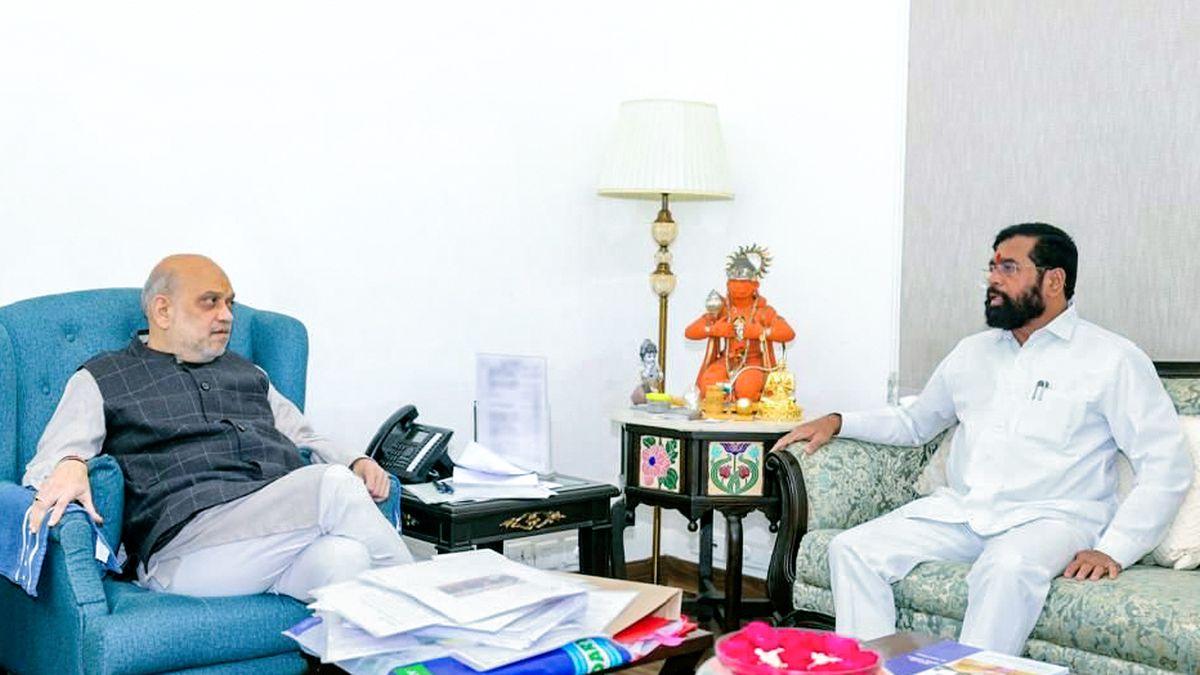
Instead of kingmaker, I'd say he's become the kingpin. Without his support, the BJP cannot have their mayor in the BMC. The BJP can't go with any other party but Shinde's Sena as their alliance partner; they are in alliance in the state government and at the Centre. They cannot suddenly set aside Shinde's party and align with others. That wouldn't be accepted by Amit Shah and Narendra Modi. So they have a compulsion to go with Shinde.
Even if Shinde's bargaining power in Mumbai has increased he won't get the mayor's post, though he can, and he will, ask for (positions of) standing committee chairman and other key positions.
Do you think Shinde will play hardball with the BJP? Will he try to extract maximum benefits out of these 29 corporators?
Yes, not only in the BMC but also in the state government. We've seen that after Devendra Fadnavis became the chief minister, he curtailed Shinde's powers. He shut down several schemes which Shinde had introduced.
Most of the projects or tenders which Shinde approved during his chief ministership have been cancelled. In some cases, he initiated probes against scams involving people close to Shinde.
Now Shinde will bargain with BJP both in the BMC and in the state.
Shinde will get maximum leverage now, also in the state government, because BJP will depend on him for getting a Mumbai mayor.
There are also reports of Eknath Shinde taking his corporators to a suburban five-star hotel. What's the game being played here?
Though his spokesperson said they're giving training to the newly elected corporators, I think he (Eknath Shinde) fears that some of his corporators may split from his party and join the BJP. But I don't think this will happen.
At this stage, the BJP won't take such a risk. They've already split the original Shiv Sena and supported Shinde in 2022. Now if they create a split in Shinde's Sena for BMC power, they'll be exposed. Everybody will say that BJP can use and throw any political party.
'Uddhav Thackeray is the biggest winner of this election'
Is it true that non-Marathis voted as a consolidated vote bank for the BJP? There are figures stating that 35 out of the 89 BJP corporators are non-Marathis. How has this divide played in this election?

Actually, when Raj and Uddhav came to Shivaji Park, their tagline was 'Marathi Manoos' -- to save the Marathi Manoos, Marathi asmita, to save Mumbai for Marathis. This created a polarisation. The non-Marathis fearing the Thackerays, came together and voted for the BJP.
If we tally, there are 76 non-Marathi corporators who won in these elections out of 227 seats. Maximum are from BJP -- 33. Congress has 18 non-Marathi corporators, SS (UBT) 8, Shinde Sena 4, AIMIM 7, MNS 1, NCP (Ajit Pawar faction) 3, Samajwadi Party 2. But these include Muslims corporators from various parties as well.
If we look purely at non-Marathi corporators, maximum numbers are with the BJP.
Do you fear these voting patterns could further lead to more divisions in Mumbai? That the Marathi versus non-Marathi card will be played by both winners and losers?
No, I think the election is over now. There won't be any Marathi-non-Marathi tensions in the city going forward.
In terms of numbers, who are the biggest winners and losers of this election?
Don't go by arithmetic alone. In my opinion, Uddhav Thackeray is the biggest winner of this election.
Despite the split in his party, despite not having the party symbol or the party name, he has shown that Mumbai is with him. He's proved it without any doubt.
Photographs curated by Manisha Kotian/Rediff








 © 2026