

Years of repression and disappearances have taught Venezuelans, the hard way, not to voice either their anger or their joy, observes Radha Roy Biswas who spent her formative years in Venezuela.

"At four in the afternoon, the park where I come almost every day to walk my dog was silent. It was as if people had suddenly abandoned their routines. On any ordinary day, there would be children chasing a ball, boys arguing over a basketball score, old men negotiating shade on a bench, pups pulling their owners in loose circles. Instead, there was only stillness. This silence had weight.
"The emptiness felt deliberate, as if people were staying away -- waiting. It was really surprising. I would have expected celebrations and firecrackers, given what had just happened. Maduro was gone, finally gone. Personally, I went numb. I couldn't think."

This is how Daniel, a friend in Venezuela, described his observations in a New Year message, following the Venezuelan president's capture and removal from the country in a shocking US military operation on January 3rd.
From nearly opposite corners of the world, we had connected as usual to exchange greetings. This year, our exchange coincided with momentous events that had just unfolded in Venezuela.
Since then, I have been scrolling through Instagram posts and news web sites -- as I invariably do when it comes to this country, one that occupies an outsized corner of my mind and heart.
I lived there in my formative years and formed memories of a beautiful, thriving place that now seems to exist only in recollection.
It is hard not to react emotionally when I read or hear about developments there, even though when Venezuela gets its five minutes of global attention, it is usually for the wrong reasons: Crime, prisons, exodus, exile.

Recently, Venezuela spiked twice in the international media. First, when Opposition leader-in-exile María Corina Machado won the Nobel Peace Prize and tipped her hat to US President Donald Trump in her acceptance speech.
The gesture left many Venezuelans both surprised and bemused, even though the two have been aligned by their shared opposition to Maduro, albeit for very different reasons.
Machado has been the popular and galvanising figure of the Opposition, disbarred from running for elections.
She picked Edmundo González Urrutia to run in her place, but his electoral victory in 2024 was declared void by Maduro who reinstated himself as president of Venezuela while the winner was forced to flee the country.

Trump, meanwhile, has sought since his first term, to corral the Venezuelan president economically and politically.
While Trump is not the first US president to pursue this path, his sweeping embargo against Venezuelan exports marked a dramatic escalation of sanctions against entities and individuals, building on measures imposed by previous administrations.
Since last year, he has raised the stakes further by directing a military build-up in the Caribbean and authorising attacks on Venezuelan ships on grounds of alleged narco-terrorists, steps that, in hindsight, appear to have been stage-setting exercises for this latest salvo.
By now, there has been no shortage of analysis of the possible motivations and ramifications of this dramatic American coup.
Control over the world's largest oil reserves -- aimed at propping up the petrodollar increasingly threatened by non-compliant oil actors, including Maduro's attempts to strike oil-for-revenue deals in alternative currencies, has been cited.
So has the desire to wrest control over vast mineral reserves in a competitive bid with China, or to stage a neo-colonial demonstration of power by a US President seeking to shore up declining popularity at home.
The consequences are also being widely debated: That this act may be the straw that breaks the back of the international rules-based order, setting a precedent for similar predatory moves -- not only by the United States, but by other powerful, covetous nations across the globe.

Cause and consequence, shock and awe aside, the reactions of ordinary Venezuelans also merit attention.
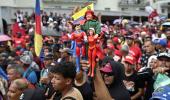
Long beleaguered by economic collapse, political polarisation, and decades of decline, Venezuelans are living through a sombre reckoning.
On the one hand, as Daniel says, millions are undoubtedly jubilant at Maduro's removal.
Since coming to power in 2013 after succeeding Hugo Chávez -- the socialist who rose to the presidency electorally before consolidating his authority into that of a familiar Latin American strongman -- Maduro remained a loyalist to the Chávez project, only in a harsher, more repressive form.
He cracked down brutally on dissidents, led a falling economy into free fall, funded unaffordable welfare schemes, and allowed his cronies to enrich themselves, while vast sections of the population slipped into extreme poverty and hunger.
According to the UN, nearly eight million people -- more than a quarter of the population, have fled the country as of 2024, dispersing across Latin America and beyond, many attempting perilous journeys to the United States.

And yet, according to Danny, that night was marked not by jubilation, but by something else entirely.
"That night, something else did not happen. My dog, fearful of strangers and terrified of fireworks, did not hide under the bed. For years, December and January in Venezuela have meant explosions of sound -- crackers through Christmas, New Year's, and well into mid-January. Venezuelans love fireworks with an almost reckless devotion. That January night, there were none. Not one."
The many Instagram posts I have been scrolling through reinforce this impression. It is a restive calm after the storm, as if there is more to come.
"Silence is never accidental in Venezuela," Daniel writes. "It is learned." Years of repression and disappearances have taught Venezuelans, the hard way, not to voice either their anger or their joy.

Among the hopeful, the American operation is seen as incomplete. Most Venezuelans appear to be waiting, watching to see where this leads.
The long-anticipated regime change, especially after Machado dedicated her Nobel Prize to Trump, has not materialised.
Instead of Conrado and González, whom many had hoped would assume leadership, Venezuelans are now confronted with Maduro's Vice President Delcy Rodríguez taking charge with Trump's nod, alongside other entrenched officials, with the army standing firmly behind them.
Many see this as the most visible sign that Chavismo -- as the entire regime is still referred to -- is well and alive.
Official notices issued in the immediate aftermath for weary Venezuelans, this is merely another blow to a country long abandoned by the world.
In fact, some voices on Meta express outrage that the legality of the operation has taken precedence in international discussions, rather than the fate of Venezuelans.
Joy, relief, outrage at the US' audacity -- Venezuelans may be feeling all these simultaneously, but for now, staying quiet seems the wisest course.

IMAGE: Daniel Vargas Danus in Venezuela.
There is, however, another group that is openly jubilant about Maduro's ouster: Venezuelan expatriates in Chile, Argentina, and elsewhere.
Their whispered incredulity, shared through Instagram stories and Meta reels, speaks volumes. Couples wake each other with joyous embraces, equal parts disbelief and relief.
A son informs his elderly mother, 'Maduro ya no está en Venezuela. Le llevaron a Maduro (Maduro is no longer in Venezuela. They've taken Maduro)'.
His words are met with a tearful smile. A refrain echoes through these exchanges: 'Podemos volver. (We can return).'
Another friend from my years in Venezuela, Andrés, now living in Chile, sees this hopefulness around return as a kind of delusion -- though an understandable one, given Venezuelans' deep attachment to family, especially those left behind.
He may be right. As the aftermath of the coup unfolds and Trump's vague promises give way to the continued grip of Maduro's cabal, hopes of a new dawn are already dimming.
Just the other day, state police forces issued official notices warning that anyone caught celebrating or supporting the attack and capture would be immediately arrested.
Reports have already emerged of people being detained. Under such circumstances, it is not difficult to imagine what might await émigrés who fled the regime should they attempt to return.

IMAGE: Andrés Vargas in Chile.
Yet, the dynamics continue to shift by the day. Perhaps mindful of global scrutiny and aware that the world is watching, authorities appear to be loosening their iron grip slightly, releasing some political prisoners, but only the prominent ones are confirmed so far.
However, the real ramifications are just beginning to unfold, not just for Venezuelans, but for the rest of the world as well, including India.
If, according to the American plan, American-controlled oil companies take charge of the country's oil production and reopen its oil flows, what would that mean for global oil supplies and prices, including those for India?
Although India has historically purchased less than 10% of its oil from Venezuela, there have been reports of long-term purchase arrangements in alternative currencies of Venezuelan crude oil by Indian oil companies, particularly in light of the growing geopolitical constraints around its imports emanating from Russia.
Therefore, how this coup reconfigures oil supplies to India and the world is something we will have to wait and watch for over the next few months.
Rarely do dictators and their regimes fall in the ways in which they rule.
Dictatorships operate on appearances -- by delusions of invincibility and permanence and choreographed displays of obedience rooted in fear.
When they collapse, they do so in confusion, silence, or sudden violence. Depositions can be loud and theatrical, as in the case of Nicolae Ceaușescu's final days în România; symbolic, through the toppling of statues; or a swift vanishing in the dead of night, as with Maduro.
In whichever way a dictatorship ends -- in capture, execution, or exile, the watershed moment is often psychological: it is the instant when fear and hope both change direction.
In Venezuela's case, the brief shock of awe is giving way to resignation with another cycle of hope blighted.
Venezuelans, instead of raising a toast to the New Year, are drinking in their disappointment over the coup that was, and the change that should have, but did not, come.
Radha Roy Biswas is a Public Policy Specialist and Researcher - Workforce, Higher Education and Regional Development. She spent her formative years in Venezuela and remains a keen observer of events in the country.
With gratitude to Daniel Vargas in Venezuela and Andrés Vargas in Chile for their inputs and insights.
Daniel Vargas, is a communications professional born in Chile, who moved to Puerto Ordaz, Venezuela, when he was 11 and has lived in the area ever since. Despite being deeply affected personally and professionally by the ongoing crisis, Daniel continues to root for his adopted home.
Andrés Vargas is a documentary filmmaker based in Santiago, Chile, with extensive experience in collective memory and human rights.
Feature Presentation: Rajesh Alva/Rediff




 © 2026