
A 10-part series that explains all you want to know about how India's EPF turns a slice of your monthly salary into long-term savings, pension, and life insurance.
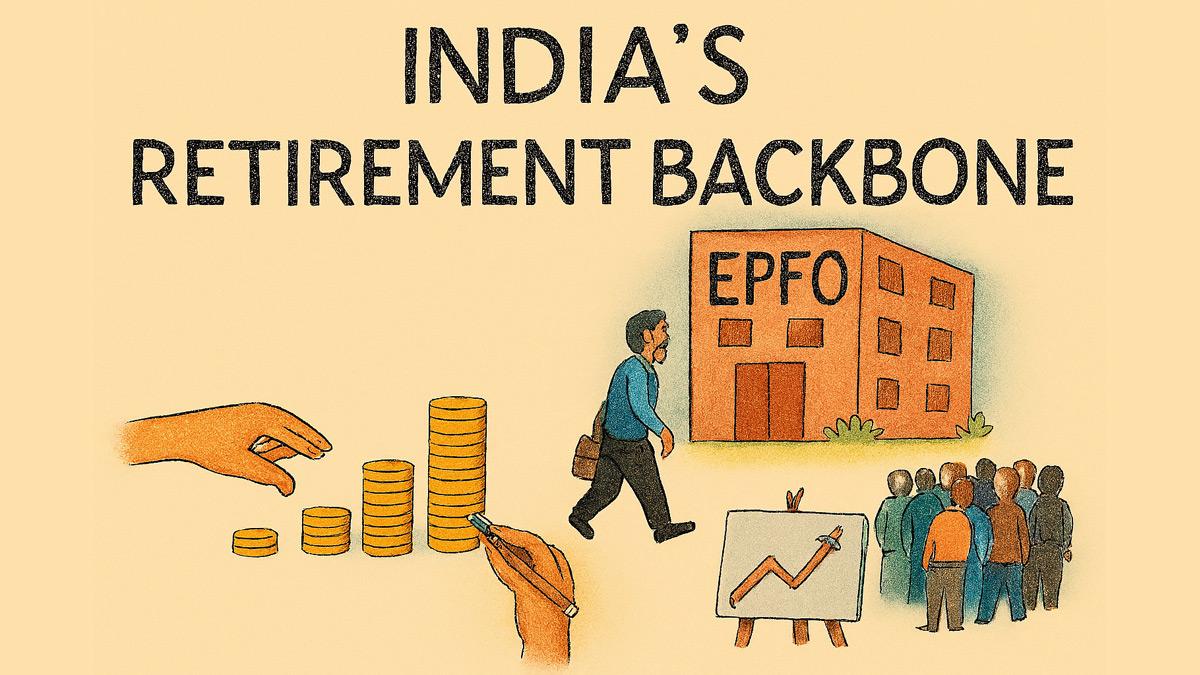
Every salaried Indian's Payslip hides a powerful but often misunderstood deduction: The Employees' Provident Fund (EPF). In Part 1 of this 10-part series, we unpack what EPF really is, where it comes from, and why it matters to the country's retirement system.
A 1952 law that shaped Indian retirement savings
The Employees' Provident Fund (EPF) is not a product of corporate benevolence; it is a statute.
The system was created under the Employees' Provident Funds and Miscellaneous Provisions Act, 1952 -- the law that authorises the Central Government to frame schemes for contributory provident funds, a pension scheme and a deposit-linked insurance fund for organised-sector workers.
That legal foundation makes EPF a compulsory, enforceable mechanism for retirement savings in many covered workplaces.
EPFO: One of the world's largest social-security managers
The EPF scheme is administered by the Employees' Provident Fund Organisation (EPFO), a statutory body under the Ministry of Labour and Employment.
EPFO runs not only the provident fund accounts of members but also the Employees' Pension Scheme and certain insurance functions for workers in the organised sector.
The organisation publishes annual reports, scheme rules and circulars that explain the mechanics of contributions, interest crediting and claims. That institutional heft is why EPF is often described as a core pillar of retirement provision for salaried Indians.
Why your salary today funds your tomorrow
At its simplest, EPF channels a slice of an employee's monthly pay into a pooled account that earns government-declared interest and can be accessed on retirement or under specified conditions. The scheme stitches together three pieces:
- Compulsory monthly contributions from employee and employer
- An interest credit that compounds the pot, and
- Rules for pension and insurance that draw on parts of the employer's contribution
Those three strands -- saving, return, and social protection -- are why EPF matters as more than a locked bank account. The EPF Scheme documentation and EPFO guidance set out these functions in detail.
Numbers that show EPF's unmatched scale
The scale is not abstract. EPFO manages accounts for tens of millions of subscribers and records regular net additions as India's workforce formalises. In 2025, EPFO reported record net member additions in its payroll data -- a sign that growing numbers of first-time employees are being brought into statutory retirement saving.
For example, an EPFO press release in July 2025 noted an all-time high net member addition in May 2025. Those flows matter because every new subscriber is simultaneously a saver, a future pensioner and a claimant under a huge public balance sheet.
The promise -- and the limits -- of a compulsory saving pot
EPF's strengths are plain:
- Legal backing
- Automatic discipline (savings taken at source)
- Predictable interest declared annually by the government, and
- Digital plumbing such as the Unified Portal and UAN that make accounts portable
EPFO's own circulars show that the government ratified an interest rate of 8.25% for FY 2024-2025 -- an example of the predictable, centrally determined returns that make EPF attractive to risk-averse savers.
But there are limits: The pension component (EPS) has wage ceilings and vesting rules and a provident corpus can be eroded by premature withdrawals or by inflation if returns don't keep pace with rising costs. Advisers therefore treat EPF as a solid base for retirement saving -- not necessarily a complete plan.
A simple anecdote, with a point
Consider the young recruit who starts work at 24. Each month a small share of that first salary is channelled away by law into an EPF account that will accumulate returns and, decades later, pay out a lump sum or contribute to a pension.
That is why recent EPFO payroll data -- which shows hundreds of thousands of new subscribers joining each month -- is relevant: It is the on-ramp that converts informal earners into contributors to a formal retirement system.
The data also explains why EPFO's recent digital upgrades (single-login features, Passbook-Lite and faster auto-settlement of small claims) are focused on making that conversion as frictionless as possible.
What the first-time reader should take away
If you are new to salaried life, the key facts are straightforward and verifiable:
- EPF is statutory (Act of 1952)
- It is run by EPFO
- It automatically converts part of your salary into a tax-advantaged, interest-bearing retirement pot
- It sits inside a larger architecture that includes pension and insurance
For practical next steps: Activate and link your UAN and KYC (Aadhaar, PAN, bank), check your passbook online, and treat EPF as the safe core of a retirement portfolio that you may need to top up over the decades. Official EPFO guides and mainstream financial pages explain how to do each of those steps in plain language.
Why you must not miss this 10-part series
This opening piece sets the foundation. Over the next nine parts, we'll demystify:
- Contributions: How much employee and employer pay, and why
- EPS: Your pension rights and rules
- Withdrawals and advances: What's allowed, what isn't
- Interest: How rates are declared and credited
- EDLI: The hidden life insurance cover
- Digital tools: UAN, passbooks, online claims
- Judicial angles: Supreme Court rulings on pensions and higher wages
- Inflation and planning: Whether EPF is enough for retirement
- Maximising EPF: Smart strategies for first-time earners.
Part 2 of the series: EPF Secrets Revealed: Where Your 12% Goes
If you're a first-time reader, this series will give you the complete picture of EPF -- its legal base, financial mechanics, and practical use in your working life.
You can ask your personal finance questions to rediffGURUS HERE











 © 2025