

Who pays what into Employee Provident Fund (EPF), Employee Pension Scheme (EPS), and Employees' Deposit Linked Insurance (EDLI) -- the 12% math explained.
In Part 1, we traced EPF's origin, its legal backbone, and why it matters for every salaried Indian.
Now in Part 2, we break down how contributions work in simple terms: what comes from you, what comes from your employer, and how pension and insurance are calculated.
We also explain why salary ceilings matter and how voluntary contributions can boost your retirement pot.
The 12% Rule -- Every Month:
- You (employee) contribute 12% of your basic salary + DA to your EPF kitty
- Your employer also contributes 12% of the same amount, but...
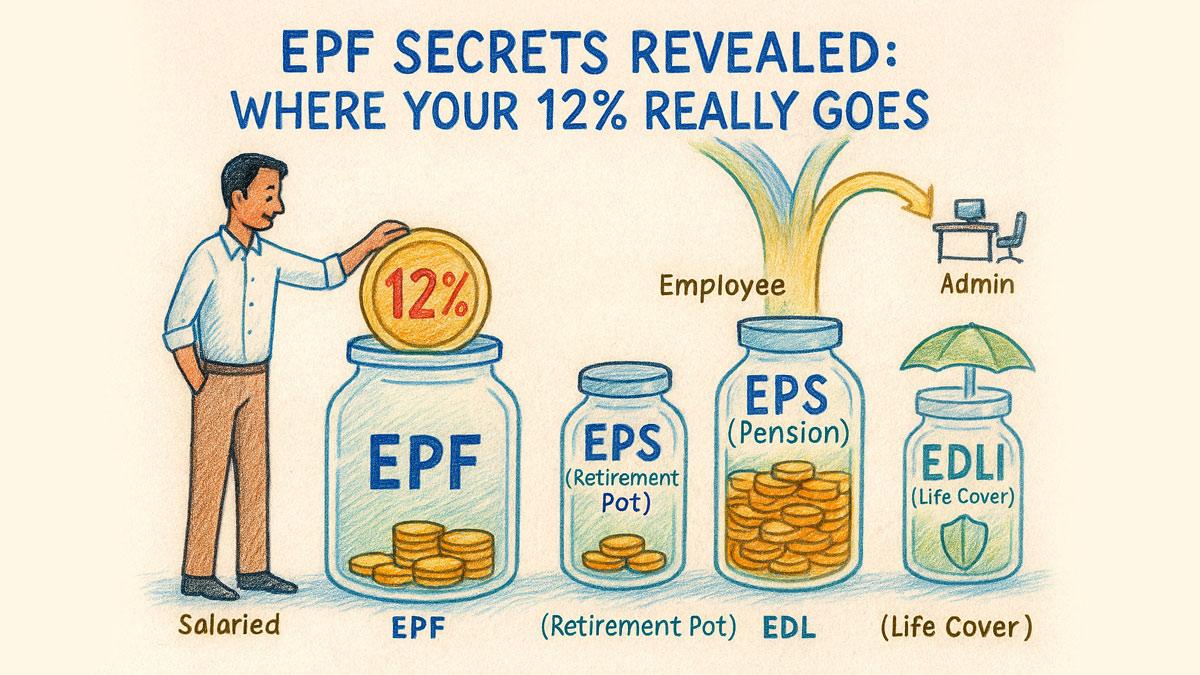
Here's the twist: Not all of the employer's 12% goes into your EPF account. Part of it is redirected to:
- EPS (Employee Pension SCHEME -- not to be confused with the EPF or Employee Provident FUND) -- for your future pension
- EDLI (Employees' Deposit Linked Insurance) -- life cover in case of death
- Administrative charges -- small amounts to run EPFO
So, your EPF account grows from both your contribution and the employer's remaining share.
Employer Contribution Split:
| Contribution | Who pays | Amount / % | Notes |
| Employee EPF | You | 12% | Entirely goes to your EPF account |
| Employer EPF | Employer | ~3.67% | Remainder after EPS contribution, goes to your EPF |
| EPS (Pension) | Employer | 8.33% | Only calculated on Rs 15,000/month salary ceiling |
| EDLI + Admin | Employer | Small | Insurance + running the EPFO office |
Tip: Think of EPS as 'pension insurance,' EPF as 'your retirement pot,' and EDLI as 'life cover for your family.'
The Wage Ceiling: Why EPS Has A Limit
- EPS contributions are capped at a salary of Rs 15,000/month; that is, as per this 15% cap, EPS amount to be kept aside every month is calculated with Rs 15,000 as the base but EPF is calculated on your monthly basic salary (Do not get confused between EPF and EPS)
- Example: If you earn Rs 30,000 basic + DA:
- EPS = 8.33% of Rs 15,000 (remember the cap of Rs 15,000?) = Rs 1,250
- After deducting 8.33%, remaining fund = 12% - 8.33% = 3.67% of Rs 30,000 (EPF is calculated on your basic salary, that is, Rs 30,000) = Rs 1,101 goes into your EPF
Key point: EPF grows with salary, but pension (EPS) doesn't increase beyond the ceiling.
Voluntary Contributions -- VPF
- If you want more in your EPF account, you can contribute extra voluntarily via VPF (Voluntary Provident Fund)
- The employer doesn't match this extra, but your retirement corpus can grow faster
- VPF is flexible, safe, and earns the same government-declared interest as EPF.
Simple Illustration: Rahul and Priya
- Both earn Rs 30,000/month basic + DA
- Employer contributes 12% of salary
- EPS (pension) contribution = 8.33% of Rs 15,000 = Rs 1,250 (same for Rahul and Priya)
- Remaining employer share goes to EPF: 3.67% of Rs 30,000 = Rs 1,101
Takeaway: Even if your salary is high, EPS is capped, but your EPF grows with higher pay.
What first-time employees should check
- Salary split: Make sure basic + DA is correct on your Payslip
- Employer compliance: Ensure full employer share is paid, and EPS/EPF split is correct
- Voluntary contributions: Use VPF to accelerate your savings if needed
- Policy changes: Watch for updates on EPS ceiling or contribution rules
The takeaway
EPF is a dual savings-and-pension machine:
- 12% from you, 12% from your employer
- Employer contribution splits into: EPS (pension), EPF (your retirement pot), EDLI (insurance)
- EPF grows with salary, EPS is capped; EDLI protects your family
Understanding this split ensures you don't leave pension or savings on the table.
Part 3: EPF@8.25%: Is It Really Worth It?
You can ask your personal finance questions to rediffGURUS HERE










 © 2026