
Medical negligence arises when a medical professional deviates from reasonable standards of care, causing injury to the patient.
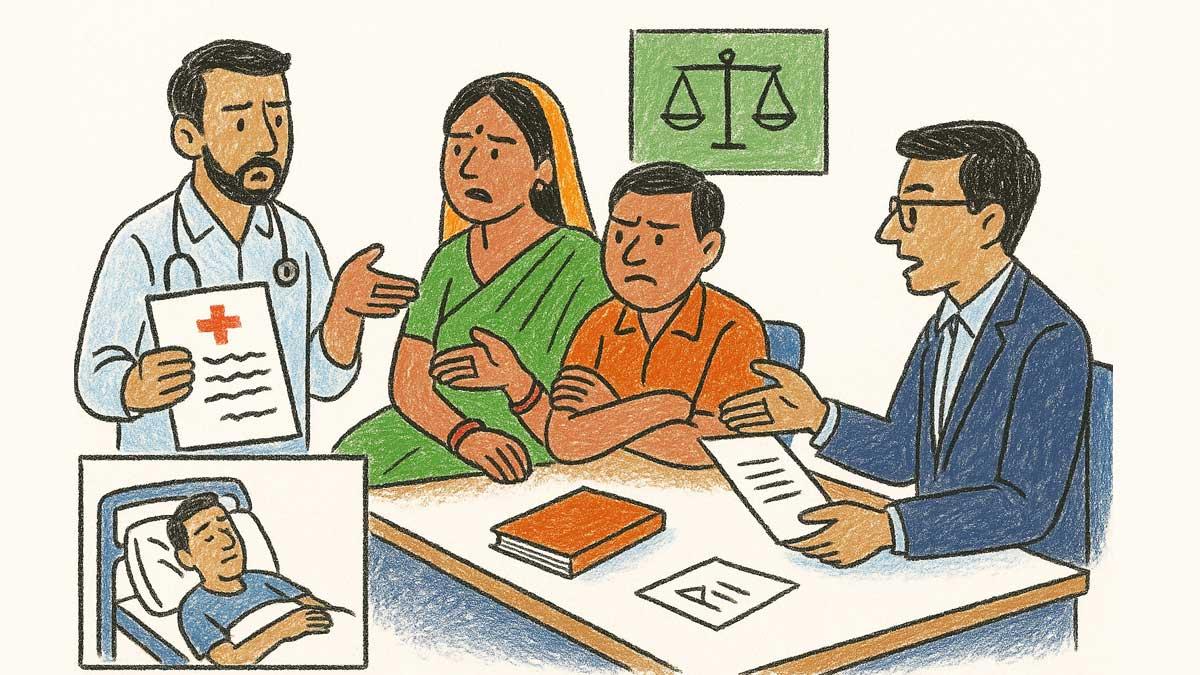
In a recent case, the Gujarat State Consumer Disputes Redressal Commission clarified that even if a hospital does not charge any money, the patient remains a consumer because the hospital provides a service under the provisions of the Consumer Protection Act.
"Courts have clarified that patients receiving free care in hospitals that also offer paid services are treated as consumers.
"However, hospitals providing only free treatment may fall outside the Act's scope, unless payments or cross-subsidies are involved," says Smita Paliwal, partner, King Stubb & Kasiva, Advocates and Attorneys.
What is medical negligence?
Medical negligence arises when a medical professional deviates from reasonable standards of care, causing injury to the patient.
"The Supreme Court has clarified that not every mishap amounts to negligence; only 'actionable negligence' applies -- where a duty of care existed, was breached, and resulted in damage," says Nidhi Singh, partner, IndiaLaw LLP.
"Medical negligence is established when there is a breach of duty of care through deviation from accepted standards, lack of informed consent, or denial of emergency care," adds Mayank Arora, partner, Chambers of Bharat Chugh.
Courts have consistently held that liability arises only in case of proven negligence, not from sympathy or adverse outcomes.
Provide evidence of negligence
To succeed, complainants must show, on a balance of probabilities, that a doctor owed a duty of care and breached it.
"This must be supported by medical records and other written communication," says Singh.
Medical negligence cases rest on evidence.
"Patients or guardians must proactively preserve proof to show breach of duty by doctors or hospitals," says Arora.
Singh adds that courts give the greatest weight to documented records backed by the testimony of credible experts who may be independent or court-appointed.
"I have proposed to the Government of India and state governments the creation of such core expert groups -- also including a reputed consumer representative -- to be attached to District, State, and National Commissions under the Consumer Protection Acts of 1986 and 2019 for investigating medical negligence complaints," says Bejon Kumar Misra, international consumer policy expert.
Choose the right forum
The right forum for a consumer dispute depends on the amount spent: Cases of up to Rs 50 lakh go to the District Forum, Rs 50 lakh to Rs 2 crore to the State Commission, and above Rs 2 crore to the National Commission.
"Jurisdiction is usually where treatment occurred or the patient resides, and is based on the amount spent on care, not the compensation claimed," says Arora.
Remedies available
Paliwal informs that landmark judgments from the Supreme Court and the National Commission have significantly clarified the legal standards for proving negligence and awarding relief in such cases.
When negligence is established, courts may order refund of fees, reimbursement of corrective treatment costs, and damages for mental agony.
"In cases of permanent disability or death, compensation can also include loss of future earnings, ongoing care, and support," says Arora.
Consumers as patients must be compensated fairly and without delay.
The Supreme Court, Misra suggests, should direct states to establish healthcare regulators under the long-delayed Clinical Establishments Act, 2010.
"Despite several court rulings, core issues remain unresolved due to non-implementation of this Act, leaving the healthcare system ineffective," adds Misra.
Mistakes to avoid
The complainant must act within the limitation period and diligently collect all medical records, since the burden of proof lies on the complainant.
"Registered practitioners are required to maintain admitted patient records for three years and provide copies within 72 hours under the Medical Council of India (MCI) Regulations, 2002.
"A complaint can also be lodged with the Medical Council of India," says Singh.
Steps for proving medical negligence
- Obtain complete medical records of patient
- These include prescriptions, bills, and test reports
- Secure expert medical opinion
- Maintain a timeline of events
Source: Chambers of Bharat Chugh
Disclaimer: This article is meant for information purposes only. This article and information do not constitute a distribution, an endorsement, an investment advice, an offer to buy or sell or the solicitation of an offer to buy or sell any securities/schemes or any other financial products/investment products mentioned in this article to influence the opinion or behaviour of the investors/recipients.
Any use of the information/any investment and investment related decisions of the investors/recipients are at their sole discretion and risk. Any advice herein is made on a general basis and does not take into account the specific investment objectives of the specific person or group of persons. Opinions expressed herein are subject to change without notice.
Feature Presentation: Ashish Narsale/Rediff











 © 2025